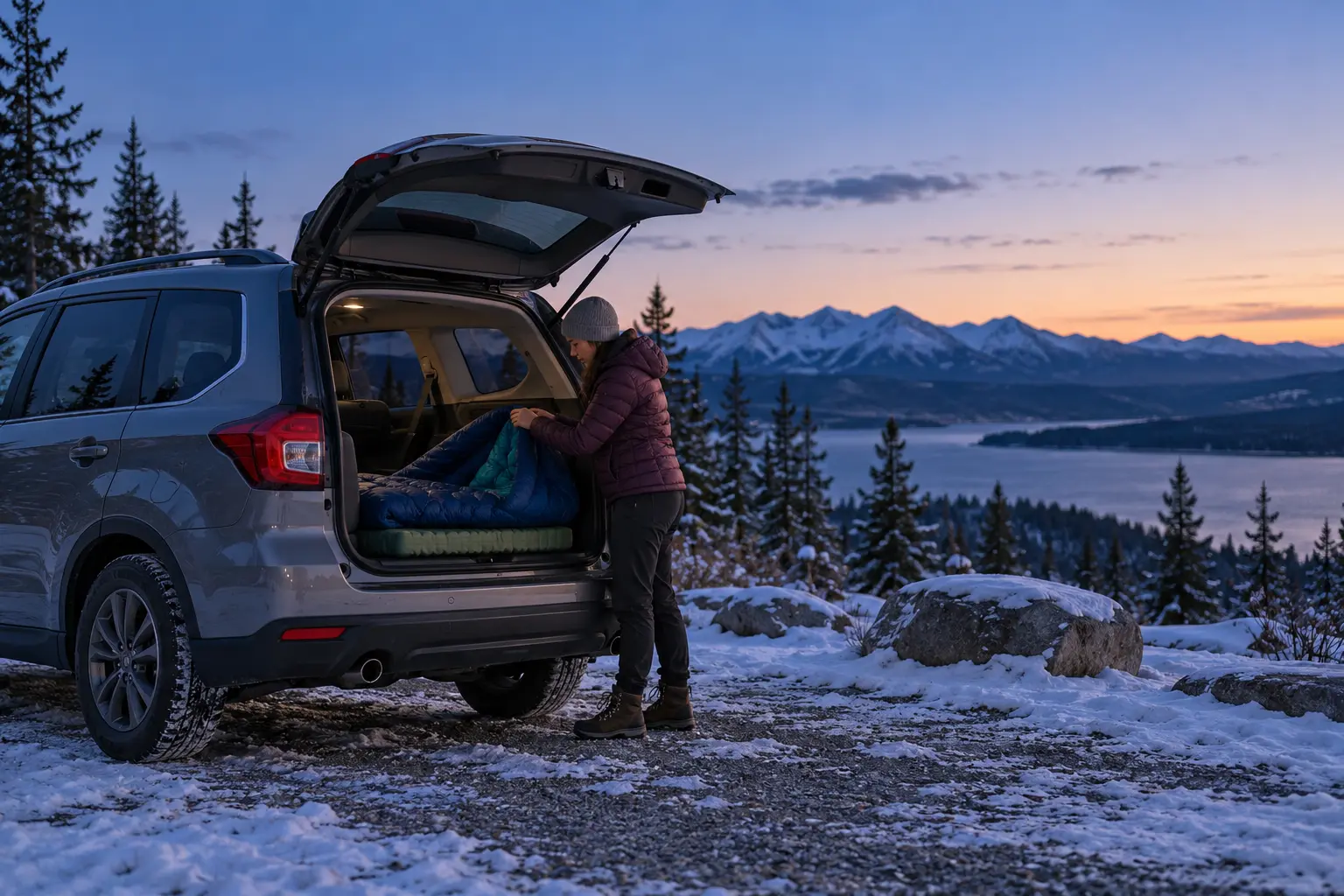
Short answer: for a planned night of car camping, do not use an idling gasoline, diesel, or hybrid vehicle as your sleeping heat source. Warm the cabin only while you are awake—and only where the vehicle manual, site rules, and local law allow it—then turn the engine or hybrid system off before sleep. There is no universal number of overnight idling minutes that can make every vehicle and parking spot safe.
The concern is carbon monoxide (CO), an odorless, colorless gas produced when fuel burns. The CDC says even a small exhaust-system leak can allow CO to build inside a car. Snow can block a tailpipe, airflow can change, and someone who is asleep may not recognize warning symptoms. If your engine-off sleep setup cannot handle the forecast, the safer answer is to change the plan, relocate, or use suitable shelter.
Why “I’m parked outdoors” is not a complete guarantee
Outdoor air is better than an enclosed garage, but it does not turn a running vehicle into a certified overnight heater. The risk depends on the vehicle, exhaust condition, obstruction, wind, and surroundings. A recently serviced exhaust, a cracked window, a CO alarm, or a trouble-free night in the past may affect risk; none creates a universal guarantee for sleeping beside an unmonitored combustion source.
The CDC warns that a snow-blocked tailpipe can make engine-produced CO build quickly inside a vehicle. Its general CO guidance also notes that opening only an SUV tailgate while the engine runs can pull exhaust into the vehicle. These are not the only possible conditions, but they show why “outside” is too simple an answer.
A CO alarm can add protection, but it is not permission to sleep with the engine running. The U.S. Consumer Product Safety Commission describes alarms as added protection rather than a substitute for correct operation and maintenance. If you carry one, use a model rated for the temperature and environment you expect, and follow its instructions.
Why driving with the heater on is different from sleeping
The important difference is not simply “heater on” versus “heater off.” While driving, you are awake, monitoring the vehicle, and moving through changing airflow. While parked and asleep, the vehicle is stationary and an exhaust fault or obstruction may go unnoticed. Driving does not eliminate CO risk—the CDC recommends having a mechanic inspect a car or truck’s exhaust system every year—but it is not the same unattended situation.
A brief warm-up while you remain awake is also different from relying on the engine all night. Do it only in an open, permitted place, follow the exact owner’s manual, and stay alert. Do not use an internet timer as a substitute for vehicle-specific instructions and conditions.
Which situation are you in?
| Situation | Action | Why |
|---|---|---|
| Planned recreational sleep | Turn the combustion engine or hybrid system off before sleep. Use an engine-off sleep system or change plans. | You are not depending on an unmonitored exhaust source while asleep. |
| Brief warm-up while awake | Use only an open, permitted place; follow your exact manual and local or site rules; remain awake. | Vehicles and conditions differ, so there is no responsible universal timer. |
| Unexpectedly stranded or stalled in severe winter weather | Request help, stay with the vehicle when current authorities advise it, and follow their complete emergency instructions, including tailpipe checks and intermittent running. | Emergency guidance balances cold exposure, rescue, and CO risk. It is not a camping-comfort routine. |
| Symptoms or a CO alarm | Shut the source down if you can do so safely, get everyone into fresh air, and call emergency or poison services. | CO can impair judgment and become fatal. |
Text equivalent: planned sleep means engine off; an awake warm-up requires your manual and a permitted open location; a genuine winter stranding requires current emergency instructions; suspected exposure means fresh air and immediate help.
A snowstorm stranding is an emergency—not a campsite routine
This boundary matters. Emergency advice accepts tradeoffs that a planned leisure night should avoid. Before a trip, check the forecast, carry winter emergency supplies, tell someone your route, and leave before worsening conditions trap you. If you can drive away safely, an unsuitable sleep setup is a reason to exit—not a challenge to solve by idling until morning.
What about hybrids and EVs?
Do not assume a quiet hybrid is engine-off. Depending on its operating mode, a hybrid may start its combustion engine automatically. Follow the manual for your exact model rather than copying another vehicle’s routine.
A battery-electric vehicle has no tailpipe CO, but that does not validate every unattended parked-climate setup. Battery state, charging, ventilation, weather, location rules, and manufacturer instructions still matter. This guide does not certify a particular vehicle or mode for overnight use.
If you suspect carbon monoxide
Headache, dizziness, weakness, nausea or vomiting, chest pain, and confusion are among the symptoms listed by the CDC, but they are not specific enough for self-diagnosis. A sleeping person can be overcome before recognizing them.
If exposure is suspected, get everyone into fresh air immediately. In the United States, Poison Help says to call 1-800-222-1222; call 911 for an emergency. Elsewhere, call the local poison center or emergency service. Do not re-enter or restart the source merely to investigate.
Build warmth around sleep, not exhaust
For a planned trip, the simple rule is useful: the vehicle gets you there; your sleep system gets you through the night. Use the forecast, insulation below you, suitable bedding, dry layers, and a clear exit threshold. Our guide to building an engine-off cold-night sleep system covers that job without repeating it here.
Ventilation for moisture is a separate problem from CO produced by combustion. Cracking windows may help manage ordinary overnight moisture, as explained in our car-camping condensation guide, but it does not certify sleeping beside a running engine. And do not replace the engine with a stove or portable fuel-burning camping heater inside the vehicle.
Bottom line: for planned recreational car camping, turn the combustion engine or hybrid system off before sleep. If the forecast is beyond your engine-off setup, leave or use appropriate shelter. Save stranded-snowstorm instructions for the emergency they were written to address.
Sources
- CDC: Carbon Monoxide Poisoning Basics (January 12, 2026)
- CDC: Clear Snow from Tailpipes (updated August 26, 2026)
- NHTSA: Winter Weather Driving Tips (accessed October 23, 2026)
- National Weather Service: Cold and Winter Hazards (accessed October 23, 2026)
- U.S. Consumer Product Safety Commission: Carbon Monoxide Fact Sheet (accessed October 23, 2026)
- HRSA Poison Help: Carbon Monoxide (accessed October 23, 2026)