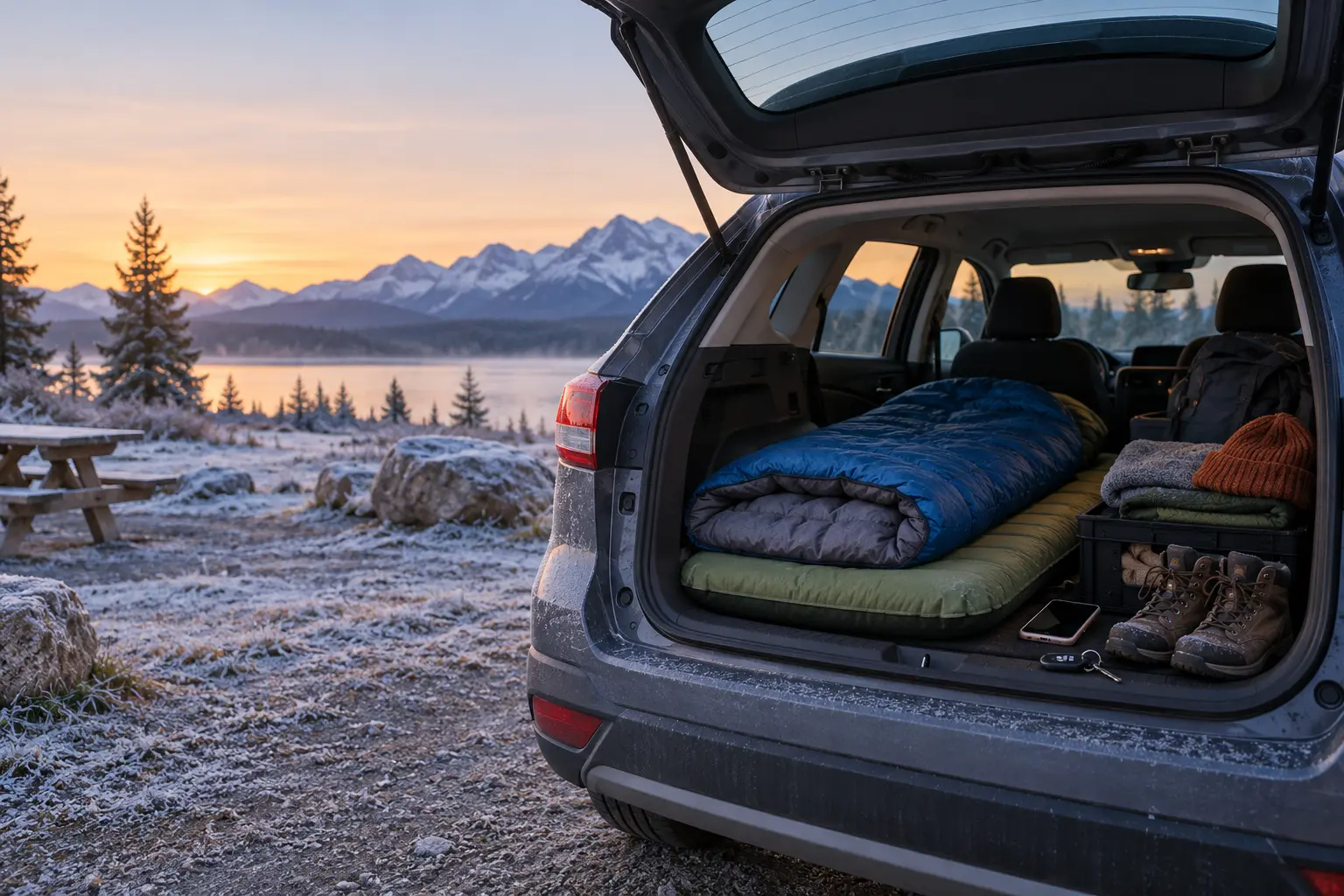
You can sleep warmer in a car without turning the cabin into a heated room. The practical answer is to build a complete sleep system: check the overnight forecast, insulate yourself from the cold surface below, understand what your sleeping-bag rating actually means, keep sleep clothing and bedding dry, and preserve an easy way to leave.
A parked car blocks wind and precipitation better than an exposed campsite, but it is not a controlled indoor climate. Its body, glass and cargo floor can become cold, and a soft mattress is not automatically a well-insulated one. No checklist can certify one setup for a particular temperature or person, so treat cold-night planning as a go-or-no-go decision rather than a test of toughness.
Use five checks before committing to the night
The useful question is not simply, “How cold is it?” Your comfort and safety depend on several connected conditions. Run this sequence while packing, then repeat it at the campsite if the weather or your gear has changed.
The cold-night sleep-system check
1. Forecast
Question: What are the overnight low, precipitation and worsening-weather risks?
Action: Plan for the night, not the mild afternoon. Upgrade the whole system or change plans if conditions exceed it.
2. Below
Question: What verified insulating layer separates you from the vehicle floor?
Action: Check the exact pad or mattress information. Do not count softness alone as insulation.
3. Around
Question: What does the sleeping bag’s tested label actually say?
Action: Read the comfort and lower-limit information, then allow for personal and weather differences.
4. Dry
Question: Are your sleeping clothes and bedding dry?
Action: Reserve a dry sleep set and keep wet footwear and outer layers away from the bed.
5. Exit
Question: Can you leave, call for help or reach warmer shelter without unpacking the car?
Action: Keep keys, phone, footwear and the backup plan reachable from bed.
Text equivalent: Check the overnight weather, insulation below you, sleeping-bag information, dryness of clothing and bedding, and a reachable exit or warmer backup before staying.
Start with the forecast, not a universal cutoff
Check the expected overnight low and precipitation close to departure, using the relevant official weather service for your location. The U.S. National Weather Service includes warm layers, hat, gloves, boots, extra clothing, blankets or sleeping bags, a charged phone and a spare charger in cold-weather vehicle preparation. Outside the United States, use your local weather authority, local emergency number and current site rules.
A single temperature cannot decide the trip for everyone. Wind exposure while outside, wet gear, changing precipitation, personal cold sensitivity and the complete bedding system all matter. The CDC also warns that hypothermia can occur at temperatures above 40°F when a person becomes wet and chilled. That is a medical warning, not a recommended camping threshold.
Insulation below you matters as much as loft above
The surface below you is part of the sleep system. The National Park Service emphasizes using a pad and notes that moisture beneath the body can rob heat. In a car, identify every layer between you and the cargo floor or folded seats: platform, mat, mattress and any pad added above it.
If the insulation value is unknown, call it unknown. Do not infer warmth from mattress thickness, foam appearance or a comfortable showroom feel. Our air, self-inflating and foam mattress comparison explains the space and construction trade-offs; it does not certify any option for a particular cold night.
Check the sleeping surface for gaps and unsupported sections too. Cold-night preparation should not tempt you to pile bedding over a support problem that still needs to be resolved.
Read the sleeping-bag label carefully
ISO or EN sleeping-bag information may distinguish a comfort rating from a lower-limit rating. REI describes comfort as the reference for a cold sleeper and lower limit as the reference for a warm sleeper. They are different comparison points, not two names for the same promise. Actual comfort still varies with the person, clothing, sleeping pad, weather and other conditions.
Look for the actual tested label or specification rather than relying on a number in the product name. A manufacturer estimate on an unrated bag is not directly comparable with a standardized tested rating. Even a tested figure is a comparison aid, not a guarantee that your combined car setup will keep you comfortable.
A liner, blanket or extra layer may change the system, but do not assign it a universal temperature gain without evidence for that exact configuration. If the bag’s rating is unclear, treat it as unresolved before the trip.
Keep a dry set for sleeping
Reserve base layers and socks that stay dry until bedtime. Put wet jackets, footwear and towels in their planned containment area instead of laying them on the sleeping bag. Change out of damp clothing before settling in.
The National Park Service also advises against breathing inside the sleeping bag because added moisture can make the sleeper colder. Keep your face outside the bag rather than trying to seal every opening. For moisture management in the cabin, use our car-camping condensation routine; ventilation advice is not permission to operate a combustion heater while sleeping.
Make the backup usable from bed
Keep your keys, phone, footwear and an outer layer where you can reach them without unloading the sleeping area. Know the route to a warmer building, staffed facility or backup lodging before darkness. A plan that depends on reorganizing a full car while cold and tired is not a strong backup.
CDC warning signs of hypothermia in adults include shivering, exhaustion, confusion, fumbling hands, memory loss, slurred speech and drowsiness. Stop the night and seek medical attention promptly if hypothermia is suspected. Do not use a checklist or sleeping-bag label to diagnose the situation.
| What you find | What to do |
|---|---|
| Forecast is colder, wetter or less stable than planned | Upgrade the whole system or do not stay. |
| Sleeping-bag rating is unclear | Treat it as unverified, not as a promise. |
| Insulation below you is unknown | Resolve the exact layer and specification before the trip. |
| Sleep clothing or bedding is damp | Change, dry it or use the warmer backup. |
| Any hypothermia warning signs, such as shivering, confusion, fumbling hands, slurred speech or drowsiness | Stop the night and seek medical help promptly. |
A simple final check
Before you close the hatch, say the five answers aloud: forecast, below, around, dry, exit. If one answer is vague, solve it while you still have light, warmth and alternatives. The goal is not to prove that you can endure a cold vehicle. It is to arrive with a sleep system you understand and a backup you can actually use.
For the wider trip plan—permission, weather, bedding, privacy and a fallback—use the first-night car-sleeping checklist.
Still working out the bed itself? Use our car-sleeping measurement checklist to record the supported space and headroom before choosing a mattress.
Sources
- U.S. Consumer Product Safety Commission: Portable Heaters & Camping Equipment — carbon-monoxide hazards, symptoms and the instruction not to use portable heaters or lanterns while sleeping in vehicles.
- CDC: Preventing Hypothermia — wet-and-chilled risk, adult warning signs and prompt medical attention.
- National Park Service: What to Bring Camping — sleeping pads, moisture, dry clothing, sleeping-bag choice and keeping breath outside the bag.
- National Weather Service: Prepare for Cold Weather — forecast preparation, layers, blankets and communications.
- REI: Understanding Sleeping Bag Temperature Ratings — ISO/EN comfort and lower-limit terminology and the limits of ratings.