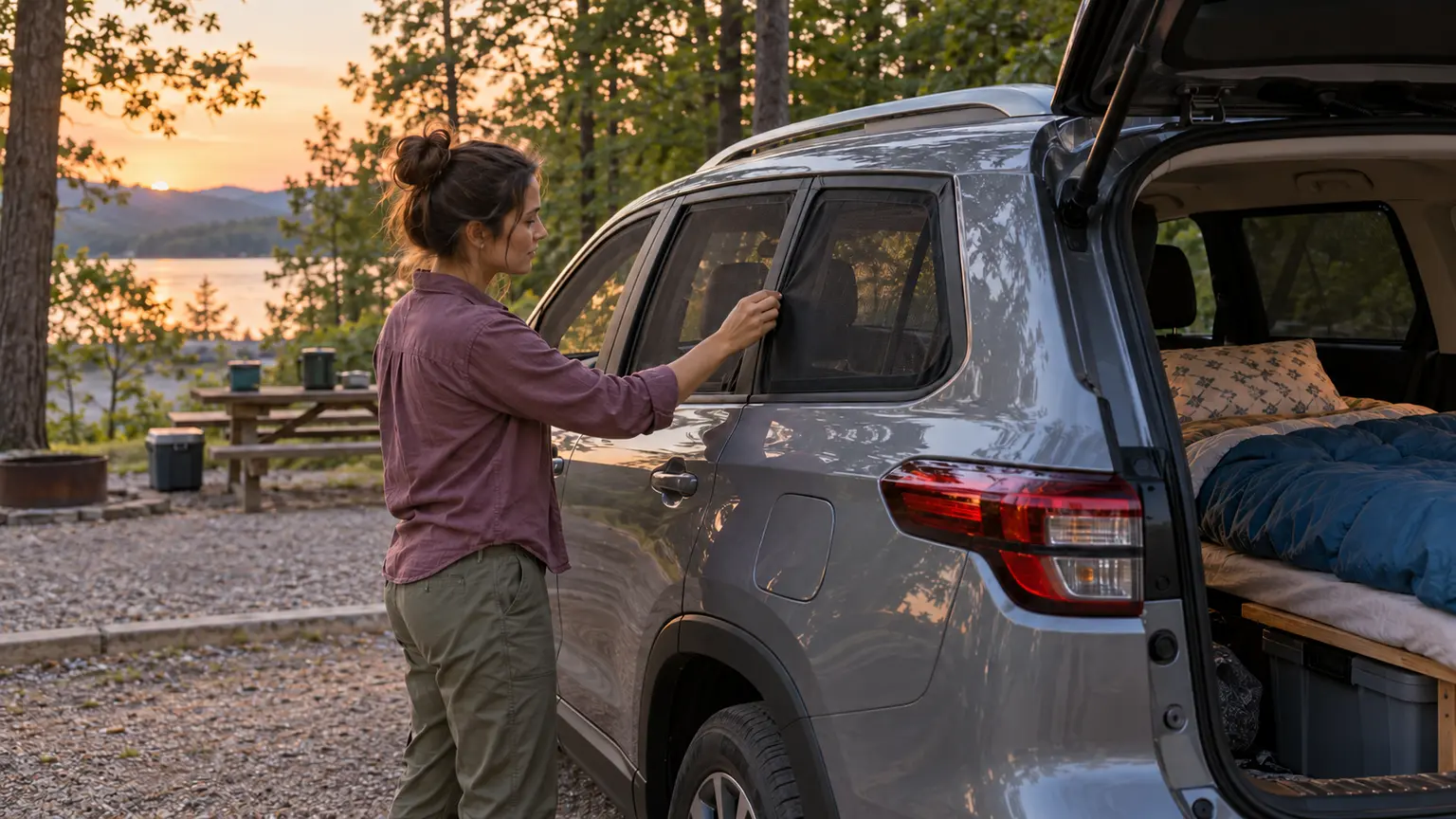
You can keep a window cracked without turning your car bed into an open invitation for mosquitoes. The useful answer is not one magic accessory: fit an intact removable screen, use label-directed personal bite protection, and make fewer door openings after you settle in.
Do the setup while you can still see every edge. A screen can reduce mosquito entry, but it cannot guarantee a bite-free night—and it does nothing to make a dangerously hot car safe. If the forecast or the cabin feels unsafe, leave or choose safer accommodation. Start with our hot-weather car-camping safety guide, not a mesh purchase.
Fit the screen before the local biting period
Install your removable screen in daylight, then look at the whole opening from both sides. Check the top corners, seams and any place where a mirror, trim or door frame changes the shape. Slowly operate the window only as its instructions allow. Close and latch the door, and make sure the screen does not interfere with your planned exit.
Do not assume one design fits every vehicle. Frameless windows move when a door opens. Sliding doors, sunroofs and unusually shaped rear windows create different gaps. Use a solution compatible with your vehicle and follow its instructions; this is not the moment for a universal opening measurement or an improvised magnet pattern.
The principle is simple. The US Centers for Disease Control and Prevention recommends intact screens on windows and doors and repairing holes as part of mosquito-bite prevention. That guidance is written for buildings, so applying it to a removable vehicle screen is a practical adaptation—not a claim that the CDC tested your car accessory.
Four layers before you close the door
No one layer does the whole job. Check the night, the mesh, the person and the way you enter.
1. Night check
Confirm the forecast and a safe sleeping temperature. A screened opening does not solve dangerous heat.
2. Screen check
Fit it in daylight, inspect every edge, and confirm the window, door and emergency exit still work.
3. Person check
Use label-directed repellent and protective clothing. Permethrin belongs only on label-approved clothing or gear, never on skin.
4. Entry check
Put bedding and water in place, minimize repeat door openings, then recheck the screen after you enter.
Text summary: A screen reduces openings; personal protection covers the gaps; the entry routine keeps you from undoing both.
Use repellent on the person, not as cabin treatment
A window screen is only one layer. The CDC recommends EPA-registered skin repellents and names active ingredients including DEET, picaridin (also called icaridin), IR3535, oil of lemon eucalyptus, PMD and 2-undecanone. That is a list, not a ranking. Choose a product for your situation and follow its label for where, how and when to apply or reapply it.
The US Environmental Protection Agency says registration means a skin-applied repellent was evaluated for human safety and effectiveness when used according to its label. Some minimum-risk products are exempt from registration, and EPA has not evaluated those ingredients for effectiveness. Outside the United States, use the local public-health regulator and the label legally supplied in your region.
More is not automatically better. EPA notes that performance varies with factors such as perspiration, water exposure, air temperature and the individual. Follow the label instead of inventing an “all night” interval. CDC also says not to put repellent under clothing; if you use sunscreen, apply sunscreen first and repellent second. Follow CDC, your local health authority and the product label especially carefully for children.
Permethrin is different from skin repellent. CDC guidance covers treating clothing and camping gear with 0.5% permethrin and says never to use permethrin products directly on skin. Keep that discussion within the label: do not spray car upholstery, bedding, pets, the cabin or an unspecified window screen. Our separate camp-to-bed tick routine explains overlapping clothing precautions without turning this into a pesticide recipe.
Avoid improvising with coils, candles, foggers, aerosol “bombs,” plug-in vaporizers or pesticide clouds inside a sleeping car. This guide does not establish a label that permits those uses in an occupied vehicle.
Build a one-entry bedtime routine
The easiest door opening to defend is the one you do not need. Before the local biting period, arrange the sleeping pad, water, medication, headlamp and tomorrow’s clothes. Finish cooking and food storage. Decide which screened opening will provide airflow, then keep privacy covers from blocking it completely; our window-cover comparison can help with that choice.
- Prepare outside first. Put frequently used items within reach so you will not repeatedly open a door.
- Enter and close. Move through the door without leaving it standing open, then latch it normally.
- Recheck the edge. Look for mesh pulled away by the door movement and confirm your exit remains clear.
- Keep the airflow plan. Do not cover the screened opening just to gain darkness. If moisture starts building, use the ventilation routine in our condensation guide.
This is a practical sequence, not a promise that mosquitoes will never enter. Different species and locations have different biting patterns, so “before dusk” is only a planning example—not a universal rule.
If mosquitoes still get inside
Turn on a light, step out of the bed area if needed and physically remove the insects where practical. Then find the route in: an unseated corner, a torn seam, a door opened for forgotten gear or an unscreened opening. Reseat or repair the screen according to its instructions. If the screen cannot fit without blocking a latch or safe exit, stop using that setup rather than forcing it.
Do not answer a fit problem by spraying an unspecified pesticide around an occupied cabin. If biting pressure is heavy, the screen keeps failing, or local public-health advice says conditions are unsuitable, change location or accommodation.
Reset the setup in the morning
Remove the screen as directed, inspect it for tears and let it dry before storage. Check portable items that can hold water—buckets, pet bowls, gear lids or folded tarps—and empty, turn over, cover or pack them as appropriate. CDC recommends regularly dealing with water-holding containers; on a short trip, this small reset prevents your own gear from adding avoidable standing water. It does not control mosquito populations across a campground.
Some destinations flag the issue directly. Cape Hatteras National Seashore, for example, warns that mosquitoes may be a campground problem and recommends netting and repellent. Treat that as a location-specific reminder to check current campground and public-health advice, not a universal forecast.
The simple answer
Set up the screen in daylight, protect the person according to the label, arrange the bed before repeated door openings begin, and inspect the mesh again after entry. Keep heat, ventilation and exit safety ahead of mosquito comfort. A removable screen can reduce entry; it cannot make every vehicle, campsite or night safe.
Sources
- CDC: Preventing Mosquito Bites, dated August 28, 2024.
- CDC: About Permethrin-Treated Clothing and Gear, dated May 14, 2024.
- EPA: Regulation of Skin-Applied Repellents, last updated June 25, 2026.
- EPA: Using Insect Repellents Safely and Effectively, last updated November 10, 2025.
- National Park Service: Cape Hatteras campgrounds, last updated June 22, 2026.