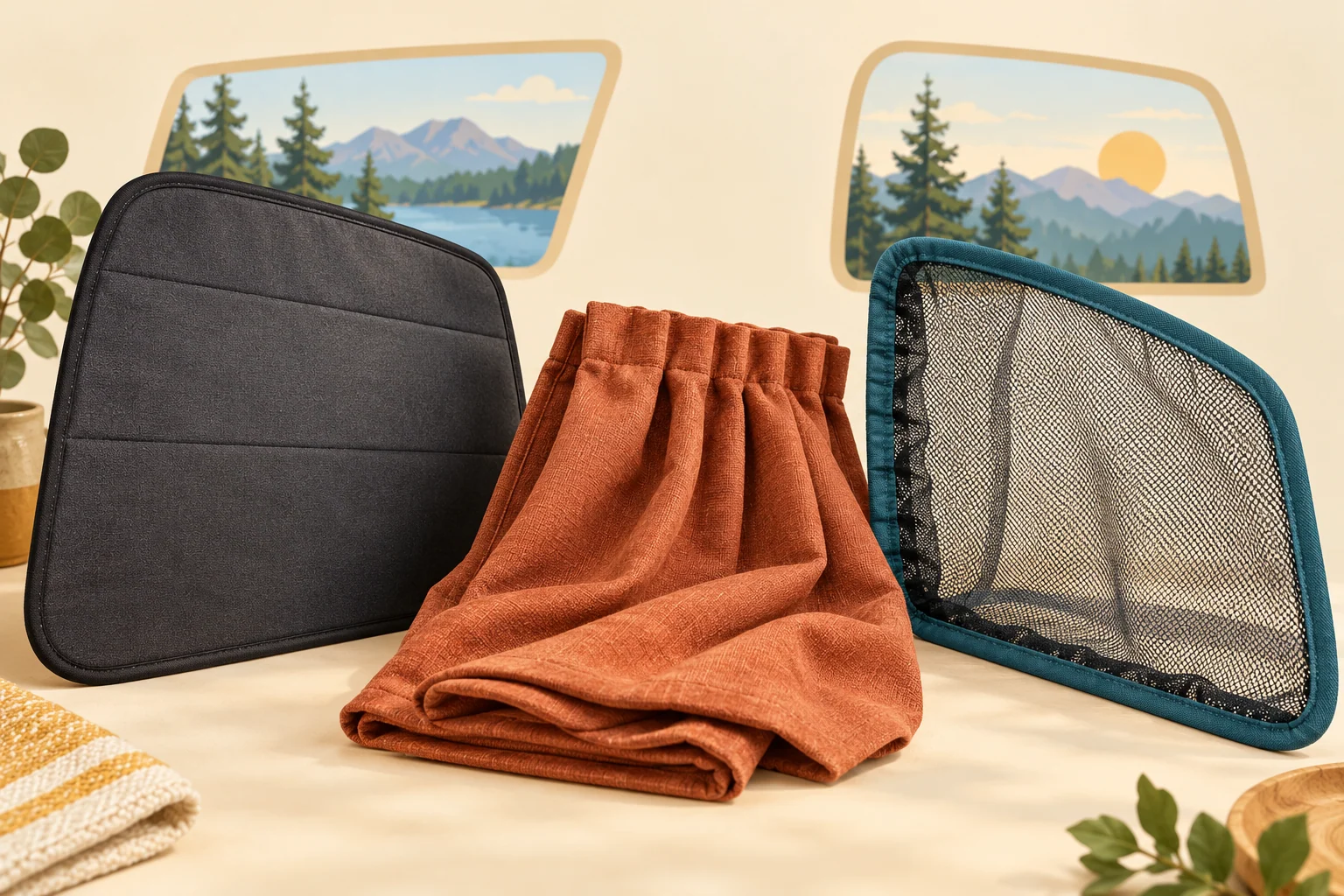
For most short car-camping trips, start with removable opaque covers for the glass you want to block. Add mesh window socks where you plan to open a compatible window, or choose a curtain if you want to separate the sleeping area from the front seats. You may need a combination—but you don’t need to turn your car into a tiny curtain showroom.
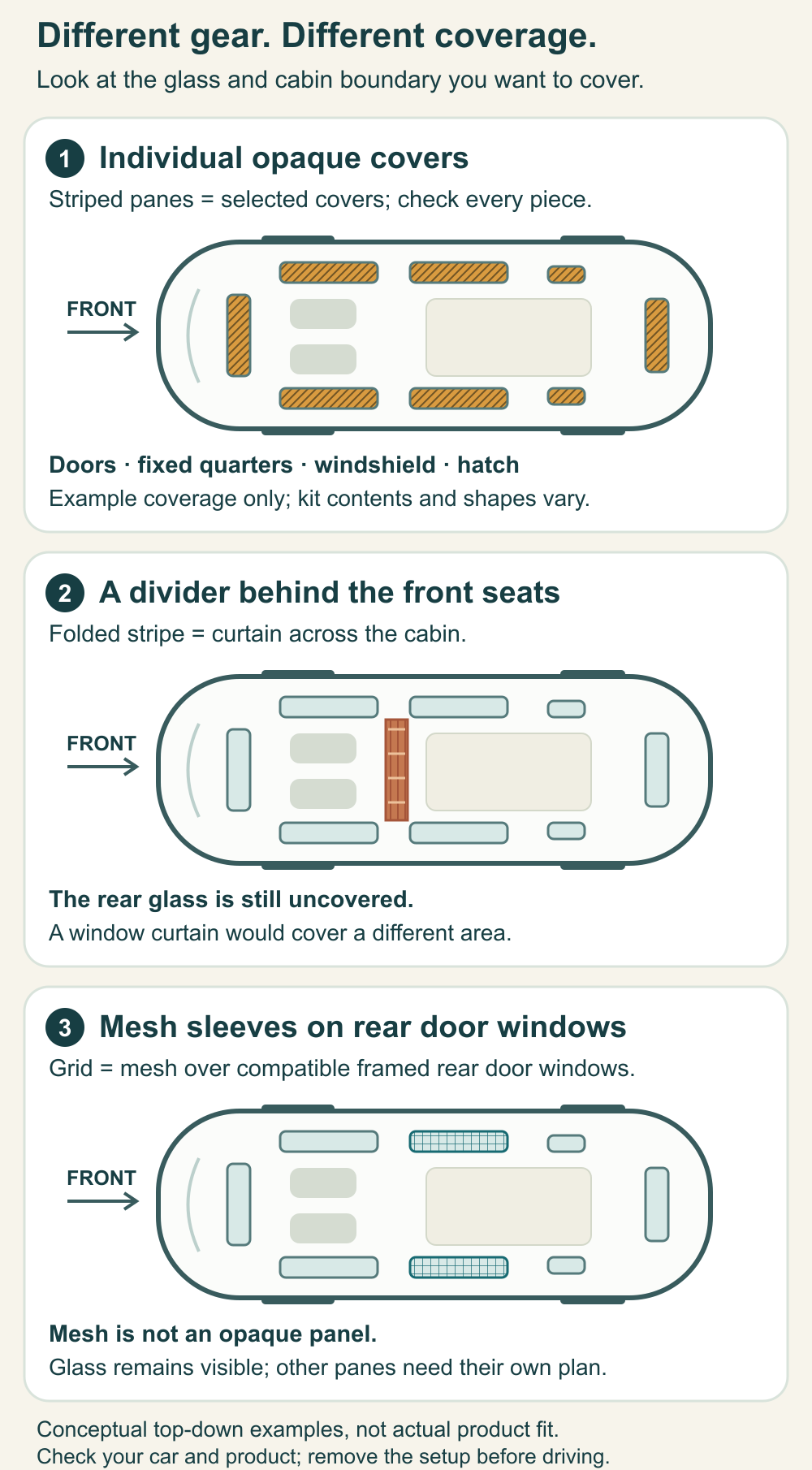
The important difference is coverage. A curtain behind the front seats leaves the rear windows exposed. Two door screens leave the windshield and hatch untouched. And mesh isn’t the same thing as an opaque cover when you switch on a light inside.
This is a researched guide based on manufacturer documents and an attributed public account. We haven’t physically tested these products.
What each approach actually covers
“Window covers” is a broad label. Here, it means removable opaque panels or inserts placed against individual windows. “Window socks” means mesh sleeves fitted over framed car doors. Curtains can hang across a window or divide the cabin; check which kind you’re buying.
| Approach | Choose it for | Check before buying | What it leaves to solve |
|---|---|---|---|
| Opaque window covers | Blocking particular sightlines and outside light | Exact window shape, retention and included pieces | Other glass panels; compatibility with a planned opening |
| Removable curtains | Covering a window or separating front seats from the bed | Actual placement, dimensions and attachment points | A cabin divider leaves rear side and hatch glass uncovered |
| Mesh window socks | Screening a compatible open door window for insects | Door frame, size and front/rear restrictions | Nighttime opacity and all the other windows |
The takeaway: choose where you want opacity first. Then work out how a suitable screened opening can fit into that arrangement. Buying three accessories without checking their coverage can still leave the one window beside your pillow uncovered.
Window covers: deal with the glass beside your bed
Individual covers let you choose which windows to treat. If a campsite light shines through the hatch, a divider behind the front seats won’t solve that problem. A cover for the hatch glass is the more direct option.
Count the panes before you count the price. Alongside the obvious door windows, your car may have small fixed quarter windows and rear hatch glass. A windshield shade covers the windshield—not the whole front cabin, and certainly not the whole car.
Vehicle-specific products can make the shortlist easier. For example, WeatherTech’s SunShade buying guide describes a foam-core shade selected by vehicle year, make and model, with full-vehicle kits available for some applications. That doesn’t mean a full kit exists for your car. Use the vehicle selector and inspect the selected kit’s contents, including the small panes.
These are US catalog examples; check your regional listing and exact variant. Neither the product name nor a matching make and model establishes tested camping fit or nighttime blackout.
For an occasional trip, a mixed arrangement may be enough: an existing front sunshade plus removable opaque covers elsewhere. Check that each piece stays where intended and can be removed without obstructing access. This guide doesn’t prescribe a universal adhesive, cutting allowance or DIY attachment method.
Also decide where the covers will live during the drive. A stack of panels needs a home that isn’t underneath the bag you reach for at every stop.
Curtains: check whether you’re covering a window or dividing the cabin
A divider is useful when you want the bed separated from the front cabin without covering every front pane. It can make the sleeping area feel more private, but the rear glass still needs its own decision.
The Luno Car Privacy Curtain illustrates this distinction. It is a front-to-rear cabin divider, listed at 51 × 26 inches—about 129.5 × 66.0 cm—not a set of curtains for every window.
Look at the attachment instructions as closely as the fabric. Luno’s curtain instructions use grab-handle anchors, straps around the door pillars and cords attached around the front seatbelts. The maker warns against overtightening the straps and interfering with the belts. Its magnetic closure closes the curtain; it doesn’t mean the whole thing magnetically attaches to your window trim.
Before ordering, check that your vehicle has the specified attachment points and that the curtain’s position works with your sleeping layout. If your pillow sits immediately behind the front seats, consider where the hanging fabric will fall. “Fits most cars” is a starting claim to investigate, not a fit confirmation.
A curtain intended for an individual window is a different arrangement again. Check its covered area and mounting method rather than assuming any product called a “car curtain” solves the same problem.
Window socks: useful mesh, with specific fit limits
Mesh sleeves cover the door’s window area while allowing the glass to be lowered behind them. Their role is insect screening at an opening. Treat privacy and darkness as separate questions.
For a concrete example, Luno Car Window Screens come as a pair and are specifically designed for framed rear door windows. They are not suitable for front windows or frameless rear windows. Those restrictions apply to this product; don’t extrapolate them into a universal rule for every screen on sale.
Open the door and inspect its construction. Is there a fixed frame around the glass, or does the glass stand on its own? Then follow the maker’s sizing diagram. A vehicle name in a recommendation list is less useful than the shape and measurements of your actual door.
Wind deflectors can change the fit too. Luno’s rain-guard guidance advises considering Large if the door is near the upper end of Medium sizing and has deflectors. That is sizing advice, not a promise that rain will stay outside.
Mesh also needs to remain intact. Luno’s screen instructions say not to use damaged mesh, not to use it near flames or heat sources, and not to rely on it for security.
Don’t cover your planned opening with an opaque panel and assume the screen behind it still provides the same airflow. Equally, choosing a screen doesn’t establish that ventilation will be sufficient for your conditions. For the moisture side of the setup, see our car camping condensation guide.
Check the setup with the light you’ll actually use
Before the trip, rehearse the arrangement while parked. If possible, have someone look from outside while you use your normal reading light or phone. Check the side windows, rear glass and edges of covers; check from bed level too.
This is a practical way to notice unwanted sightlines and light gaps. It isn’t a blackout certification or a security test.
In a public discussion about window covers, commenter Weekley13 reported that someone outside could still see them through tinted rear glass when an interior light was on, prompting additional covers. That’s one person’s account, not a rule about every tint—but a useful reason to check your own nighttime lighting.
For a first attempt, keep the decision small:
Identify the glass that exposes the bed or admits unwanted light.
Choose removable opaque coverage for those areas.
Check whether your planned window opening accepts a suitable screen.
Rehearse installation, door access and removal.
Give every piece a storage place for the drive.
You can improve the arrangement after a trip. You don’t have to buy a matching set simply because the product photos look tidy.
Remove the setup before moving
Our default recommendation is to remove window panels, mesh sleeves and temporary curtains before driving, then restore your normal view and seatbelt function.
Luno’s screen instructions explicitly prohibit driving with the screens installed. Its curtain instructions[1] conflict: one step permits leaving the curtain bunched after detaching the seatbelt cords, while the warning says not to operate the vehicle with it installed. Follow the stricter warning and remove the curtain before moving.
The legal details depend on where you drive. For example, Great Britain’s official windscreen-obscuration guidance addresses the driver’s unobstructed road view. It is not a worldwide rule about every rear window or permission to sleep in a particular place.
Covers address visibility into the cabin; they don’t make a location secure or establish that overnight camping is allowed. For that broader preparation, use our first-night car-sleeping checklist.
Choose covers for the windows that matter, a divider for the cabin boundary you want, and compatible mesh for an opening. Check the whole arrangement in your own car—then pack it away before the wheels turn.