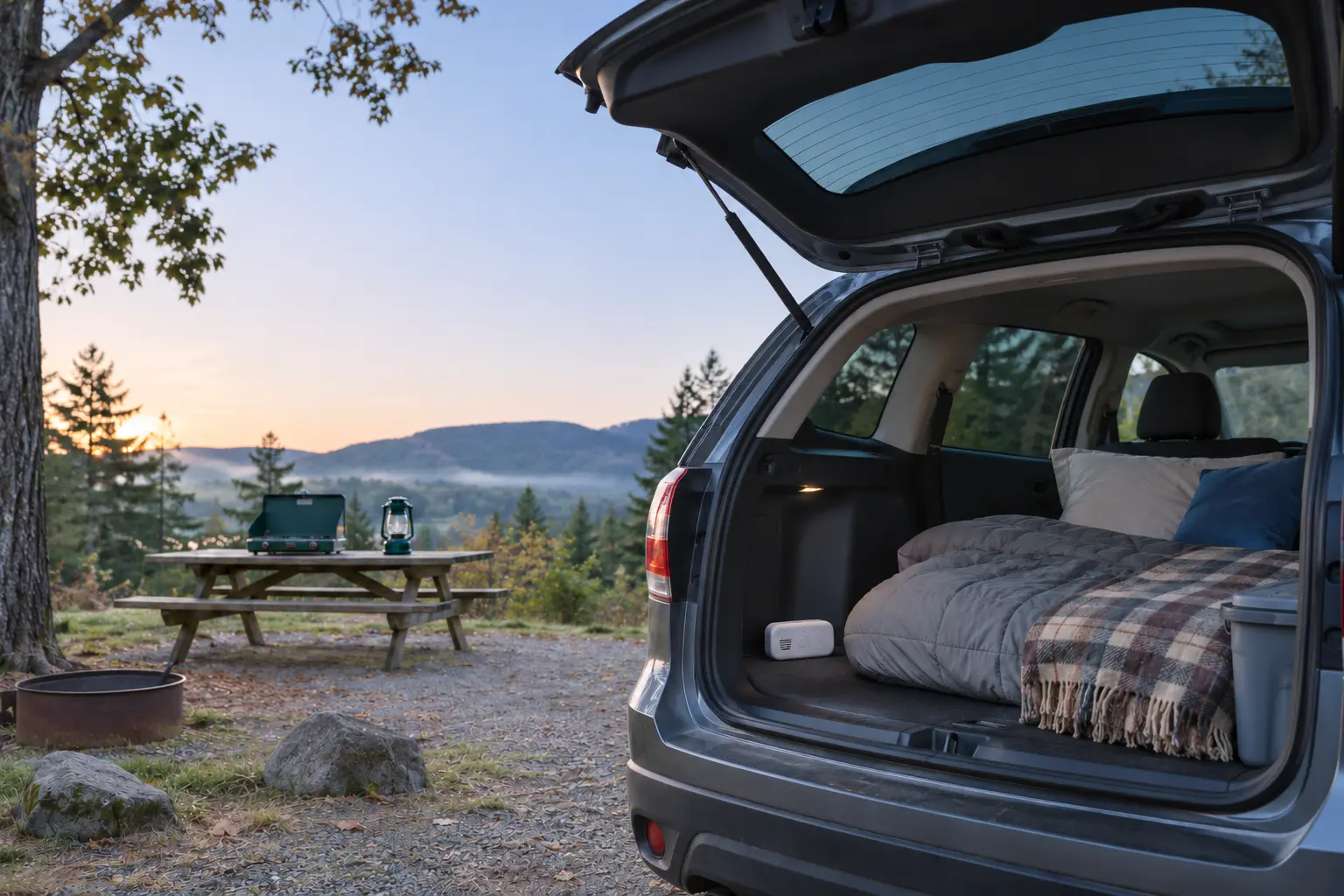
A carbon monoxide alarm can be a sensible extra layer for car camping, but it is not a permission slip. It cannot make it safe to run an engine or a portable fuel-burning heater, stove, lantern, generator or charcoal device in the sleeping cabin or close enough for exhaust to reach it. The first job is always to remove the possible source; the alarm is backup for the danger you did not expect.
That distinction matters because carbon monoxide (CO) gives you no useful warning from your senses. It is colorless and odorless, and a sleeping person may not notice symptoms in time. A switched-off car at an ordinary campsite is not the same situation as a garage or a vehicle with its engine running, but nearby exhaust, a damaged exhaust system and forgotten combustion equipment are still reasons to make a deliberate plan.
So, do you need one?
Requirements vary by jurisdiction; this guide treats an alarm as an optional backup for an ordinary switched-off car, not as a substitute for local rules or source control. For many campers, a suitable battery-powered alarm is a reasonable backup—especially when camping near other vehicles, generators or places where unexpected exhaust could reach the car.
“Suitable” is doing real work in that sentence. Do not assume every household unit is designed for a car’s temperature swings, humidity or travel vibration. In the United States, look for a recognized testing-laboratory listing and check the exact application named in the instructions. The U.S. Consumer Product Safety Commission points consumers to alarms meeting the current UL 2034 standard, while UL notes that listings can cover specific uses, including travel and recreational vehicles. Outside the US, standards, markings and emergency numbers differ, so use the certification and instructions for the country where you bought and use the alarm.
Source first, alarm second
Use the alarm as a backup after you have dealt with the source—not as a reason to stay beside it.
Car off, no combustion nearby
Confirm the engine is fully off and keep fuel-burning equipment outside and unused while anyone sleeps.
Alarm role: optional extra layer.
Vehicle or generator idling nearby
Move the sleeping car or ask for the source to be shut down. Wind can change during the night.
Alarm role: backup, not justification to stay.
Plan runs the engine or a fuel burner during sleep
Change the plan. A detector cannot make an engine or portable fuel-burning appliance in the sleeping cabin acceptable.
Alarm role: it does not make this safe.
Alarm sounds or someone feels ill
Wake everyone, get outside to fresh air and call local emergency services. Do not search for the source first.
Alarm role: leave immediately.
Choose the alarm by its instructions, not its appearance
Start with a battery-powered model so it does not depend on the car’s accessory socket or starter battery. Read the manual before the trip and answer four questions:
- Is the intended use appropriate? Check the listing mark and whether the maker names travel, RV or similar use. Do not infer that claim from a compact shape.
- Will it work in your conditions? Verify its operating temperature and humidity range. As one example of why this matters, Kidde says many home smoke and CO alarms are designed for 40–100°F (about 4–38°C); your exact unit may differ.
- Can everyone hear it? Follow the manual’s placement instructions and keep the unit unobstructed. Do not bury it under bedding, clothes or gear.
- Is it still serviceable? Check the battery and end-of-life date, then use the test button as the manual directs. CPSC cautions that the button checks the circuitry and audible alarm; it is not a live-CO calibration test.
Avoid inventing a “high” or “low” mounting rule for the car. Placement guidance varies, so the instructions supplied with the listed alarm should win. Likewise, do not shop by a dramatic parts-per-million claim without understanding the applicable standard. UL explains that compliant alarms are designed to avoid alerting at ordinary low background levels while still warning about dangerous exposure. That is another reason to treat a silent alarm as backup information, not a safety certificate.
Remove the hazards the alarm cannot fix
Before bed, verify that the vehicle is in Park and the engine is fully off. Keyless systems behave differently, and NHTSA advises drivers to learn their vehicle’s alerts and shutdown procedure. If you are unsure, consult the owner’s manual and check the instrument panel rather than assuming silence means off.
Do not run the vehicle for warmth while sleeping. Our guide to sleeping warm without relying on the engine covers safer planning. Keep stoves and other fuel-burning equipment out of the cabin; build an outside cooking plan instead. If another camper’s generator exhaust points toward your car, the practical move is to relocate before making the bed—not to wait for a detector. See the generator-exhaust relocation checklist for that specific situation.
Vehicle maintenance matters too. CDC advises having the exhaust system checked regularly because even a small leak can allow CO to build inside a car. It also warns that running a vehicle with the tailgate open can draw exhaust into the cabin. An alarm may reveal a problem, but it cannot repair one.
If the alarm sounds, leave first
Do not spend time opening apps, checking wind direction or hunting for a faulty appliance. Wake every occupant, move into fresh air and call the local emergency number. Do not go back into the vehicle until emergency responders or another qualified authority says it is safe. Follow the same leave-first rule if someone develops possible CO-poisoning symptoms even when the alarm is silent; an alarm can fail, be out of range or be incorrectly placed.
Finally, keep CO separate from CO2 and condensation. A CO alarm does not measure the carbon dioxide people exhale, judge ventilation comfort or keep windows dry. It answers one narrow safety question. Good car-camping practice still means an engine-off sleeping plan, no combustion in the cabin, attention to nearby exhaust and a quick exit if anything changes.
Sources
- U.S. Consumer Product Safety Commission: Carbon Monoxide Fact Sheet — alarm role, testing, response and UL 2034 guidance.
- U.S. Consumer Product Safety Commission: Portable Heaters and Camping Equipment — sleeping and combustion-equipment warning.
- Centers for Disease Control and Prevention: About Carbon Monoxide, reviewed October 26, 2026 — vehicle exhaust, inspection and symptom risk.
- UL Solutions: Carbon Monoxide Alarm Codes — listings, applications, alarm behavior and maintenance.
- National Highway Traffic Safety Administration: Keyless Ignition Systems — shutdown checks and vehicle-specific alerts.
- Kidde: Temperature Effects on Alarms — example operating-temperature guidance; check the manual for your exact model.