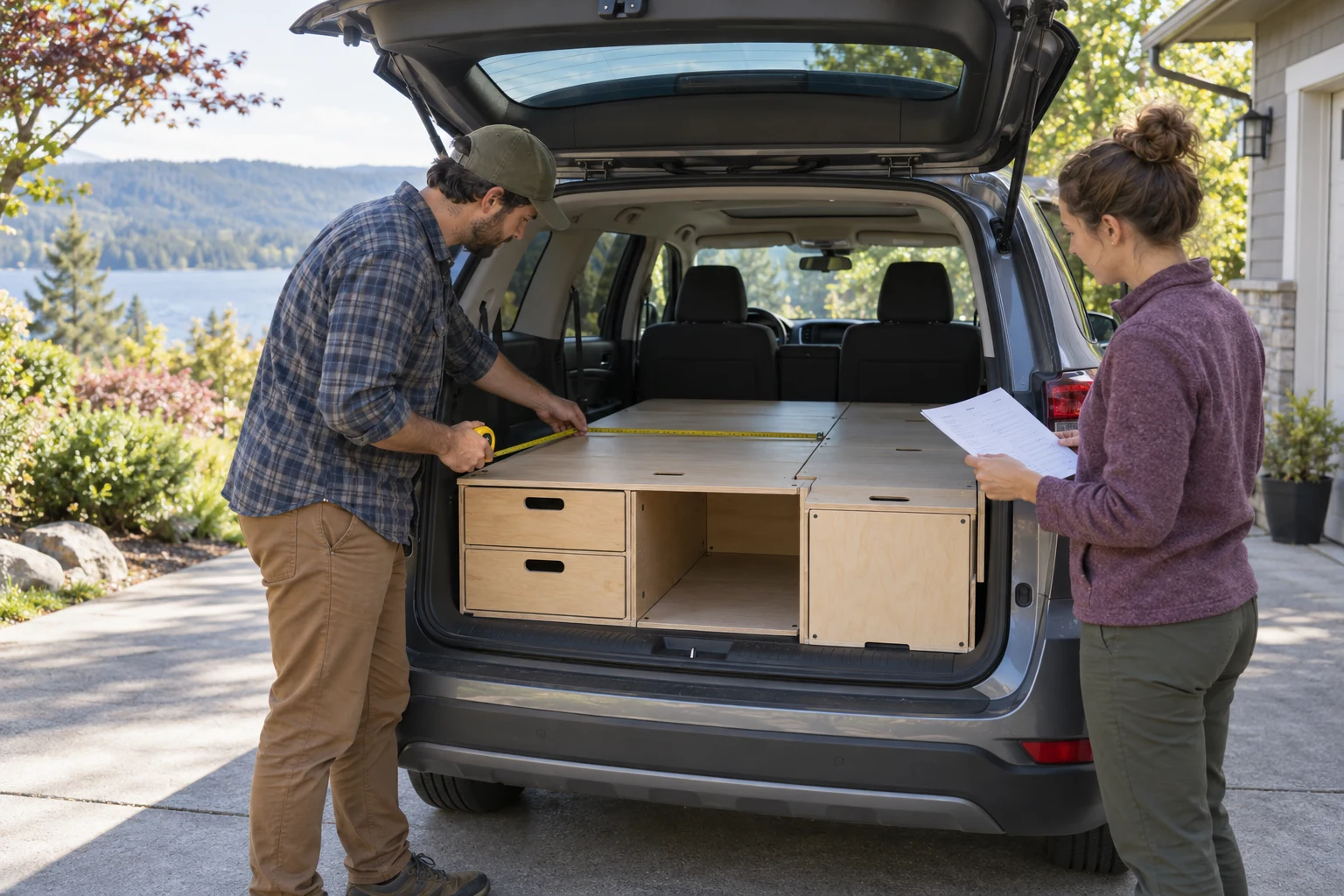
A removable camping box can turn an everyday car into a sleeper without a permanent conversion. It can also block the hatch, steal headroom, remove needed seats or prove too heavy to lift.
The product photo cannot answer the question that matters: will this exact box work in your exact vehicle and routine? Before ordering, make the seller clear seven gates. If one answer remains fuzzy, pause the purchase.
If you are still deciding between building and buying, start with our guide to DIY platforms versus removable kits. This checklist begins after you have chosen the ready-made removable-box route.
The seven-gate camping-box check
- Exact fitDoes the maker confirm your year, trim, wheelbase and options?Evidence: a written compatibility answer and installed dimensions.
- Sleep spaceCan you lie down and sit up with the hatch shut?Evidence: bed dimensions and measured mattress-to-roof clearance.
- Travel modeWhich seats, belts and access points remain usable?Evidence: a diagram for driving and sleeping configurations.
- SecurementHow is every module restrained while driving?Evidence: model-specific instructions, hardware and approved anchor points.
- WeightWill the loaded car stay within its limit, and can you move the parts?Evidence: total weight plus the heaviest individual piece.
- KitchenCan you reach equipment and operate the cooker safely outdoors?Evidence: a full deployment drawing and appliance instructions.
- OwnershipWhat happens after delivery—and between trips?Evidence: landed price, storage plan, warranty and return terms.
1. Confirm the exact vehicle, not merely the model name
“Fits compact SUVs” is not a compatibility guarantee. Ask the maker to confirm the model year, trim, wheelbase, seat configuration, cargo floor and options such as a subwoofer or powered tailgate. Measure the narrowest hatch opening as well as the cargo bay. A box that fits inside may not fit through the door.
Request both the packed and deployed envelope: width, depth and height, plus the space required to unfold the bed and open every drawer. Roadloft, for example, publishes model-and-year compatibility information and gives some vehicle-specific fit notes. You still need to confirm the exact options and measurements for your car. That is a useful reminder, not proof that a different box will fit.
2. Measure the sleeping geometry with the hatch closed
Add the mattress thickness, then measure from its top surface to the lowest roof or hatch trim. Check whether the front seats can remain in a comfortable driving position before deployment.
One maker lists a 110 × 195 cm bed; another Canadian compact-SUV box lists 45 × 72 inches. These are different products for different markets, not a ranking. What matters is the space around your body in your vehicle. Confirm that hinges, drawers and bedding do not hit the closed hatch.
3. Write down what happens to every seat
Do not rely on a photo showing an empty cargo area. Ask which seats stay upright while driving, which must fold and which must be removed. The answer may change with wheelbase or vehicle version. One manufacturer says its third row must be removed, and identifies a short-wheelbase pairing that generally prevents rear-seat occupancy.
Check the vehicle manual before carrying passengers. Make sure usable seats retain their belts and head restraints without obstructing child-seat anchors. Confirm access to the spare, jack, battery service points and an exit when the bed is deployed.
4. Demand a real travel-restraint plan
A close fit is not a restraint system. Neither is a generic bungee cord. Ask for the box maker’s instructions showing the supplied hardware, approved vehicle attachment points and separate travel and deployed configurations. If the seller cannot explain how the unit is secured in your vehicle, do not improvise a claim of crash safety.
UK government guidance says car loads should be secured against harm, with cargo placed against the boot bulkhead and gaps filled where possible. The kit instructions and vehicle manual still control. A stated strap rating applies only to that product and prescribed installation.
5. Add payload and test the lifting route
Count the box, mattress, occupants, water, fuel, food and every piece of camping gear. In the United States, the B-pillar placard gives the combined occupant-and-cargo limit; elsewhere, use the vehicle plate and manual. Stay within the limit that applies to your car.
Published box weights are not directly comparable because the included parts differ. Current examples range from 28 kg for one SUV kit to 60 kg plus listed furnishings for another, while a Canadian compact-SUV system lists 80 lb including its mattress. Ask for the heaviest single removable piece, not only the total.
Trace the route from car to storage. Can one person grip it, clear the bumper, cross stairs and set it down safely? If two people are required, will they be available after every trip?
| Example checked October 19, 2026 | Published figure | What still needs confirmation |
|---|---|---|
| Roadloft SUV kit, US page | US$2,495; 28 kg | Exact vehicle/options, installed headroom and delivered price |
| QUQUQ KombiBox, Germany | €2,790 including 19% German VAT; shipping extra; 60 kg plus listed furnishings | Vehicle version, seat use, shipping and applicable VAT |
| Campal removable kits, UK | Slimline from £900; Estate from £1,320 | Model-specific fit, included equipment, warranty and delivery |
| Freeway Bounty Hunter Compact SUV, Canada | 80 lb including mattress; 45 × 72 in bed | Your measured vehicle dimensions and delivered cost |
These are manufacturer-published examples, not tested recommendations. Prices, specifications, availability, tax and shipping can change by date and destination.
6. Treat the kitchen as outdoor equipment
Can the kitchen drawer extend on uneven ground? Does the hatch shelter it or drip onto it? Can you reach food, water and utensils without dismantling the bed? Where will hot cookware sit?
Portable fuel-burning camping equipment belongs outdoors unless its manufacturer expressly designed and instructed it for enclosed use. The U.S. Consumer Product Safety Commission warns against using portable fuel-burning camping equipment inside a vehicle or tent. Remove the cooker, follow its manual and keep combustion away from the sleeping cabin.
7. Calculate ownership, not just checkout
Ask for the landed price in writing: box, mattress, options, freight, tax or VAT, import fees and required restraint hardware. Prices checked on October 19, 2026 ranged widely across US, Canadian, UK and German pages, so currency figures are not directly comparable.
Read the warranty territory, return window, custom-order exclusions and responsibility for return freight. Ask whether replacement hinges, slides and straps are available. Measure the dry home-storage space too.
Do a closed-hatch proof before paying
Obtain written answers, then recreate the box at home with a taped floor outline, cardboard volume and equivalent test weight. Close the hatch. Start with the front seats in your driving position, deploy the bed, sit up, open the required drawers, reach an exit and lift every proposed section. Rehearse only the restraint method specified by the maker.
This dry fit can expose bad dimensions and awkward handling. It does not validate crash safety or replace manufacturer instructions.
Bottom line
A good removable camping box should answer all seven gates for your car and travel pattern. Fit and convenience are measurable; vague compatibility, improvised restraints and “probably manageable” lifting are reasons to wait.
Sources
- Roadloft SUV Camper Conversion Kit and vehicle compatibility guidance
- QUQUQ KombiBox specifications and current price list
- Campal removable camper conversion kits
- Freeway Bounty Hunter Compact SUV platform
- NHTSA interpretation of the occupant-and-cargo placard
- UK DVSA guidance for securing loads in small vans and cars
- CPSC carbon-monoxide fact sheet and camping-equipment guidance