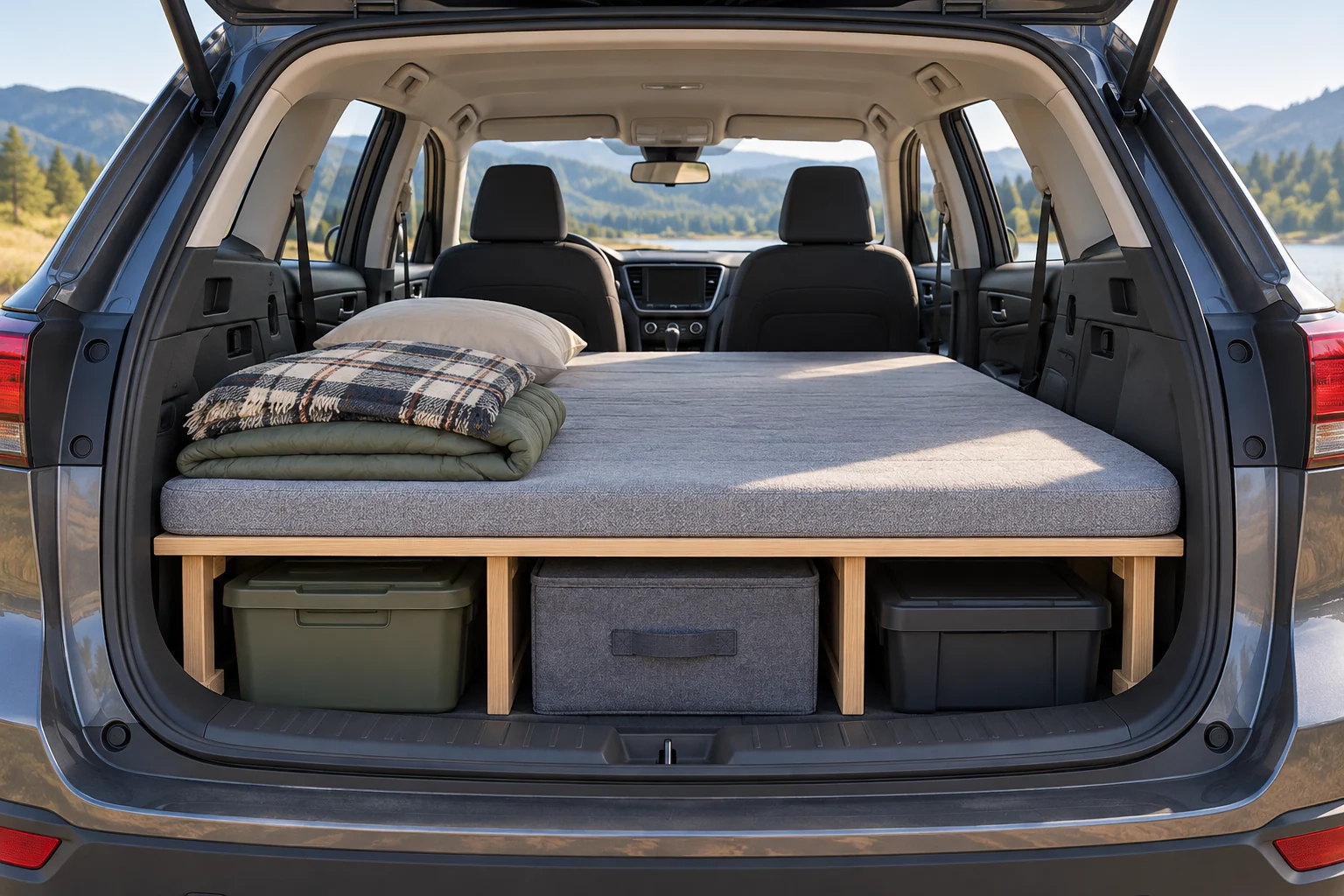
You need a sleeping platform when it solves a specific problem: an unsupported gap, an awkward seat slope or gear that has nowhere to go at bedtime. If your existing supported surface works and you can store your bags beside it, a raised deck may add more bulk than benefit.
A removable DIY platform offers flexibility if you have the skills to design and build it. A bought kit can reduce that work when its documented fit matches your exact car. Either way, the best starting question is “What needs fixing?” rather than “How much plywood fits in here?”
This is a researched decision guide based on manufacturer documentation and published guidance. We haven’t built or physically tested these platforms.
First decide what the platform needs to do
Separate support from storage. A deck designed to address uneven folded seats has a different job from one raised high enough to hold camping boxes underneath. You might need the first without wanting the second.
Before planning a platform, use our car-sleeping measurement checklist to map the usable space and support questions. Check the layout with the hatch closed and the front seats where they’ll actually be overnight.
A thicker mattress isn’t a platform design. Choose the sleeping surface and its support together; our air vs self-inflating vs foam mattress guide explains the separate mattress trade-offs.
Three routes worth considering
Keep the surface low
Solves: unnecessary bulk when the existing supported layout works.
Costs you: the under-bed storage a raised deck could provide.
Verify: mattress support and where every bag goes at bedtime.
Build a removable deck
Solves: a layout that needs a custom arrangement.
Costs you: design responsibility, tools, time and home storage.
Verify: the support design, access and removal plan.
Choose a removable kit
Solves: some design and assembly work where documented fit matches.
Costs you: upfront expense and the kit’s configuration limits.
Verify: exact vehicle, support parts, inclusions and removal.
Choose by the problem you need to solve; none of these routes is a tested overall winner.
Storage height comes out of your sitting space
A high deck can create useful storage, but the roof stays where it is. Include the support height, deck thickness and mattress when considering how much room remains above the bed.
REI’s published platform example asks readers to weigh bin clearance against headroom and account for both the mattress and building materials. Its measurements belong to that particular full-size van, not your hatchback. [1]
Think through a rainy evening: can you sit where you want to read or change clothes? Can you reach your overnight bag without lifting the mattress? A box that fits underneath but won’t slide out with the bed deployed is technically stored—and practically playing hide-and-seek.
Try planning lower storage for seldom-used items and an accessible spot for things you’ll need overnight. That is a layout choice, not a reason to make every platform as low or as high as possible.
Test two states: bed down and seats restored
Sketch both arrangements before buying materials or a kit. The sleeping layout is only half the decision for a car that still needs to do ordinary car things.
- Bed deployed: where is the supported sleeping surface, how much space remains above it, and which bags or drawers can you reach?
- Ready to travel: which pieces fold, retract or come out, where do they go, and can the seats and restraints function normally?
Include removal at home. A platform may come out of the car easily enough but still be awkward to carry through a narrow doorway or store in an apartment. Record the number of pieces, their carried dimensions and verified weight; don’t judge removal by a tidy product photo.
DIY makes sense when the layout needs customization and you can take responsibility for the design. REI’s example uses saws and a drill, among other tools. Having a board cut to size is not the same as establishing how the complete bed will be supported. [1]
Two kit examples show why exact fit matters
The Luno x BamBeds Vehicle Sleeping Platform is described by its maker as removable and tool-free. Its selections distinguish 4Runner generations, powertrains and seating configurations; the listing excludes the seven-seat Lexus GX550. “SUV platform” is a category, not compatibility.
The same US listing specifies USA-only shipping and final sale, despite general return badges elsewhere on the page. Treat the product-specific wording as a reason to resolve fit and purchase conditions before ordering.
TrunkMate’s support guidance illustrates another distinction: its extended bed frame must be supported before loading. The basic SUV supports are for rear bench-seat arrangements; captain’s seats require upgraded supports. Check the exact platform and support combination, rather than assuming an adjustable length solves every seat layout.
These are documented examples, not our fit tests or recommendations for every vehicle. We haven’t established comparable structural, comfort or crash-restraint performance.
Compare the whole job, not just the headline price
Make two short lists using current local costs. For DIY, include materials, finishing, hardware, tools you don’t own and the time you’ll spend. For a bought kit, include required supports, accessories, delivery and tax.
Then add the non-price questions: can you remove it on your own, can you keep the seats you need, and is there somewhere to put it between trips? DIY isn’t automatically cheaper once those jobs are included; a bought kit isn’t automatically easier in your car.
Keep parked support and travel restraint separate. A sleeping load rating doesn’t establish that a platform is restrained in a collision. Follow the relevant vehicle and product instructions for carrying it, and restore seating and restraint function before travel.
For a location-specific example, Great Britain’s Highway Code, Rule 98 requires loads and heavy or sharp objects to be secured. That isn’t approval of a particular homemade anchor or a worldwide legal summary.
Choose the smallest useful change
Keep the surface low if support and bedtime storage already work. Consider DIY when a custom layout is worth the design and building work. Shortlist a bought kit when the exact fit, supports, removal plan and total cost make sense.
Whichever route you choose, it should improve the night without making tomorrow’s drive a furniture-removal project.
Sources
- REI: DIY Van Life—How to Make a Sleeping Platform, Ashley Brown, April 3, 2018. Vehicle-specific build example and height considerations.
- Luno: Vehicle Sleeping Platform / Luno x BamBeds. Manufacturer’s configuration, shipping and purchase restrictions.
- TrunkMate: Bed Support Comparison. Manufacturer’s support requirements and seat-layout distinctions.
- GOV.UK: Highway Code Rules 89–102. Great Britain load-security guidance, Rule 98.