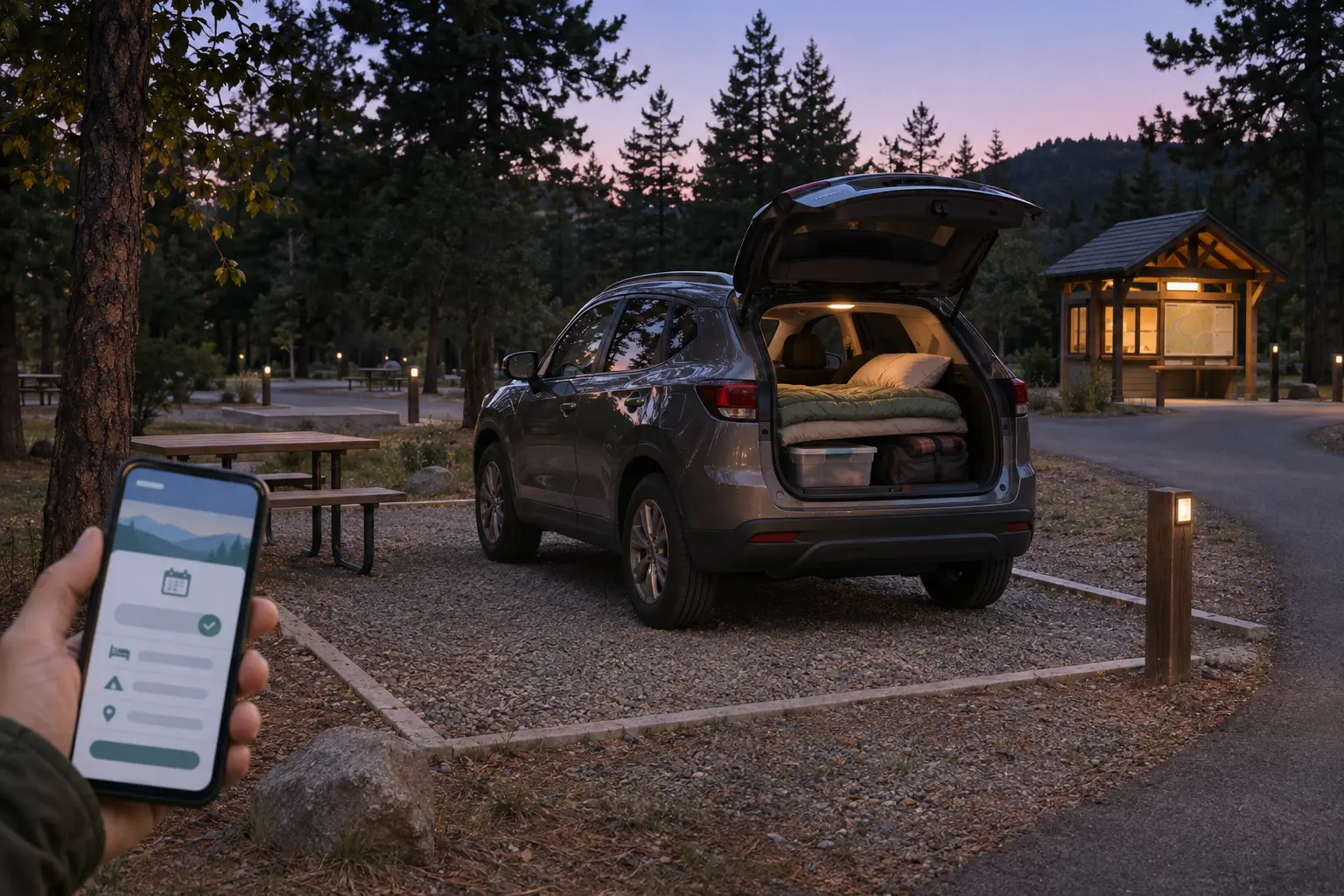
A paid campsite is not always held indefinitely. If you will arrive after the office closes—or miss the first reserved night—the campground’s own gate, registration and no-show rules decide what happens next.
The practical answer is to check the exact facility page and confirmation before reception disappears. Find four separate details: office hours, gate access, after-hours registration and the no-show deadline. If the local instructions say to call, message or modify the booking, do that through the listed channel. A contact attempt can document your delay, but it does not guarantee that the site will be held.
This guide was checked on November 6, 2026. It uses U.S. examples and one Parks Canada comparison to show why there is no safe universal cutoff.
First, separate late check-in from a missed night
Two situations can sound like “late arrival,” but they may trigger different rules:
- After-hours arrival on the booked first date: You still plan to occupy the site that night, but the office may be closed or the gate may have restricted access.
- Missing the first reserved night: You will not occupy the site until the next day. The reservation may be treated as a no-show unless you notify the facility or modify the booking as directed.
Do not assume a booking platform’s general policy overrides the campground page. Recreation.gov, for example, publishes a general definition for staffed facilities but says facility-specific rules apply and procedures can differ at unstaffed locations.
Late-arrival decision
Match your situation to the local instruction. These are decision prompts, not transferable campground rules.
Office closed, same arrival date
Follow the posted after-hours registration and site-assignment procedure.
Missing the first reserved night
Check the no-show deadline and notify or modify the booking as directed.
Gate access is restricted
Do not bypass it. Use the facility’s stated alternative or a lawful fallback.
No clear local rule
Contact the facility before reception closes and keep the reply with your booking.
A six-step plan before you lose service
- Open the exact facility page. Read the campground page, booking confirmation and current alerts. Search for “late arrival,” “after hours,” “gate,” “check-in” and “no-show.”
- Identify which situation applies. Decide whether you will arrive after office hours on the first date or skip the first night entirely.
- Use the listed local channel. If the facility asks delayed guests to call, leave a message or modify the reservation, follow that instruction. Save the confirmation or a note of the contact attempt without treating it as a guarantee.
- Save what you need offline. Keep the site number, reservation details, campground map, gate instructions and directions available when mobile service disappears.
- Prepare a lawful fallback. If the gate is closed or entry is prohibited, do not drive around a barrier or improvise a campsite in a pullout. Choose a place where overnight parking or lodging is actually permitted.
- Finish any required morning check-in. Some after-hours procedures allow you to occupy the assigned site and report to staff the next morning. Follow the facility’s stated time and process.
Why one deadline cannot cover every campground
The official examples are deliberately inconsistent:
- Yosemite National Park: Guests arriving after the ranger leaves may go to their assigned site and check in the next morning. A guest arriving later than the reservation start date must call; without contact or check-in by noon after the first night, the reservation may be forfeited.
- Joshua Tree National Park: The park says there is no formal check-in and a late-night guest may proceed to the reserved site. Someone who will not arrive for the first night should call and leave a message to help prevent cancellation.
- Bonita Canyon Campground: The road and campground are open overnight, but an unclaimed reservation may be canceled after 24 hours. Guests who will skip a night are directed to modify the reservation.
- Parks Canada: Most frontcountry campgrounds allow evening or overnight arrival, but after-hours procedures remain park-specific. Its general policy says a site is held until 11 a.m. the next day when no more restrictive message applies; a later arrival requires contacting the campground.
Those times belong to those operators and pages as checked on November 6, 2026. They are examples, not a menu from which to choose the most convenient deadline.
Arrive without waking the loop
Once entry is permitted, make the last ten minutes boring. Save the site number in advance, keep bedding accessible, and avoid unloading the whole car. Use only the light needed to park safely, do not idle longer than necessary, and postpone nonessential setup until morning. Close doors gently and respect the posted quiet hours.
Pre-packing the bed matters more in an everyday car than in a permanent camper. If you need to reorganize the cabin at the site, group the bedding and sleep clothes where they can be reached without repeated doors, lights and rummaging.
Before booking, confirm that the site permits your actual sleeping setup; our guide to checking whether a campsite allows sleeping in your car covers that separate question. Arrival permission does not fix a booking that never allowed the vehicle as a sleeping unit.
Do not trade a closed gate for unsafe driving
If the posted rule blocks entry, follow it. Do not tailgate another vehicle through a controlled gate, move a barrier or park on an access road. Contact the facility if a legitimate after-hours channel is available, then use your lawful fallback.
At the same time, do not continue driving when dangerously fatigued merely to protect a campsite fee. Stop driving as soon as it is safe to do so and use permitted lodging or overnight parking. A reservation is replaceable; a collision is not.
Sources
- Recreation.gov reservation policies — general no-show definition and reminder that local facility procedures control.
- Yosemite National Park camping FAQ — after-hours site occupancy, next-morning check-in and later-start-date contact rule.
- Joshua Tree National Park campgrounds — no formal check-in, late-night arrival and first-night absence instructions.
- Bonita Canyon Campground — overnight access, unclaimed-reservation timing and modification instruction.
- Parks Canada reservation policies — general holding time and park-specific after-hours procedures.