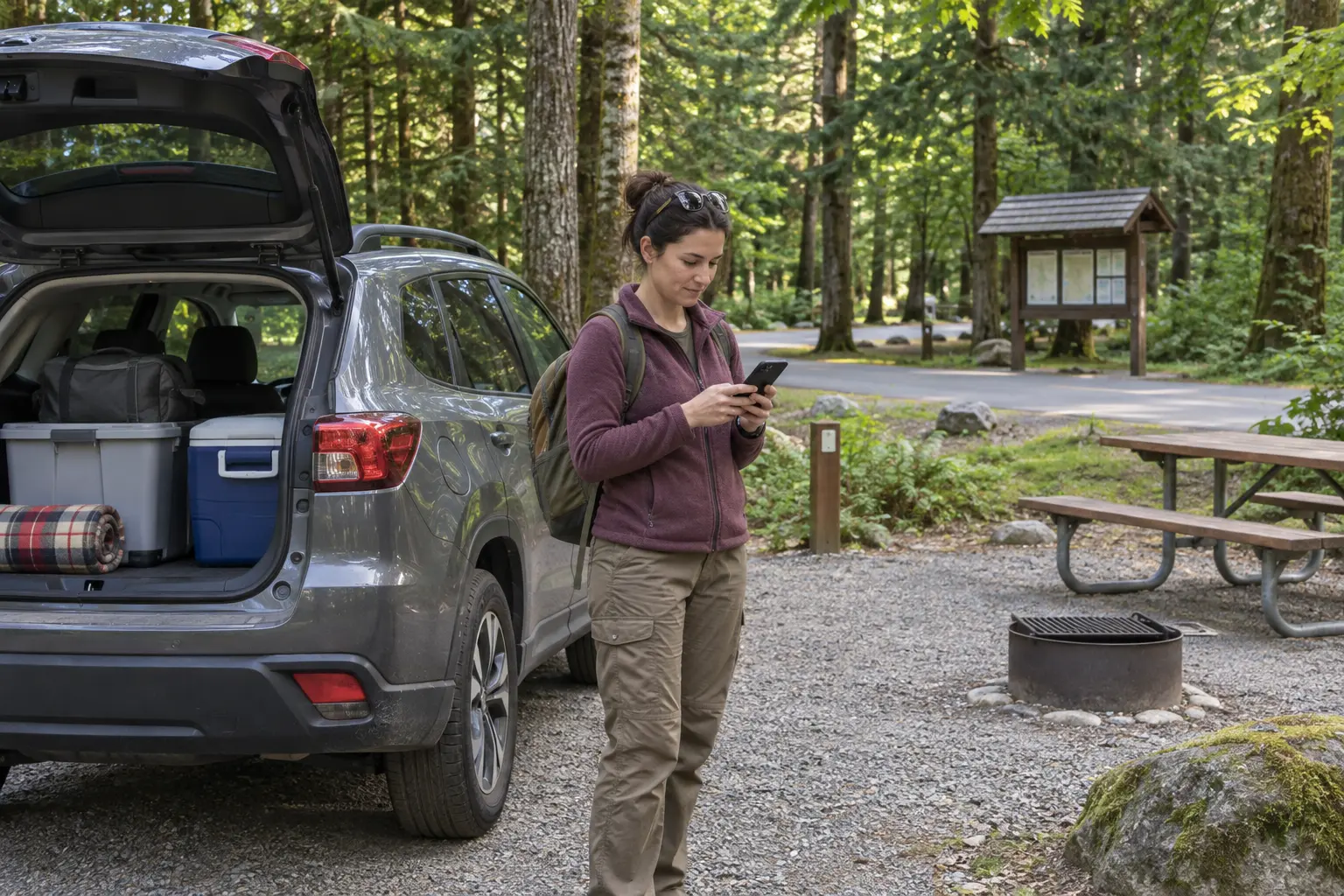
A campsite reservation is not automatically permission to sleep in your car. Before paying, check the exact site—not just the campground—for vehicle access, driveway fit and an explicit rule that allows your planned sleeping arrangement. If the listing is silent or contradictory, ask the operator and keep the reply.
This is a U.S.-first guide. Federal campground examples show why the details matter, but rules also vary among state, county, municipal, tribal and private campgrounds. The operator responsible for your exact site has the final word.
The booking decision
| Reservation signal | What it proves | Action |
|---|---|---|
| Drive-in site and sufficient driveway | The vehicle can reach and fit the site | Continue checking the sleeping rule |
| Walk-in, hike-in, boat-in or group designation | The sleeping area may be separate from parking | Do not assume car sleeping is allowed |
| Explicit permission to sleep in a vehicle | Positive permission in that stated context | Save the rule and book if the other limits fit |
| Explicit prohibition | The planned car bed is not permitted | Choose another site |
| Silence or conflicting categories | Permission remains unresolved | Contact the operator before paying |
Text equivalent: Book only when the exact site fits the vehicle and its rules allow the planned sleeping arrangement; silence means ask, not assume.
Why “campsite” is not a complete answer
Two sites in the same campground can work differently. One may be a drive-in pad beside the sleeping area. Another may require campers to leave their vehicles in a separate lot and walk to the site. A reservation system may also ask what equipment you are bringing without explaining whether an ordinary passenger vehicle counts as an approved sleeping unit.
Official rules illustrate the variation. North Cascades National Park says visitors may sleep in a vehicle at a lawfully occupied designated campsite, but not at trailheads, dirt roads, parking lots or roadsides.[1] Yosemite likewise says sleeping in a vehicle is allowed only in a campsite—not in a parking lot or along a road.[2]
Those examples do not create a rule for every campground. They show why the exact location and its written terms matter.
First check: can the vehicle reach the sleeping site?
Start with the site type. Look for labels such as:
- Drive-in: The vehicle normally reaches a driveway or parking spur at the campsite.
- Walk-in: Parking and the sleeping area may be separated by a path.
- Hike-in or backcountry: The reserved accommodation is away from the vehicle.
- Boat-in: Access depends on water travel rather than a campsite driveway.
- Group site: Parking and sleeping rules may differ from those at individual sites.
A parking space near a walk-in site does not prove that overnight occupancy of the vehicle is allowed. Point Reyes National Seashore, for example, says there is no car or RV camping anywhere in the seashore; its reservable campgrounds are hike-in, bike-in or boat-in.[6] Permission to leave a vehicle overnight is not the same as permission to use it as the sleeping accommodation.
Second check: does the complete vehicle fit?
Read the driveway length, vehicle limit and permitted-equipment fields. Use the full length of the vehicle as it will be parked, including any attached carrier, open equipment or trailer that the operator tells you to include. Do not assume a generous campground-wide limit applies to every site.
North Cascades directs campers to the allowable-vehicle and driveway details for the specific Recreation.gov campsite.[1] Furnace Creek’s current listing similarly requires the complete vehicle-and-equipment combination to fit within the campsite driveway.[4]
Fit answers only one question: whether the vehicle can occupy the assigned space. It does not answer whether a person may sleep inside it.
Third check: find the sleeping rule
Open the exact site details, then read the campground’s “Need to Know” section, alerts, rules and park page. Search for direct language about:
- sleeping or camping in vehicles;
- overnight occupancy;
- walk-in, group or overflow parking;
- passenger vehicles, vans, camper vans and RVs;
- parking lots, trailheads, pullouts and roadsides.
Grand Teton National Park states that sleeping in vehicles is not allowed in pullouts, parking areas, picnic grounds or anywhere outside designated campgrounds.[3] That makes the location boundary decisive: being inside the park, or even in a place where parking is allowed, does not establish permission to stay overnight in the vehicle.
Do not treat “tent only” as a universal shorthand. The words may describe the equipment expected, the physical layout or a rule that differs by site. Furnace Creek separates drive-in and walk-in categories and says campers in specified walk-in and group sites may not sleep in vehicles.[4] Assateague’s current listing also prohibits sleeping in vehicles at walk-in and group sites while separately publishing vehicle limits.[5] A permitted parking vehicle can therefore fail the sleeping-permission test.
Do not game the equipment field
If a booking form offers “vehicle,” “camper van,” “tent” or another equipment category, choose the description that truthfully matches the planned setup. Do not select an inaccurate category merely because it makes the form accept the reservation.
Reservation fields can serve several purposes: assigning a suitable driveway, enforcing equipment restrictions or helping the campground understand what will occupy the site. A successful checkout is not evidence that every assumption behind the selection was correct.
If an ordinary car used as a bed does not fit the available labels, describe it plainly when contacting the operator: “I will arrive in a standard passenger car and plan to sleep inside it at the assigned site. Is that permitted at site X?”
When the listing is silent or contradictory
Ask before paying when possible. Contact the campground, park office, concessioner or private host responsible for the site. Include:
- the campground and exact site number;
- the site type shown in the reservation system;
- your vehicle type and total length;
- that you plan to sleep inside the vehicle;
- the dates, because seasonal rules or closures may apply.
Keep the written reply or note whom you spoke with and when. That record does not override a later closure or staff direction, but it reduces the chance that you and the operator interpreted a vague listing differently.
If you cannot resolve the conflict, choose a site with clear permission. A refundable reservation is still a poor substitute for knowing that the sleeping setup is allowed.
Dispersed camping uses a different check
There may be no reservable campsite at all on dispersed public land. The Bureau of Land Management says most BLM lands allow dispersed camping unless an area is closed or restricted, but rules vary by state and local area. Visitors must follow posted signs, check with the relevant office and keep vehicles on designated roads or trails unless otherwise authorized.[7]
Verify the exact land unit rather than relying on a general statement about the agency. Check current closures, stay limits, route restrictions, permits and local fire rules. Do not transfer a dispersed-camping rule to a nearby national park, trailhead, municipal lot or private road.
Recheck shortly before travel
Save the rule that supported the booking, then revisit the official listing and alerts before departure. Closures, construction, wildfire restrictions, seasonal access and campground operations can change after a reservation is made.
Once the permission and fit questions pass, assess the physical sleeping spot. Our guides to sleeping level on a sloped campsite and avoiding hazard trees above the car cover decisions that come after the location is lawful and suitable for the vehicle.
The useful booking rule is simple: access, fit and sleeping permission are three separate checks. Pass all three before treating the confirmation email as a place to make the car bed.
Sources
- National Park Service: North Cascades Frequently Asked Questions
- National Park Service: Yosemite Camping and Reservation Help
- National Park Service: Camping in Grand Teton
- Recreation.gov: Furnace Creek Campground
- Recreation.gov: Assateague Island National Seashore Campground
- Recreation.gov: Point Reyes National Seashore Campground
- Bureau of Land Management: Camping on Public Lands