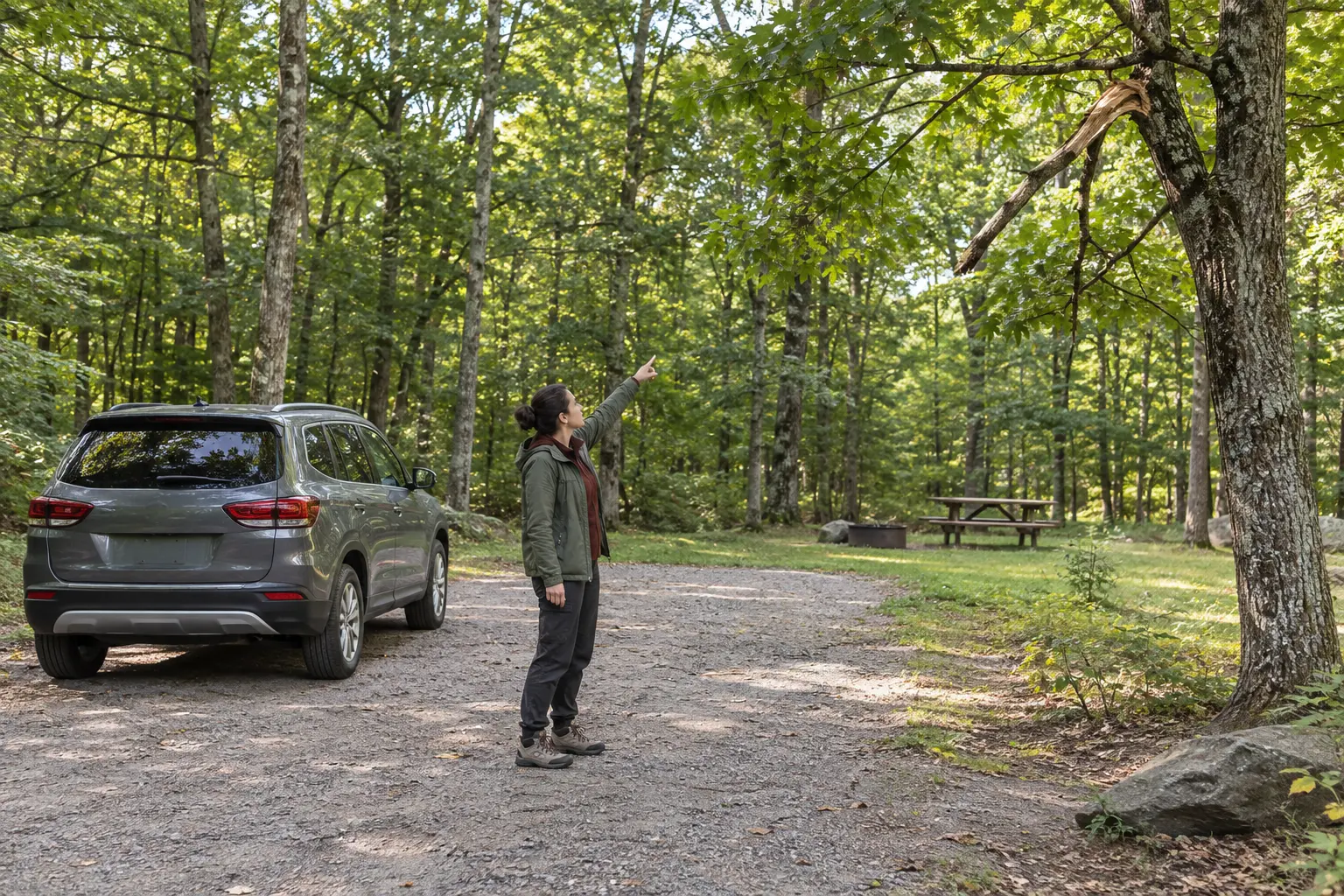
Before you unfold the mattress, look up and around the parking spot. If a dead, cracked, broken or hanging limb—or a leaning or visibly decayed tree—could reach your car, do not make the bed there. Move to a clearer spot or ask campground staff for another site.
A calm evening is not an all-clear. National Park Service guidance warns that live or dead trees and branches can fall even when there is no wind.[1] Your check cannot certify that every tree is sound. It can keep an obvious overhead hazard from becoming part of the sleeping setup.
The short decision
| What you see | What to do | Why |
|---|---|---|
| A dead, cracked, broken or hanging limb—or a leaning or decayed tree—that could reach the car | Move before making the bed | The sleeping position is inside a plausible fall zone |
| No obvious defect, but the site still feels uncertain | Ask the host or ranger, or choose a clearer alternative | A visual check cannot certify a tree as safe |
| Wind, snow loading, recent damage, an official warning or a closure | Follow the alert and relocate as directed | Conditions and official restrictions can change the risk |
Text equivalent: If a suspect tree or branch could reach the car, the sleeping spot fails.
Why the car roof is not the plan
A vehicle may feel more substantial than a tent, but its roof is not a substitute for choosing the site carefully. USDA Forest Service guidance tells campers to place vehicles and tents where a falling tree cannot strike them.[2] The useful question is therefore not “Would the roof protect me?” It is “Can I keep the sleeping vehicle out of the possible path?”
Do not turn that question into an invented distance formula. Tree height, lean, broken tops, neighboring limbs and terrain differ from site to site. There is no universal number in the cited guidance that makes every parking position safe. If the reach is uncertain, a clearer site is the simpler answer.
Do the scan before the car becomes a bedroom
Walk the pad before unloading. Look from more than one angle; the view through the windshield or open hatch can hide a broken top or a limb directly above the roof.
Check four areas:
- Overhead: Look for dead, cracked, broken or hanging branches and broken tops.
- Trunks: Notice trees that are dead or leaning toward the parking area, as well as large cracks, cavities or obvious damage.
- Bases: Look for visible rot, conks or mushrooms, scars and cracked or peeling bark. These are warning signs to avoid, not a checklist for diagnosing the tree.
- Surroundings: Downed limbs, dead trees and woodpecker activity can be reasons to take a closer look at the area, according to Forest Service guidance.[2]
The National Park Service similarly advises visitors not to linger or camp beneath dead, cracked, broken or hanging branches, or beneath trees showing signs such as basal rot and cracked or peeling bark.[1] You do not need to identify the tree species or decide why the damage occurred. You only need to notice that the exposure is avoidable.
Think beyond the painted parking pad
A suspect tree does not become irrelevant because its trunk stands beyond a campsite marker. Look at what could reach the vehicle, including limbs extending from neighboring trees. The marked pad organizes the campsite; it does not certify the overhead space.
This is the same reason site selection needs more than one check. A spot can be level but still have an overhead problem. Use our routine for sleeping level on a sloped campsite only after the broader location passes the safety scan. Also keep water movement in mind with the flash-flood sleeping-spot guide.
Recheck when conditions change
The first scan is not permanent. Wind and snow loading can increase concern around compromised trees, according to Forest Service guidance.[2] Recent fire damage, fresh fallen limbs, newly visible cracks, a posted warning or a closure also justify a new decision.
After a windy afternoon or an overnight weather change, make another quick look before settling in. Our car-camping thunderstorm guide covers the wider storm decision. Hazard-tree awareness is not limited to storms, however: official park guidance says branches and trees may fall in calm conditions too.[3]
Follow current notices from the campground or land manager. Local drought, insects, fire history and maintenance can change which areas are open and what staff want visitors to do. A general article cannot replace a closure or a site-specific instruction.
At a developed campground: ask, report or move
If a limb or tree concerns you, contact the campground host, ranger or other responsible staff. Describe its location and what you can see. The National Park Service tells visitors to report close calls involving tree hazards, while Forest Service work on campground trees relies on trained personnel and contractors.[1][5]
Do not climb the tree, cut a limb, pull on damaged wood or attempt your own technical assessment. Those actions are not necessary to make the car-camping decision. The practical choices are to ask for help or move the vehicle.
If you are in a dispersed area without staff, choose the clearer alternative. Also consider whether the access road could be blocked by a fallen tree; Forest Service guidance recommends thinking about an exit route that is less likely to be obstructed.[2]
If you hear cracking or snapping
If cracking, snapping or falling wood begins, leave the area promptly. NPS guidance says to get away when those sounds are heard.[1] Do not stand beneath the tree to study it, and do not stop inside the fall zone to retrieve bedding or reorganize gear.
Once you are clear, follow staff or emergency instructions appropriate to the situation. Report the location so other visitors are not left to discover the same hazard.
What this check can—and cannot—do
A pre-bed scan is a filter for obvious exposure, not a guarantee. Trees are living structures, and failures are not fully predictable. California State Parks, for example, warns locally that mature limbs can sometimes drop without an obvious trigger.[6] That localized warning should not be treated as an incident-rate claim for every forest. It reinforces the honest limit of a visual check.
Your goal is modest and useful: notice clear warning signs, keep the car outside an obvious fall path, obey alerts, and ask or move when uncertain. Do that before the seats fold, the windows are covered and the parking spot starts to feel permanent.
Sources
- National Park Service: Tree Hazards — Sequoia & Kings Canyon National Parks
- USDA Forest Service: Know Before You Go — Hazard Trees
- National Park Service: Camping Safety — Sequoia & Kings Canyon National Parks
- National Park Service: Safety and Hazard Tree Safety — Chesapeake & Ohio Canal
- USDA Forest Service Research: Going Out on a Limb
- California State Parks: Caswell Memorial State Park — Summer Branch Drop