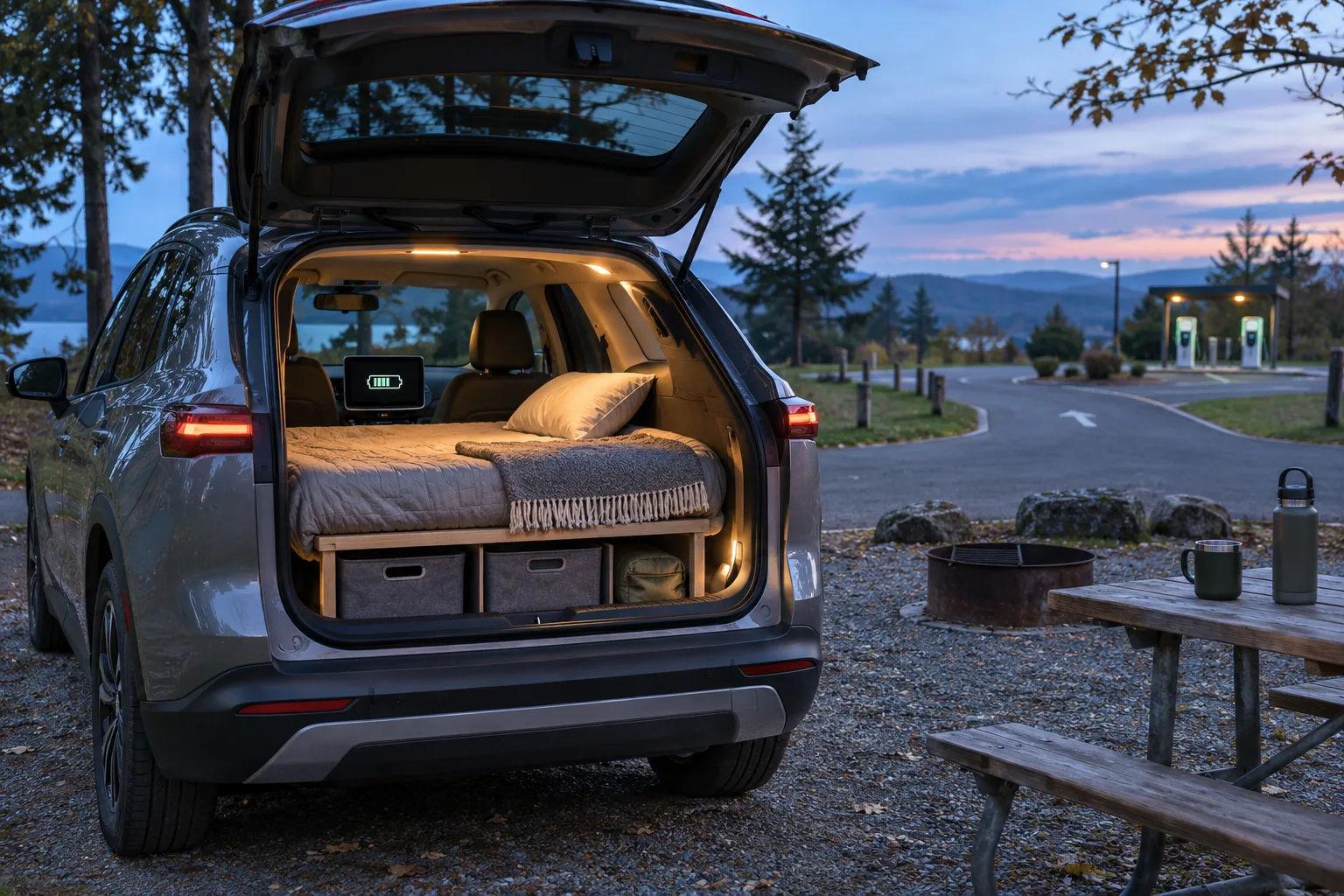
An electric car can keep its cabin comfortable without idling an engine, but that does not make an overnight stay automatic. The same parked mode that runs climate may change the locks, alarm, lights, outlets and how quickly the vehicle uses its driving battery.
Before making the bed, verify five things for your exact battery-electric vehicle: the mode, the energy reserve, the security behavior, the powered accessories and the morning route to a charger. Do not copy an overnight percentage from another owner. Weather, cabin setting, battery condition, vehicle software and the next drive all change the answer.
The five-check EV bedtime decision
| Check | Exact question | Stop condition |
|---|---|---|
| 1. Mode | Which current manual-approved mode keeps climate on while the vehicle is parked, and how do you activate and end it? | The mode, prerequisites or shutoff behavior cannot be confirmed for this model year and software version. |
| 2. Reserve | Does the displayed charge leave a conservative margin for parked climate, temperature effects, the morning drive and an alternate charger? | The plan depends on an anecdotal drain figure, an optimistic arrival estimate or one charger with no fallback. |
| 3. Security | What happens to walk-away locking, proximity locking, the alarm, cameras, exterior lights and sounds? | You cannot lock and exit from inside as expected, or the mode creates an unacceptable security or campsite disturbance. |
| 4. Accessories | Which USB, low-voltage or AC outlets stay on, for how long, and does that keep the vehicle awake? | An unneeded load or unknown timer can consume energy that the departure plan needs. |
| 5. Exit | Can you end the mode, restore normal ride or vehicle settings, drive away and reach a usable charger if the preferred one fails? | The morning procedure is untested, the route is weather-sensitive without margin, or the backup charger is impractical. |
Text version: confirm the exact parked-climate mode first. Build a driving reserve from the route and conditions rather than another owner’s percentage. Check how the mode changes locks, alarms, lights and cameras. Turn off accessories you do not need. Finally, know how to return the vehicle to driving condition and reach an alternate charger. One unclear check means use a different overnight plan.
Start with the current manual, not the mode’s nickname
“Camp,” “Stay on” and “Utility” sound similar, but they do not describe one standard feature. The activation steps and side effects differ among vehicles, years and software versions. Read the in-car manual or the manufacturer’s current manual for your exact vehicle before the trip, then confirm the same controls in the parked car.
Tesla’s current Model Y manual says Camp Mode is available in Park, maintains cabin temperature and powers USB and low-voltage outlets. It also says Sentry Mode and the vehicle alarm are disabled and Walk-Away Door Lock is inactive while Camp Mode is active. That is a Model Y example, not a rule for every EV.
Rivian’s published camping guidance separates “Stay on,” which keeps the vehicle awake with climate and other features available, from “Stay off,” which turns off outlets and most features. Rivian also offers outlet timers and a Camp Courtesy setting that changes lights, sounds, proximity locking and climate behavior. Because the public explainer dates from 2022, use the current owner guide and vehicle software as the final authority.
A 2026 U.S. Kia manual provides another distinct example: Utility Mode uses the high-voltage battery for climate, lights and other convenience features, requires the vehicle to be in READY and Park with a functioning electronic parking brake, and prevents shifting out of Park while active. Do not assume the same sequence applies to another Kia, year or market.
Build a departure reserve, not a universal bedtime percentage
Parked climate uses energy from the same high-voltage battery that provides driving range. The U.S. Department of Energy notes that range varies with conditions and that heating or cooling the cabin consumes energy, with temperature adding further uncertainty. A percentage that worked for someone else in mild weather is not a planning rule for your car on a colder or hotter night.
Work backward from the morning drive:
- Check the vehicle’s current route estimate to the intended charger.
- Add a reachable alternate charger that is compatible, accessible at your departure time and not dependent on the same road or site.
- Account for forecast temperature, elevation, wind, detours and the possibility that charging speed or availability differs from the plan.
- Set a personal departure trigger with enough margin to stop climate and leave early.
In cold weather, the Department of Energy recommends preconditioning while the vehicle is still connected to charging when possible and beginning travel with adequate charge. That can reduce the amount of trip energy used to warm the cabin and battery, but it does not replace an overnight reserve calculation.
Watch the vehicle’s own display or app during the evening and again before sleep. Treat alerts, unexpected consumption or a falling route margin as reasons to stop the overnight plan, not as invitations to calculate a more optimistic number.
Test locks, alarms and the inside exit before bed
Configure the parked mode, close the doors, then test the exact sequence you expect to use at night: lock from inside, unlock without an alarm surprise and open the chosen exit. Check whether exterior lights, welcome sounds or proximity locking will disturb nearby campers. Keep the key or phone reachable, but do not let loose bedding press controls or block a door handle.
This mode-specific check complements the broader key-fob, alarm and exit test for sleeping in a car. The EV question is narrower: did parked climate change any of those behaviors?
Turn off loads that do not help you sleep
USB ports, low-voltage sockets, AC outlets, displays, audio, cameras and wireless charging may follow different timers. Some remain available only while the vehicle is awake; others can be scheduled. Confirm each needed load in the current manual and switch off the rest.
Do not use an unverified outlet setup for a critical medical device. Follow the device maker’s power and backup instructions, and test the complete system before a remote trip. The vehicle’s climate mode is not a guarantee that every accessory will remain powered all night.
Keep EV and combustion-engine advice separate
This article applies only to battery-electric vehicles. A plug-in hybrid may start its combustion engine under some conditions, and an ordinary gasoline or diesel vehicle creates exhaust when running. If your vehicle can burn fuel, use the separate guidance on why you should not run the car for heat while sleeping. Never assume a silent start is impossible.
Even a battery-electric vehicle still needs a suitable location. Confirm that sleeping in the vehicle is allowed, that the site permits any charging arrangement, and that the cable does not cross a walkway or create another hazard. A climate feature does not grant camping or charging permission.
A five-minute morning reset
- Check the cabin and route. Review the charge, weather, road conditions and both charger options.
- End the parked mode as documented. Do not assume shifting will restore every setting.
- Restore driving configuration. Confirm normal ride height, mirrors, lights, driver-assistance settings and outlet state where relevant.
- Clear the driver’s area. Remove window covers, secure bedding and keep pedals and controls unobstructed.
- Leave while the margin is comfortable. If the reserve or route has worsened, reduce loads and depart for the safer charging option.
The useful question is not “How little battery can I get away with?” It is “Can this exact vehicle keep the cabin usable and still leave with a comfortable, verified route?” If the manual, reserve or morning plan is uncertain, choose conditions in which sleeping without parked climate is safe, or use a site with dependable charging and another safe option.