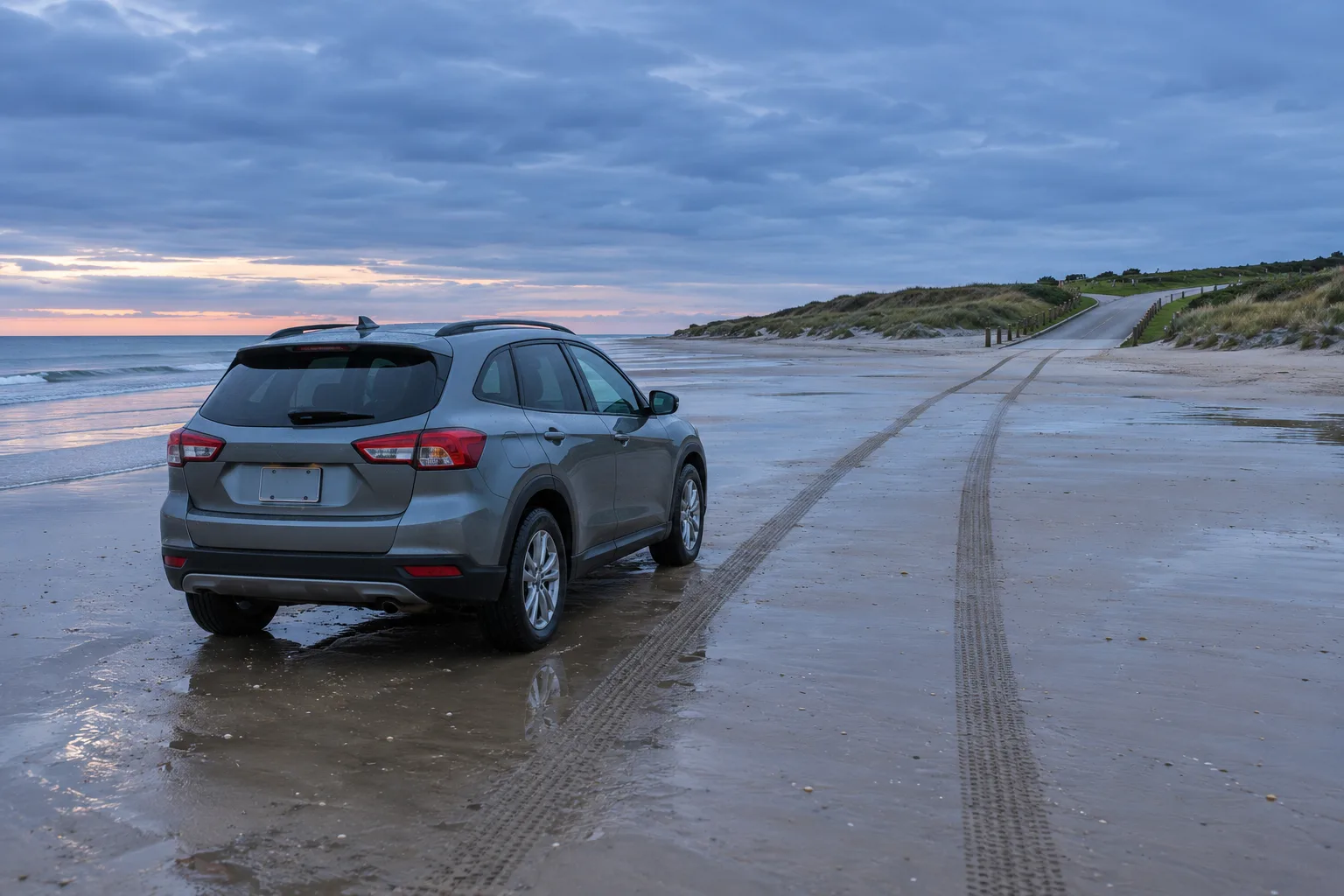
A drive-on beach can look spacious at sunset and become a narrow strip—or lose its usable exit—before morning. A tide time alone does not tell you whether sleeping there is legal, whether wind will push water above the prediction, or whether your car can handle the route.
Before making the bed, pass four separate checks: legal overnight use, water conditions, a lawful exit, and vehicle suitability. If any answer is unclear, move to a developed campground or another legal inland option. The ocean is a poor place to “see how it goes.”
The four-gate beach bedtime check
| Gate | Verify before sleeping | Stop condition |
|---|---|---|
| 1. Legal | Overnight vehicle camping is allowed in this exact zone, at these hours, with this vehicle and any required permit. | Ordinary cars do not qualify, overnight vehicles are prohibited, or a current closure applies. |
| 2. Water | Check the nearest appropriate official tide prediction together with the weather forecast, coastal alerts, observed water levels where available, and the land manager’s current guidance. | Any source indicates that the site or access may flood or close, or the combined picture remains uncertain. |
| 3. Route | Current manager status, tide and weather information support an open authorized route to firm ground through the relevant high tide, with a lawful alternate identified. | The only exit can be cut off, the alternate is closed or illegal, or conditions cannot be confirmed. |
| 4. Vehicle | Your car, drivetrain, clearance and recovery equipment meet today’s published substrate and access rules. | The vehicle or equipment does not meet the site’s current requirements. |
Text version: first confirm that your exact vehicle may legally stay overnight. Then check tide information together with weather and coastal conditions. Check that current manager status, tide and weather information support an open authorized route out, and identify a lawful alternate. Finally, match the vehicle and recovery gear to the land manager’s current rules. One failed or uncertain gate means sleep somewhere else.
Gate 1: Confirm that this exact car may stay overnight
Public beach access, permission to drive on sand and permission to camp overnight are three different things. A beach can allow daytime vehicles while prohibiting overnight parking. An off-road permit can grant access without granting a camping spot. Seasonal hours, wildlife closures and emergency restrictions can also change the answer after you planned the trip.
Read the current page for the exact beach, zone and date. Check:
- whether overnight vehicle camping is allowed;
- whether reservations, permits or decals are required;
- whether the access ramp closes at night or seasonally;
- whether the rule applies to an ordinary car, SUV or minivan; and
- whether alerts or temporary closures supersede the normal rule.
Cape Cod National Seashore is a useful warning against assumptions: overnight camping on its off-road corridor is limited to qualifying self-contained vehicles in designated areas with a permit. Its definition requires facilities and permanent holding tanks that a typical unconverted everyday car does not have. “Vehicles allowed” does not automatically mean “your vehicle may sleep here.”
If you are still choosing a conventional site, use the same exact-rule approach in Before You Book: Check Whether the Campsite Allows Sleeping in Your Car.
Gate 2: Read the tide with the weather—not by itself
Start with the nearest appropriate official tide station and confirm the station, date, time zone, high-tide time and predicted height. Then open the weather forecast, coastal-flood or surf information, observed water levels where available, and the land manager’s current conditions page.
NOAA explains why the second step matters: tide predictions describe astronomical tides. They do not predict the short-term effects of wind, rain, freshwater runoff and other weather. Accuracy also varies by location. On a shallow coast or in an estuary, actual water levels and timing can differ materially from the table.
Local thresholds must stay local. Padre Island National Seashore says that at Padre Island, a predicted high tide of 1.5 feet or more can reach the dunes and cover parts of the beach, with wind or storms increasing the effect. That is a park-specific operating warning, not a safe-or-unsafe number for another beach.
Do not turn a line of driftwood, seaweed or damp sand into a universal parking boundary. It may show where water reached previously; it does not prove where water will reach tonight or whether parking there is allowed.
Gate 3: Plan the exit before choosing the sleeping spot
The critical question is not only “Will water reach the car?” It is also “Will I still have a legal, drivable route to firm ground?” A campsite can remain dry while the low section near the ramp floods first.
Trace the entire authorized route before dark. Note the next relevant high tide, the narrowest section of beach, ramp hours, gates, wildlife closures and any low crossing. Identify a lawful alternate route or move inland. A route across dunes, vegetation, tidal flats or a closed area is not an escape plan.
Cape Lookout National Seashore warns that some beach sections become impassable at high tide or in bad weather and that the beach can be completely different from a previous visit. Current ranger information matters more than a memory, an old trip report or tire tracks leading ahead.
If water covers the road or a barrier closes it, stop. Do not drive around the barrier or enter floodwater; the surface underneath may be washed out. The same rule applies to inland storm routes, covered in Flash-Flood Risk While Car Camping: Choose the Sleeping Spot Before the Storm.
Gate 4: Match the car to today’s sand and rules
All-wheel drive is not a permission slip, and it does not make an everyday crossover immune to deep sand, hidden ruts or a rising tide. Ground clearance, tire type, vehicle weight, sand moisture and the driver’s experience all matter. Conditions can also change between arrival and departure.
Follow the land manager’s current vehicle, drivetrain, tire-pressure and equipment guidance for that beach. Do not copy a pressure number from another park: published recommendations vary because surfaces, vehicles and operating rules vary. If local guidance calls for reduced tire pressure, bring an accurate gauge and a reliable way to reinflate before returning to pavement. Low tire pressure can affect braking and handling on pavement.
A site-specific recovery kit may include a shovel, suitable jack support, traction boards, tire gauge, compressor, full-size spare and an appropriately rated recovery device. Gear does not make a marginal route acceptable. If the manager recommends a different vehicle type or warns that current conditions exceed your car’s capability, take the inland option.
A five-minute check before bed
- Refresh the land-manager page. Look for closures, changed access hours and coastal-condition notices.
- Refresh water and weather information. Check the correct official tide station, forecast, coastal alerts and observed water where available.
- Look at the route, not just the campsite. Walk only where permitted and confirm that the authorized exit is still usable.
- Set a conservative departure trigger. Follow any land-manager cutoff and leave before the authorized route begins to narrow; leave sooner if the forecast worsens, an alert appears or a ranger directs you out. If you cannot set a reliable trigger from official guidance and current conditions, do not stay overnight.
- Keep departure simple. Put keys, shoes, headlamp and phone within reach; keep the driver’s seat and footwell clear; secure loose gear; and retain enough fuel or charge to reach firm ground.
Cell service may be weak on remote beaches. Tell someone where you are going and when you expect to return. Save essential rules and maps for offline use, but refresh live conditions whenever service is available.
Leave while the route is still easy
Check conditions again before moving in the morning. A lower waterline at the car does not prove the ramp or a distant low section is clear. If the usable lane is narrowing, weather is worsening or the manager is preparing a closure, depart early.
The best beach-car-camping decision is sometimes a quiet night inland. You are not giving up the experience; you are keeping one uncertain tide, rule or sand condition from becoming a vehicle recovery—or an emergency.
Sources
- NOAA Tides and Currents: Frequently Asked Questions
- NOAA Tides and Currents
- Padre Island National Seashore: Driving Down Island
- Cape Lookout National Seashore: Tips for Beach Driving
- Cape Cod National Seashore: Self-Contained-Vehicle Camping
- Cape Hatteras National Seashore: Off-Road Vehicle FAQ
- National Weather Service: Turn Around, Don’t Drown