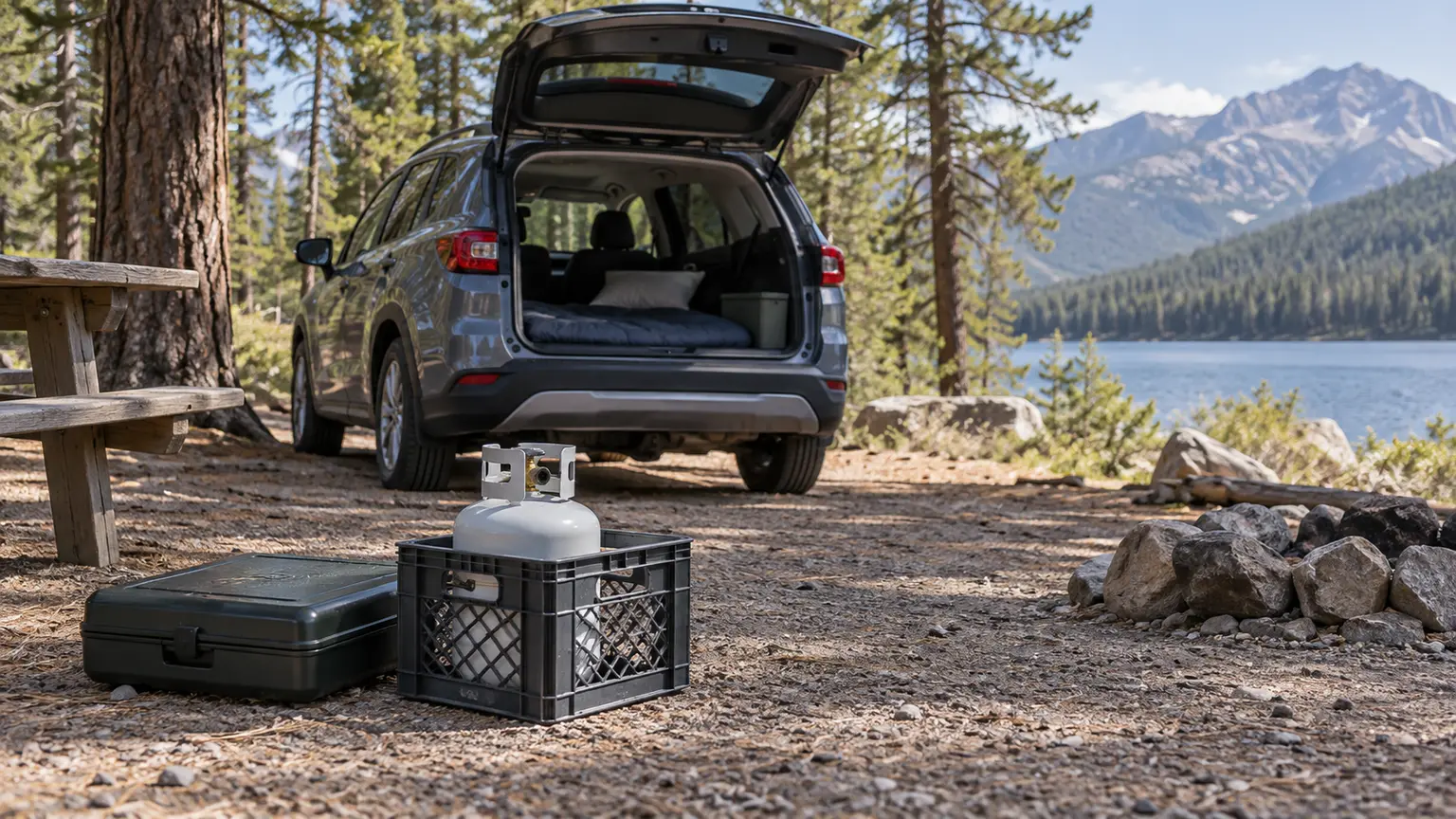
The short answer: use the car only for the necessary trip to camp. A propane cylinder should not turn your cabin, trunk or sleeping area into a fuel locker. Transport a sound cylinder upright and immobilized, unload it promptly at camp, and keep it outdoors in a location allowed by the campground and the cylinder instructions.
That handoff matters more in an everyday car than it does in a pickup with a separate bed. The same cargo space that carries your stove at noon may become your bedroom after dark. Decide where the cylinder will spend the night before you load the car. If the destination offers no source-compliant outdoor location, change the meal plan instead of improvising inside the vehicle.
Plan the cylinder’s whole trip, not just the drive
U.S. consumer guidance is consistent on the basics. The Propane Education & Research Council (PERC) says portable cylinders should stay upright and secured against falling, shifting or rolling. The valve should be closed when the cylinder is not connected or in use, and a leaking cylinder should never be transported. PERC also advises avoiding the passenger area when possible, driving directly to the destination and removing cylinders immediately on arrival.
The U.S. Consumer Product Safety Commission likewise says to transport containers upright and securely, and never leave a filled container in a hot car or trunk. Heat raises pressure; a relief valve may open and release gas. In an enclosed vehicle, escaped gas can create a flammable atmosphere.
Those instructions make the car a transport leg, not a storage solution. Cracking a window does not turn prolonged in-car storage into a safe plan. Nor does carrying a gas detector cancel the need to follow the cylinder maker’s label and transport guidance.
Where the cylinder goes at each stage
| Trip stage | Cylinder decision | Why | Stop condition |
|---|---|---|---|
| Driving to camp | Valve closed and disconnected as the instructions require; cylinder upright, secured and ventilated during the direct trip. Avoid the passenger area when possible. | Prevents rolling or damage and limits time in an enclosed vehicle. | Do not transport a damaged or leaking cylinder. |
| Parked at camp | Unload promptly. Keep it outdoors, upright and stable, away from ignition and added heat, where site rules allow. | The cabin and trunk are enclosed spaces where released gas can accumulate. | If no compliant outdoor location exists, change the cooking plan. |
| Sleeping | Keep it out of the car, trunk, tent and other enclosed sleeping spaces. | Your sleeping compartment should not double as overnight fuel storage. | A cracked window or detector is not permission to store it inside. |
| Suspected leak | Avoid switches, engine starts, flame and sparks; move people away and call trained help from a safe place. | Electrical devices and ignition sources can spark. | Do not test, tighten, cool or move a suspect cylinder in the sleeping area. |
Text version: carry only a sound cylinder for the necessary direct trip, unload it when you arrive, keep it outside while you sleep, and leave the area rather than investigating if a leak is suspected.
Before you leave: inspect the plan, not just the gear
- Read the exact cylinder label and appliance manual. Connection, disconnection, cap and temperature instructions differ. A Worthington/Bernzomatic manual, for example, tells users of the documented product to detach it for storage, keep it in a well-ventilated area and not expose it above 120°F. That figure belongs to that product document; it is not a universal limit for every cylinder.
- Reject damage or leakage. Do not load a cylinder that is leaking or visibly compromised. Do not plan to “watch it” during the drive.
- Secure it upright. Use a stable, suitable restraint so it cannot tip, roll or become a projectile. Do not depend on a sleeping bag or loose tote to hold it in place.
- Choose the outdoor overnight location now. Check campground and fire restrictions. The correct location depends on the cylinder instructions, site rules, terrain, heat and ignition sources; there is no universal exterior box or improvised mount to recommend.
- Pack a fallback meal. If you arrive and cannot store or use the fuel correctly, no-cook food is a better backup than moving the cylinder into your bed area.
At camp: unload before the car becomes a bedroom
Unload the cylinder promptly rather than leaving it in the cabin while you set up everything else. Keep it outdoors, upright and stable, away from flames, sparks and added heat. Follow the campground’s current restrictions as well as the cylinder and appliance instructions.
This article is about carrying and storing fuel. For the separate question of where to operate the stove, see Can You Use a Camp Stove Inside Your Car? Build an Outside Cooking Plan. The short version is the same: cooking belongs outside, not in the vehicle.
When cooking is over, disconnect and close the system exactly as its instructions require. Do not assume a connected appliance is an acceptable overnight storage arrangement. Keep the sleeping car free of the cylinder, including the trunk or under-bed cargo well.
Do not use quantity limits as a packing target
PERC publishes U.S. limits for cylinders in enclosed vehicles, but those are upper-limit regulatory context—not a recommended car-camping load. State and local rules may be stricter, and a campground may impose additional restrictions. Carry the minimum your actual plan requires, subject to the product instructions and applicable rules.
Outside the United States, use local guidance. The Canadian Propane Association emphasizes disconnecting and capping or plugging outlets, carrying cylinders upright, securing them against tipping, ventilating the necessary transport leg and not leaving cylinders in a parked closed vehicle. UK government guidance for goods vehicles similarly calls for upright, restrained LPG containers and proper cargo-space ventilation. That UK document is not private-car law, but the handling themes align: upright, secured, ventilated transport followed by prompt removal.
If something seems wrong
PERC lists propane odor, hissing, a visible cloud or flames among possible signs of a leak. Odor is not a perfect warning system, so the absence of a smell does not prove everything is safe. Likewise, a detector can add a warning layer but does not make improper transport or storage acceptable.
If a leak is suspected, focus on people, distance and trained help. Do not start the vehicle, touch electrical switches or create an ignition source. Get everyone away. From a safe location, call 911 or the fire department when there is immediate danger, or contact the propane supplier as directed. Do not attempt an indoor leak test or improvise a repair beside your sleeping setup.
The one-rule summary
Your car may carry the cylinder directly to camp, but it should not store the cylinder at camp or shelter it while you sleep. Secure it correctly for the trip, unload it promptly, keep it outdoors under the applicable instructions and rules, and have a no-cook fallback when the site cannot support that plan.
Sources
- Propane Education & Research Council: Safety Guide for Portable Propane Cylinders
- Propane Education & Research Council: Safety Guide for Propane Users
- U.S. Consumer Product Safety Commission: LP-gas transport and grilling safety
- Worthington/Bernzomatic fuel-gauge product manual
- Canadian Propane Association: Handling and Transporting Propane Cylinders
- UK government: carrying gas cylinders and LPG containers in goods vehicles