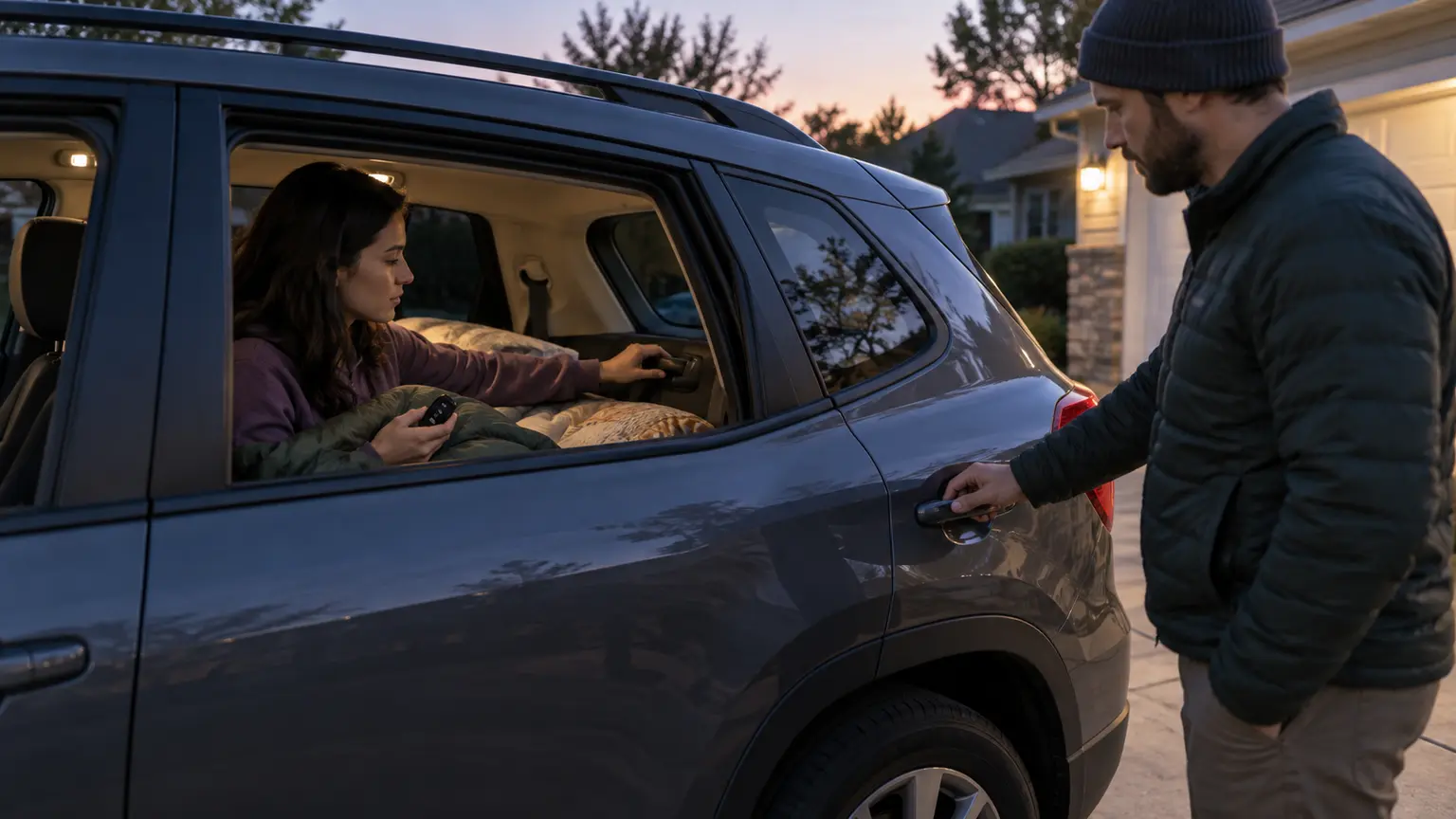
Locking the car before sleep sounds simple. With a smart key, proximity unlock, interior alarm sensors and rear child locks, it may not be. A dashboard lock icon does not tell you whether an outside handle will respond to a key inside the cabin, whether normal movement will set off the alarm, or whether your planned rear exit opens from the bed.
There is no universal button sequence. The useful answer is a short test with your exact car, its current settings and its owner’s manual—done at home before the mattress and bags turn a small inconvenience into a midnight problem.
Why a generic smart-key answer can be wrong
Smart-key behavior can change by market, model year, trim, software, settings and the way the car is locked. For example, the US 2026 Hyundai Ioniq 5 manual describes exterior-handle locking restrictions when the Smart Key is detected inside, plus configurable approach-unlock and two-press-unlock behavior. That is useful evidence that the details matter; it is not a sequence for a Toyota, Subaru, Ford or even another Hyundai model year.
Manufacturer-documented key-saving modes add another variable. Toyota’s RAV4 manual OM42809U and Subaru’s MSA5M2103B owner’s manual each document a way to reduce electronic-key activity. The exact activation and recovery procedures are vehicle-specific. Copying a forum sequence from a different car could leave you unable to use the function you expected in the dark.
Start with the manual sections for smart or intelligent access, door locks, theft alarm or interior monitoring, child safety locks, and the mechanical key. If the manual is unclear, ask the manufacturer or dealer about the exact model and market. Do not defeat a latch, sensor or alarm component.
Run the five-minute driveway lock-and-exit test
Park safely at home, keep another adult outside, and build the sleeping setup exactly as you intend to use it. Test every step without the engine running. The second adult matters: they can try the exterior handles, observe the lights and alarm, and help if the test exposes a problem.
The five-minute driveway lock-and-exit test
| Test | Controlled action | Pass condition | If it fails |
|---|---|---|---|
| Outside handle | One adult stays inside with the key; the other tries each outside handle. | The doors remain in the state the exact manual predicts. | Stop and check the manual, locking method and settings. |
| Interior exit | From the finished bed, open the planned door without moving heavy gear. | The handle and path work immediately. | Move the gear or choose and test another exit. |
| Child lock | Try every rear door from inside. | Any door counted as an exit opens from inside. | Change the supported child-lock setting when appropriate, or do not count that door. |
| Alarm | Lock by the intended method and move normally inside. | No unwanted alarm, or a documented occupant mode works as described. | Use only the manual’s supported setting; do not improvise. |
| Key recovery | Locate the mechanical key and restore normal fob operation after any supported power-saving mode in the dark. | You can do both without searching or dismantling the bed. | Practise again and assign a fixed reachable key location. |
All five checks need to pass on the actual vehicle. A successful lock test alone is not enough if the mattress blocks the only working interior handle, or if the key is buried under a sleeping partner’s bag.
Check the alarm before the campsite checks it for you
Some vehicles can arm interior-motion sensors when locked. A Ford Transit Connect owner-manual page on full-guard and reduced-guard alarm settings, for example, distinguishes “full guard” from a “reduced guard” that disables interior sensors on the covered vehicle. Treat that as an example of why you must check your own manual—not as a setting name that every Ford or other make provides.
During the driveway test, sit up, turn over, reach for water and open the door the way you would at night. Confirm whether the intended locking method arms an alarm, whether a supported occupant mode is available, and whether the car resets that choice after the next ignition cycle. Never assume that silence during one brief attempt proves the setting will persist.
Do not count a child-locked rear door as an exit
Rear child safety locks are easy to overlook when the back seat becomes a bed. NHTSA’s child-safety guide explains that a rear door with its child lock engaged cannot be opened from inside and directs owners to the vehicle manual for fitted features. If your sleeping layout depends on a rear side door, test it from the inside after the bed is built.
Keep at least one tested route free of storage tubs, shoes, window-cover straps and bedding. Make sure both sleepers can reach its handle. The National Park Service’s RV fire-safety guidance recommends identifying and practising escape routes; an ordinary passenger car is not an RV, but the planning principle still applies. Practise the route rather than merely naming a door.
Give the key one reachable home
Choose a location that the sleeper can reach immediately but cannot accidentally press or lose in bedding. Keep it away from water and from metal objects that may make retrieval awkward. If the fob contains a mechanical key, practise removing it and using the correct physical lock before the trip.
A Faraday pouch is not a universal solution. It can change proximity behavior, and it can also hide the fob or disable a function you expected to use. If you choose any signal-blocking or manufacturer key-saving method, add it to the same driveway test: lock, exterior-handle check, alarm check, interior exit, key recovery and reactivation. Do not rely on a product claim as proof that the entire system works for your car.
Repeat the test when the setup changes
- Two sleepers: each person should be able to reach the key and operate the planned exit.
- Children: use age-appropriate restraints and supervision while travelling, and never leave a child unattended in a parked vehicle. Recheck every child-lock setting before treating a rear door as an exit.
- A dog: confirm that movement does not trigger an interior alarm and that the animal cannot step on an exposed switch. Never leave a pet unattended in unsafe temperatures.
- New window covers or storage: verify that straps and bins do not obstruct a handle, lock control or sightline needed for departure.
For the rest of the setup, use the first-night car-sleeping checklist. If privacy covers are part of the problem, compare the removable options in the window-cover guide. And if you plan to use accessories while parked, pair this routine with the starter-battery shutdown checklist.
The goal is modest but valuable: no surprises from the outside handle, the alarm, the child locks, the bed layout or the key itself. Five controlled minutes in the driveway can tell you far more than a confident answer written for somebody else’s car.