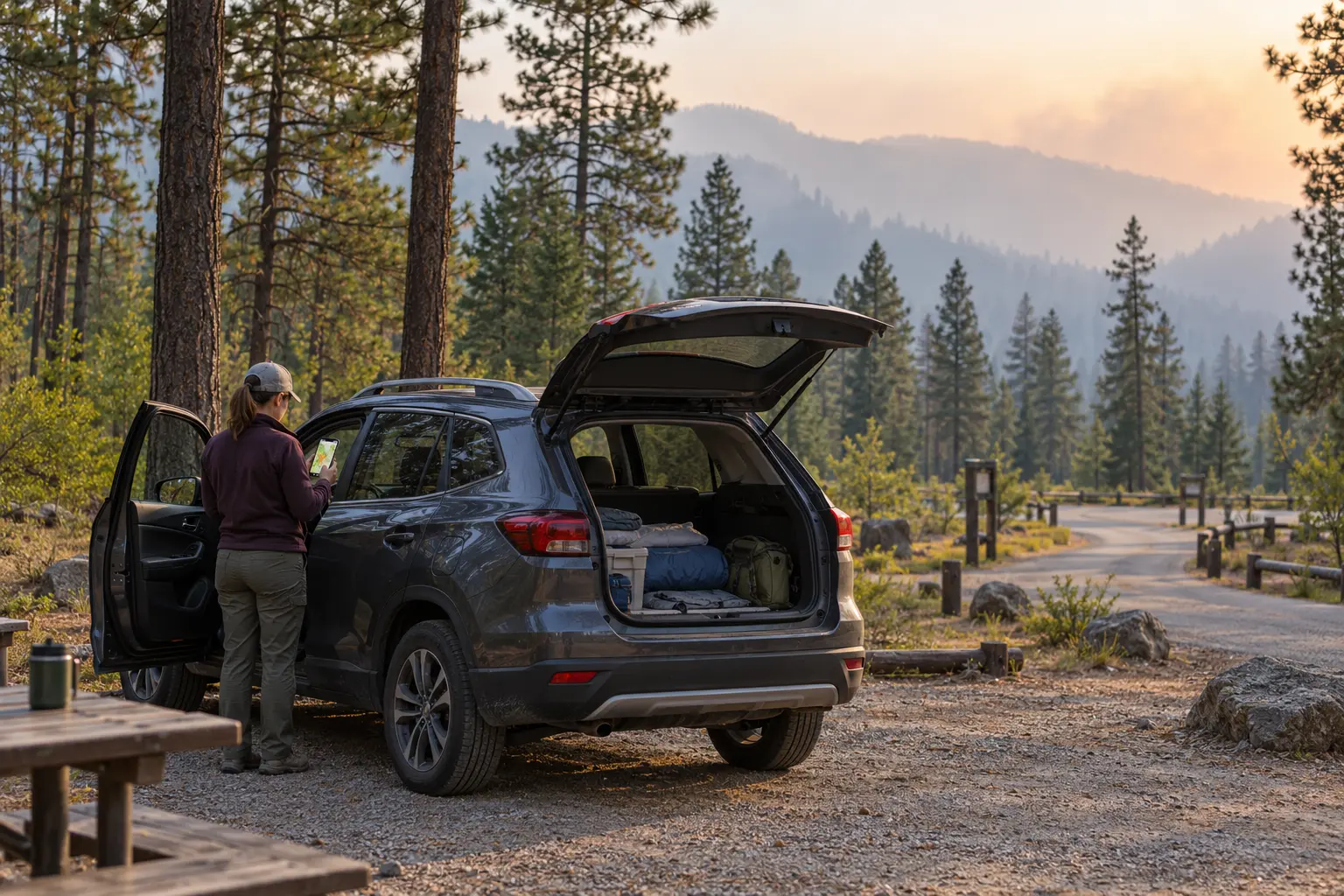
Wildfire smoke can turn a calm car-camping trip into a moving target. The right response depends on what is actually happening: an active-fire or evacuation threat, a smoke-only air-quality problem, or a short drive through smoky air. A hard-sided vehicle is useful transportation, but it is not a wildfire shelter or a guaranteed clean-air room.
Start with official alerts and access conditions, not the view from your campsite. If a land manager closes the area, emergency officials issue an evacuation instruction, or your route is becoming uncertain, leave. Do not wait for flames to appear.
The short answer
- Active fire, closure or evacuation: Follow officials and leave by the safest available route.
- Nearby fire, falling ash or worsening access: Relocate early, before traffic and visibility make the decision harder.
- Smoke without an immediate fire threat: Compare current conditions, the forecast, your own health risk and whether you can reach genuinely cleaner air.
- Driving through smoke: Close the windows, use the vehicle’s recirculation setting and slow down if visibility is reduced. Reassess after reaching cleaner air.
There is no single AQI number that makes every trip safe or unsafe. Air-quality categories describe increasing health concern; they do not replace local closures, evacuation directions, changing weather or personal medical advice.
A four-question smoke decision
Read these in order. The first “yes” gives you the next action.
1. Closure or instruction to evacuate?
Leave and follow officials. A car is your way out, not a place to wait out an approaching wildfire.
2. Nearby fire, falling ash or changing route access?
Relocate early. Keep more than one exit route in mind and avoid driving toward a visible fire to investigate.
3. Smoke only, with no immediate fire threat?
Check current and forecast conditions. Choose cleaner indoor shelter or another campsite if you cannot reduce exposure safely.
4. Driving through smoke?
Close windows and use recirculate. Slow down when visibility drops, then reassess after reaching cleaner air.
Text equivalent: Obey closures and evacuation instructions first; relocate early when fire or access conditions are deteriorating; use current air-quality information for a smoke-only decision; and use closed windows plus recirculation only as short-term travel guidance.
Check the hazard before you check the AQI
The National Park Service’s visitor fire guidance says to check closures and restrictions, know a route out and follow emergency personnel. It also warns visitors not to travel near a visible fire or park over tall, dry vegetation that a hot vehicle underbody could ignite.
That means the first question is not “How smoky is it?” It is “Is the campground still open and safely accessible?” Monitor local emergency alerts and the land manager responsible for the site. Know more than one route out where possible, and tell someone where you planned to camp. If officials tell you to evacuate, Ready.gov’s wildfire guidance is unambiguous: leave immediately.
Even without an order, deteriorating access can justify leaving. Falling ash, nearby fire activity, worsening visibility or a route that may close are reasons to relocate early rather than wait for certainty.
For smoke alone, compare “now” with “later”
In the United States, open the AirNow Fire and Smoke Map. It combines available PM2.5 readings, trends, smoke plumes, fire locations and outlooks. Conditions can change during the day, so a reading from breakfast may not describe bedtime.
AirNow also distinguishes the forecast AQI from its faster-changing NowCast. The forecast helps with planning; the NowCast better reflects rapidly changing smoke. Check both, then compare them with local alerts, wind, visibility, the reliability of your exit route and the conditions at a possible fallback location.
The official US AQI bands are:
| AQI | Official category | What it means for a campsite decision |
|---|---|---|
| 0–50 | Good | Still check fire restrictions and access. |
| 51–100 | Moderate | Consider personal susceptibility and changing conditions. |
| 101–150 | Unhealthy for Sensitive Groups | Sensitive campers need extra caution and a cleaner fallback. |
| 151–200 | Unhealthy | Exposure is a concern for everyone; relocating to cleaner air is the practical default. |
| 201–300 | Very Unhealthy | Seek genuinely cleaner air and follow local guidance. |
| 301+ | Hazardous | Emergency conditions: minimize exposure and follow official instructions. |
These categories come from the CDC’s wildfire-smoke safety guidance. They are communication bands, not universal camping cutoffs. Smoke can affect anyone, while children, pregnant people, and people with heart or lung disease or certain other conditions may need extra caution. If you have a health condition, use advice from your clinician rather than a generic internet threshold.
Why the parked car is not automatically clean-air shelter
The EPA advises travelers in heavy smoke to close the windows and use the vehicle’s air conditioner on recirculate. That can reduce exposure while traveling. It is not a recommendation to run the engine or climate system all night.
An ordinary parked car creates a three-way problem: closing the windows may reduce smoke entry, but sleeping bodies still need ventilation, and a closed car can become dangerously hot. A cabin filter or homemade window filter does not prove that the sleeping space has enough fresh air or effective smoke removal. If you cannot maintain safe temperature, ventilation and lower smoke exposure at the same time, the answer is a different campsite or genuinely cleaner indoor shelter.
This is the same hard boundary covered in our guides to hot-weather car camping and running a car for overnight heat: do not use an idling engine as overnight climate control.
If you must drive through smoke
The EPA’s smoke-exposure guidance recommends closing the windows and using recirculation while traveling through smoky conditions. Slow down if smoke limits visibility. Once the air improves, the EPA says to turn recirculation off or open the windows rather than treating the setting as permanent.
A properly fitted N95 respirator can reduce exposure to airborne particles, according to the EPA’s wildfire-smoke FAQ. It does not create clean air inside the vehicle or make a threatened campsite safe. Dust masks, paint masks and surgical masks are not equivalent substitutes for particle protection.
A practical before-you-go plan
- Save the right links. Bookmark the campground or land manager, local emergency alerts, AirNow’s Fire and Smoke Map and a weather forecast.
- Choose a fallback. Identify a less smoky campsite or genuinely cleaner indoor place before you lose reception.
- Keep the exit usable. Face the vehicle toward departure when practical, keep keys accessible and do not spread gear where it delays leaving.
- Check again before sleep. Review alerts, NowCast, forecast, visibility and access—not just the afternoon reading.
- Leave early when the picture worsens. A campsite is replaceable. A narrowing exit window is not.
For a broader severe-weather exit plan, see our car-camping thunderstorm guide. The hazards differ, but the useful habit is the same: decide your fallback before conditions force the choice.
Sources
- CDC: Safety Guidelines—Wildfires and Wildfire Smoke (updated August 24, 2026)
- AirNow: Using AirNow During Wildfires
- AirNow: Using the Air Quality Index
- EPA: Frequent Questions About Wildland Fire Smoke
- EPA: Reduce Your Smoke Exposure
- National Park Service: Wildland Fire Safety for Park Visitors
- Ready.gov: Wildfire Information Sheet (August 2024)
This article uses US air-quality and emergency sources, checked October 27, 2026. Elsewhere, use the local air-quality index, land-manager notices and emergency-alert system. It is general trip-planning information, not personal medical advice.