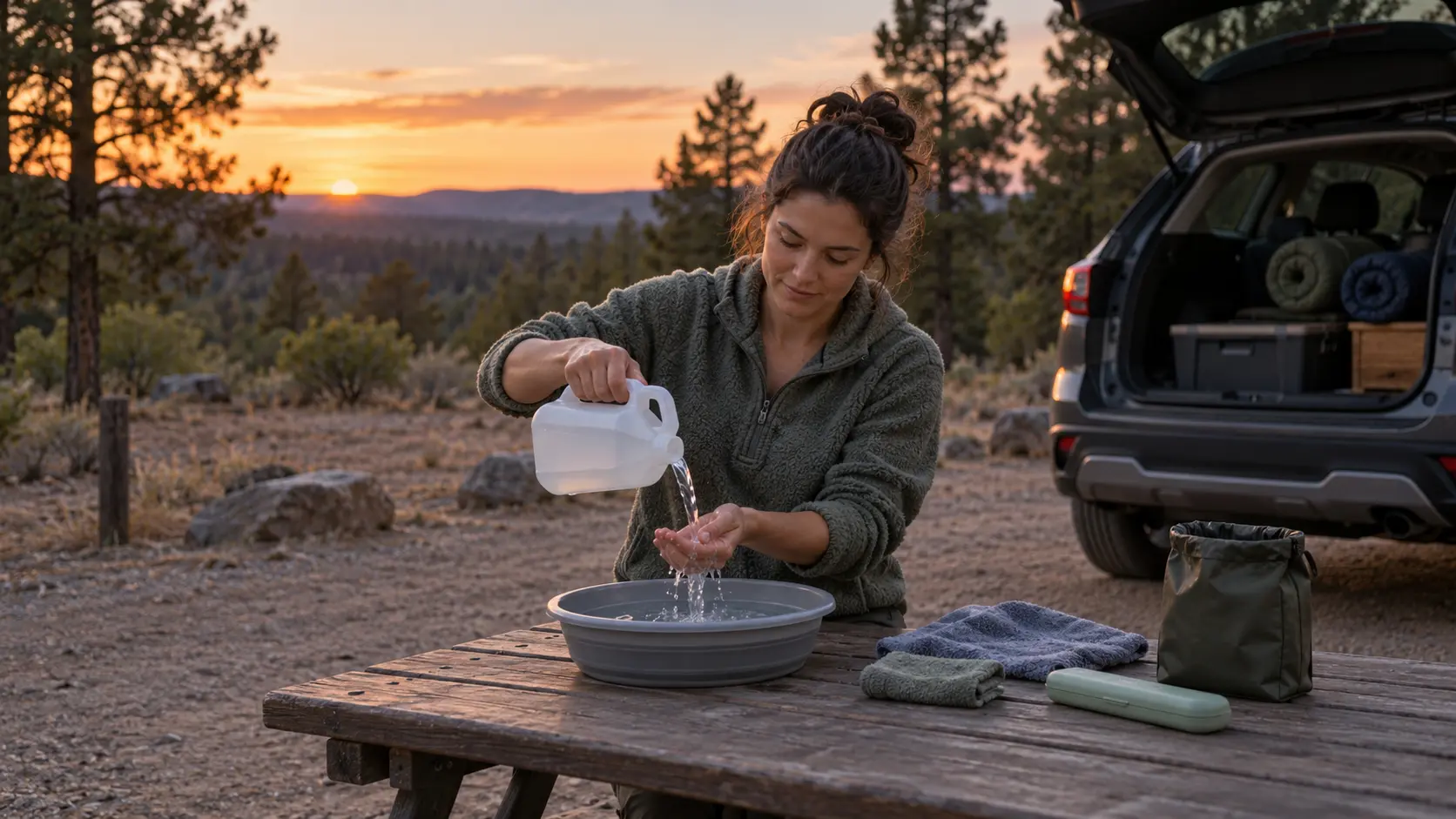
The short answer: for a one- or two-night car-camping trip, you do not need to build a tiny bathroom in the back of your vehicle. Prioritize clean hands, teeth and a simple wash that keeps you comfortable. The important part is planning where the used water, wipes and damp cloths will go before you start.
This guide is US-first because its public-health and campground examples come from the CDC, National Park Service and Leave No Trace. Washing and grey-water rules vary by campground and land manager. Check the rule for your exact site; a utility sink, toilet, drain or other designated facility may be required.
Why a no-sink routine matters in a small car
In a normal car, SUV or minivan, the wash kit often sits only a few feet from the bed. A damp towel can end up against bedding, an open tube of toothpaste can become a wildlife attractant, and a basin of used water has nowhere obvious to go. Solving those conflicts is more useful than packing a long list of toiletries.
Start with the broader first-night sleeping-in-a-car checklist, then add one compact hygiene module. Keep it removable so the car can return to daily use after the trip.
Pack a small kit with clear jobs
A practical two-night kit can be modest: a container of clean water, soap, a washcloth, a small towel, toothbrush and toothpaste, a shallow basin or other capture container, a strainer, a rubbish bag and two pouches for clean and damp items. The National Park Service includes basics such as soap, a wash basin, rags, a washcloth or towel and dental supplies in its camping packing guidance. That list does not mean every item may be used or emptied anywhere.
Add hand sanitizer containing at least 60% alcohol as a backup, not as the whole system. The CDC says soap and water are best in most situations. Sanitizer is less effective when hands are visibly dirty or greasy and does not work equally well against every germ.
A four-step no-sink routine
- Clean. Use soap and clean water for priority handwashing. Treat sanitizer as a backup when washing is unavailable.
- Contain. Catch water from washing, toothbrushing and dishes in a basin or other container.
- Dispose. Use the campground-approved sink, drain, toilet or other instructed method. Never assume the ground is acceptable.
- Dry. Bag wipes and other solids. Isolate damp cloths from bedding and dry them only where the site permits.
Text equivalent: clean the essentials with the appropriate method, capture the resulting water and solid waste, follow the exact local disposal rule, then keep damp gear out of the sleeping area.
The evening routine
- Check the site rule before opening the kit. Locate the permitted washing and wastewater facilities. If the wording is unclear, ask the host, ranger or land manager.
- Wash hands first. CDC camping guidance recommends soap and water for at least 20 seconds, especially after using the toilet and before preparing or eating food. Use clean poured water when an ordinary sink is unavailable, while following the site’s location rules.
- Use a contained washcloth routine. Put a small amount of water in the basin, clean the areas that matter for comfort, and keep every drop in the container. This is a practical short-trip routine, not a medical skin-care protocol.
- Brush over the basin. Capture the water and toothpaste instead of spitting beside the car or at a drinking-water tap.
- Separate solids from water. Wipes, floss, packaging and strained food particles belong in the rubbish bag. Even wipes marketed as biodegradable or compostable should be packed out rather than left on the ground.
- Close the loop. Put the clean kit in one pouch and damp cloths in another. Toiletries, toothpaste and rubbish may count as attractants, so use the local storage rule and the guide to food and scented gear in bear country.
The morning routine
Repeat the hand, face and dental basics, then inspect the sleep area before packing it. Move damp cloths away from the bedding and dry them only where the campground allows; do not leave them hanging unattended. The guide to keeping wet gear out of your bed offers a larger clean-and-damp packing system.
Take captured water to the approved destination, close the rubbish bag and return dry items to the clean pouch. If a cloth must travel damp, keep it separate rather than sealing it against the mattress. That also reduces an avoidable moisture source inside the car; the car-camping condensation guide covers the wider evening and morning moisture routine.
Grey water: the location decides
There is no single disposal instruction for every campsite. Leave No Trace’s educational guidance starts with checking local regulations, using provided facilities and straining food particles into the rubbish. Its scattering guidance is a conditional fallback where local rules allow it, not a default permission.
Developed campgrounds can be stricter. Crater Lake National Park’s current compendium, for example, prohibits washing at public water outlets and directs campers to use provided waste sinks or containers at camp, with grey water deposited in approved sinks, drains or toilets. That is one park’s rule, not a nationwide NPS standard, but it shows why guessing is a bad plan.
Do not empty wash water at a drinking-water spigot, on a parking pad, into a road drain or beside the car unless the responsible authority specifically permits that method. “Biodegradable soap” does not override the site rule. Capture first, then dispose according to the instruction for that exact place.
What sanitizer and wipes cannot do
Sanitizer is useful when soap and water are genuinely unavailable, but it is not a shower and is not equivalent to washing visibly dirty hands. CDC guidance also notes that sanitizer alone does not work well against norovirus. Wipes can make a quick cleanup easier, but they remain solid waste. Put used wipes in the rubbish bag and pack them out.
When a shower is worth planning
Hot weather, heavy activity, a longer trip or personal needs may make a real shower important. That is a reason to choose a campground with suitable facilities, not a reason to improvise drainage beside the car. For a quiet two-night trip, a compact contained routine may be enough; for anything more demanding, make facilities part of the booking decision.
Sources
- CDC: Preventing Norovirus When Camping, Hiking, or Outdoors — soap-and-water handwashing priorities and limits of sanitizer (page dated May 8, 2024; checked October 22, 2026).
- CDC: Hand Sanitizer Guidelines and Recommendations — 60% alcohol fallback and important limitations (page dated March 12, 2024; checked October 22, 2026).
- Leave No Trace: Grey Water Disposal — capture, strain, local-rule and conditional disposal hierarchy (2018 resource; checked October 22, 2026).
- Crater Lake National Park Superintendent’s Compendium — one current example of facility-specific washing and grey-water rules (approved December 30, 2025; checked October 22, 2026).
- National Park Service: What to Bring — compact camping hygiene and wash-kit basics (updated July 2, 2024; checked October 22, 2026).
- National Park Service: Cooking in Camp — handwashing and developed-campsite cleanup context (updated June 22, 2022; checked October 22, 2026).
- Appalachian Trail Conservancy: Health & Hygiene — packing out used wipes (checked October 22, 2026).
Reader-question evidence: one public first-time-camper discussion dated April 10, 2026 supplied the practical question about no-shower hygiene and soapy-water disposal. It is qualitative evidence only, not search volume or consensus.