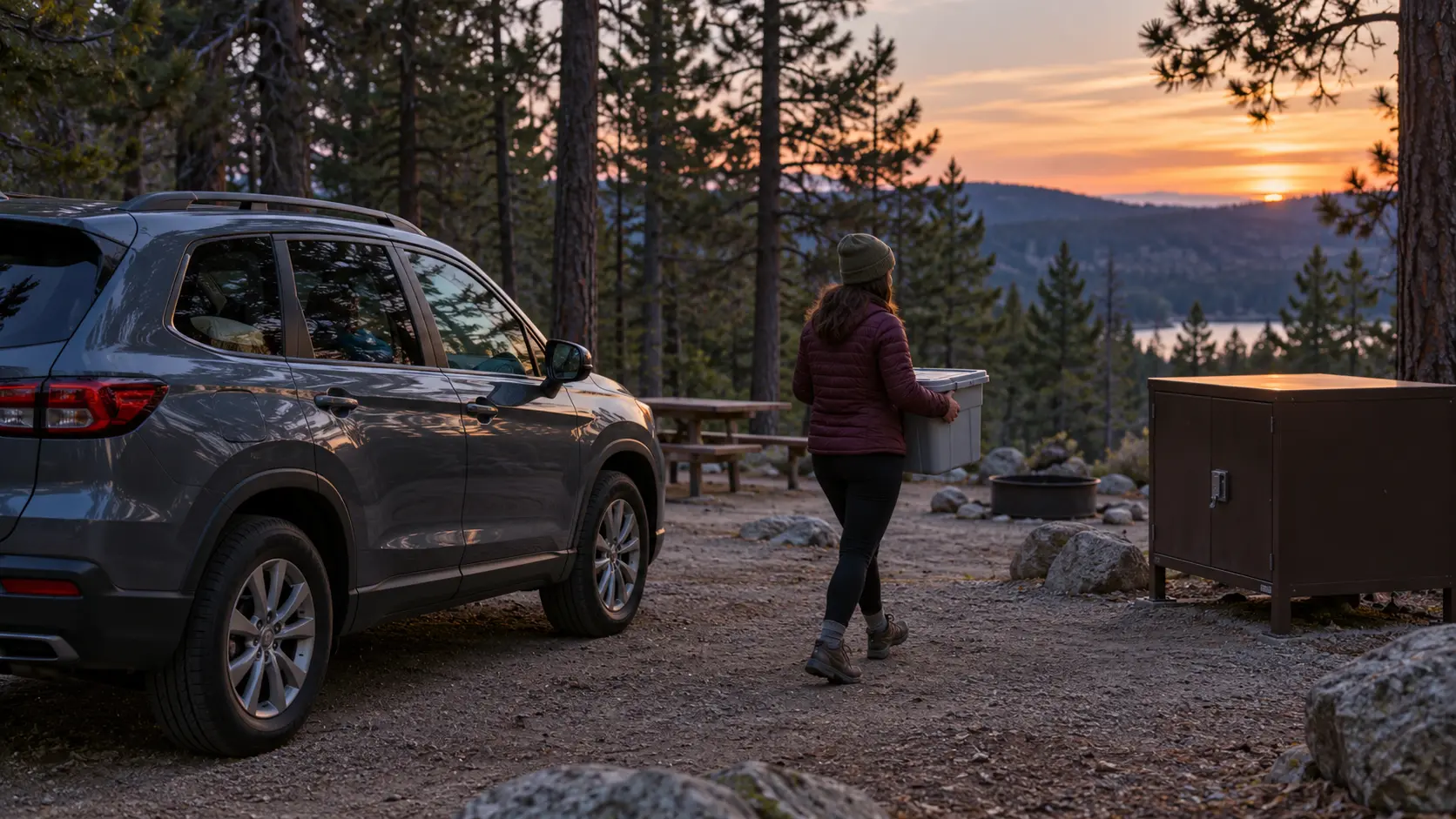
The short answer: there is no universal rule that food is safe overnight just because it is inside a hard-sided car. In bear country, the correct storage place depends on the exact park, campground or land manager. Some locations require every listed attractant to go into a food locker after dark. Others allow a vehicle only when the items are out of sight and every window is fully closed.
That distinction matters when the car is also your bedroom. If a rule allows vehicle storage only with the windows completely closed, a cracked window or open hatch does not meet that condition. Use the provided locker or ask staff for the approved alternative before bedtime. Do not assume that sleeping beside the food, hiding it under bedding or putting it in an ordinary cooler changes the rule.
This guide is US-first because the examples come from the National Park Service. Rules can differ between neighboring campgrounds and can change, so check the official page for your exact location and dates. Elsewhere, use the same process with the relevant land manager.
Why car sleepers need a separate plan
A tent camper can lock the car and walk back to the tent. A car sleeper may need the same space for bedding, ventilation and storage. That creates a conflict: the setup that makes the car comfortable for sleeping may make it ineligible as approved food storage.
Plan for that conflict before you arrive. Your campsite booking check should include one specific question: “Where must food and scented items be stored overnight if I sleep inside my vehicle?” A general statement that cars are allowed at the site does not answer it.
“Food” may include much more than dinner
National Park Service guidance treats many scented or food-contact items as attractants. The exact list varies, but it may include drinks, toiletries, cosmetics, pet food, trash, coolers, cookware, stoves, grocery bags and food packaging. A clean-looking mug or empty snack wrapper may still belong in the storage plan.
Read the local definition rather than inventing your own. Then make one sweep of the car: door pockets, console, glove box, daypack, bedside pouch, kitchen bin and the bag you carried on a hike. If the authority lists an item, move it to the approved place.
Where does the food go tonight?
- Read the exact site rule. Use the current official campground or land-manager instructions, not a general memory of “bear country.”
- Locker required? Move every attractant named by the rule into the locker. Follow any local instructions for latches and shared space.
- Vehicle allowed only when fully closed? Put allowed items out of sight, close every window and hatch, and lock the vehicle as directed.
- Need a window or hatch open? Do not rely on the vehicle as compliant storage. Use the approved locker or ask staff where the items must go.
- Rule unclear? Ask a ranger, host or land manager before bedtime. Do not fill the gap with a guess.
Text equivalent: local rules come first. A required locker overrides vehicle convenience; a vehicle-storage rule that requires fully closed windows conflicts with a ventilated sleeping setup; uncertainty means asking the responsible authority before night.
Use one transfer tote
A simple way to reduce the midnight scavenger hunt is to pack attractants so they can move in one trip. This “one-transfer tote” is a practical organizing method, not an official bear-resistant container or a substitute for the local rule.
- Start with the local list. Note what the authority counts as food or scented gear.
- Collect small items inside one washable tote. Toiletries, packaged food, trash bags and kitchen odds and ends are easier to find when they have one night address.
- Keep bulky items beside it. A cooler or stove may not fit in the tote, but it should be part of the same transfer routine.
- Move the whole group before arranging the bed. That avoids dismantling bedding to retrieve a forgotten bag.
- Do a final pocket check. Look in the console, door bins, backpacks and clothing pockets for snacks, wrappers and scented products.
This is also a useful division between daytime and nighttime storage. Your cooler or 12V fridge choice can solve temperature and power questions, but it does not decide whether the container may stay in the car. Wildlife rules are a separate check.
Three official examples show why guessing fails
Yosemite National Park provides a strict example. Its published instructions say food may be kept in a car during daylight only when it is out of sight and the windows are completely closed. After dark, food must not remain in the car or trunk; visitors use the campsite food lockers. That rule makes a cracked-window sleeping arrangement incompatible with using the vehicle for overnight food storage.
Sequoia and Kings Canyon National Parks tell campground visitors to use the metal food-storage boxes provided. Where no box is available, their storage instructions direct visitors to put food and related supplies in a vehicle trunk; in vehicles without trunks, those items must be completely hidden from view. A separate day-hiking rule adds that, at a trailhead without a box, vehicles without trunks must keep food low and out of sight with the windows closed. The page lists more than meals, including toiletries, trash, coolers, stoves and grocery bags.
Sleeping Bear Dunes National Lakeshore gives another location-specific example: its guidance allows food in a car or RV when it is out of sight and the windows are completely closed. That does not loosen Yosemite’s rule or establish a nationwide standard. It demonstrates the opposite—the place determines the answer.
Build storage and ventilation as one plan
Ventilation can help manage moisture, as explained in the guide to car-camping condensation. But do not treat a ventilation tip as permission to ignore a fully-closed-vehicle storage condition. If you need a cracked window, remove the listed attractants to the approved locker or another location expressly allowed by staff.
Prepare the sleep space only after the storage plan works. The first-night car-sleeping checklist covers the broader setup; in bear country, add four lines to it: exact rule checked, locker located, attractants gathered and morning access planned.
Arrival and morning checklist
- Open the official rule for the exact park or campground and check its date or current alerts.
- Locate the locker before dark and make sure you know how its latch works.
- Ask staff about any conflict between vehicle ventilation and storage requirements.
- Move food, toiletries, trash, pet items and other locally listed attractants before building the bed.
- Keep the locker key, combination or morning essentials accessible without leaving attractants beside you.
- In the morning, return items to the car only when the current rule allows it, then leave the locker clean.
Compliance does not eliminate every wildlife risk, and this article is not encounter advice. Follow the land manager’s separate instructions for bear encounters, closures and emergency reporting. The useful habit is simpler: treat “Where does the food go tonight?” as a location-specific question, not a property of the car.
Sources
- National Park Service: Storing Food — general attractant and location-specific storage guidance (page last updated May 13, 2025; checked October 21, 2026).
- Yosemite National Park: Bears and Food Storage — daylight vehicle conditions and after-dark locker requirement (checked October 21, 2026).
- Sequoia & Kings Canyon National Parks: Bears and Food Storage — campground lockers, listed attractants and limited closed-vehicle fallback (page last updated July 7, 2025; checked October 21, 2026).
- Sleeping Bear Dunes National Lakeshore: Do Not Feed the Bears — out-of-sight, fully closed vehicle example (page last updated January 24, 2018; checked October 21, 2026).