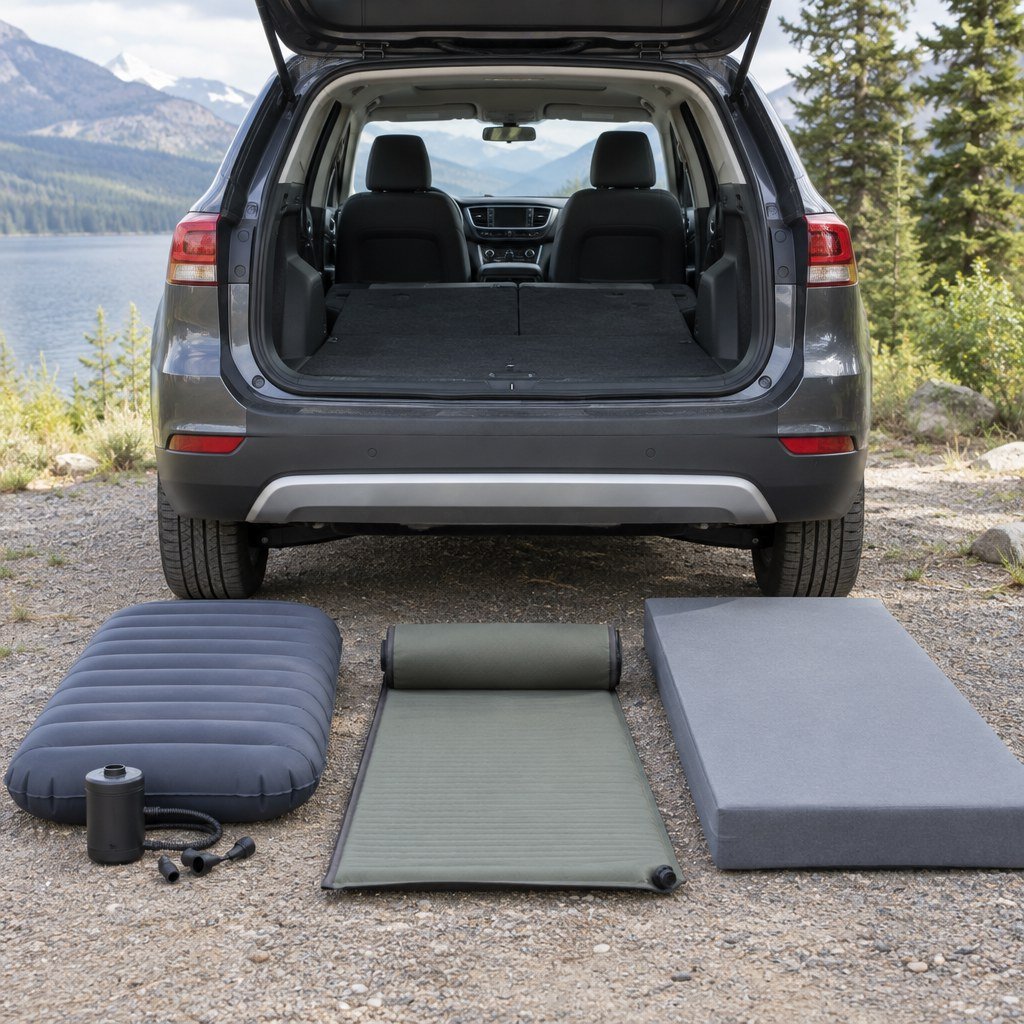
Choosing a car-camping mattress is less about the “best” material than the inconvenience your car can tolerate. Air mattresses usually pack smallest among these three broad types and can follow awkward contours. Self-inflating mats trade packed space for insulation and a steadier surface. Thick foam removes inflation, but can consume most of the cargo area before bedtime.
For a short answer: start with an air mattress when daytime storage is tight or your sleep platform has an unusual shape; consider a self-inflating mat when warmth and a less bouncy feel matter more than compact packing; choose a thick foam mattress only when you have measured a realistic place to carry it. The right decision begins with your car, not a product ranking.
Air mattress
Start here if: packed size and vehicle-specific fit are your main constraints.
Trade-off: inflation is part of setup, and loss of air can affect an inflated section or sleep surface.
Measure first: footwell gaps, wheel-well contours and access to a 12V outlet if the supplied pump needs one.
Self-inflating
Start here if: you want foam-supported comfort and useful insulation in a rollable mat.
Trade-off: it packs larger than a simple air pad and usually needs a final top-up.
Measure first: full deployed width, packed roll diameter and the height it adds beneath your shoulders.
Thick foam
Start here if: you have dependable daytime storage and want no inflation step.
Trade-off: the mattress keeps much of its bulk when packed and may be difficult to move around inside a small car.
Measure first: its folded or rolled volume, hatch opening and the space left for passengers and gear.
Text equivalent: choose air for the smallest packed load or shaped fit; self-inflating for a middle ground of insulation, support and packability; thick foam only when permanent bulk fits your daytime plan.
What the three names actually mean
An air mattress supports you mainly with an air chamber. It can compress into a relatively small package, and vehicle-specific models can shape that chamber around wheel wells or footwells. Firmness changes with air pressure, but a pump, valves and an intact chamber remain part of the system.
A self-inflating mattress combines open-cell foam with an airtight shell. Opening the valve lets the foam expand and draw in air, but “self-inflating” does not mean fully ready without help: a final top-up is commonly needed. This category often provides more insulation than basic air beds because the foam reduces air movement inside the mat. REI’s overview explains the basic construction and trade-offs among air, self-inflating and closed-cell foam pads.[1]
“Foam mattress” needs care because it can describe two different things. A thin closed-cell camping pad is light, durable and modestly cushioned; a thick foam-only car mattress can be nearly four inches deep and far bulkier. This guide uses thick foam for the second type. Do not apply the packability of a folding closed-cell pad to a full foam car mattress.
Use a four-space budget, not just length and width
- Map the deployed footprint and contour. Measure usable length at the narrowest points, width between wheel wells, gaps beside folded seats and any slope. Follow the full car-sleeping measurement process before assuming a nominal mattress width will fit.
- Subtract added height from headroom. A four-inch mattress can materially change how easily you sit up, turn or reach a door. Test the sleeping height with boxes, cushions or folded blankets before buying.
- Assign daytime packed storage. Measure the actual parcel you will carry—not just whether the mattress can technically be folded. Include pump, sack and repair kit.
- Rehome nighttime gear. When the mattress expands, coolers, shoes and bags must move somewhere. If that somewhere is the front seat, confirm you can still reach an exit and keep the driver’s area clear.
This sequence catches a common mismatch: a mattress fits at night but leaves nowhere sensible for itself or the rest of the kit during the day. Run the arrangement at home, then use the first-night car-camping checklist.
Exact examples show how different the space trade can be
Swipe to compare →
| Example | Type | Deployed / packed | Insulation and weight | US price / listing note |
|---|---|---|---|---|
| Luno AIR Pro | Vehicle air mattress | 4 in thick; 8 × 26 in packed | R-value 1.5; 13 lb | $349.99; 12V pump included |
| EXPED MegaMat Auto 2025 | Self-inflating | 77.6 × 52/41 × 4 in; 27.6 × 11.8 in packed | R-value 8.1; official page conflicts: 7 lb 15 oz in specifications, 8 lb 8 oz in comparison | $399.95; out of stock |
| HEST Foamy | Two-layer foam | 64 × 25 × 3.9, 78 × 25 × 3.9 or 78 × 30 × 3.9 in | Maker states R-value 8.8; test basis not confirmed. REI lists regular at 11 lb. | REI guide starts at $279; all variants on HEST direct page were sold out |
The figures are not perfectly comparable. Luno is a shaped vehicle system with a supplied electric pump; the EXPED is a tapered self-inflating mat that still calls for a top-up pump; HEST is a foam-only rectangle. The EXPED manufacturer page also contradicts itself on weight, so both values are retained rather than choosing one. For a closer look at the first two designs, see our Luno AIR Pro vs EXPED MegaMat Auto comparison.[2][3][4]
Warmth matters, but an R-value is not a comfort score
R-value describes resistance to heat flow through the pad; higher numbers indicate more insulation. It does not tell you whether a mattress fits your hips, feels stable to you or works at every temperature. Conditions, sleeping bag, clothing, ground or vehicle-floor construction and personal cold sensitivity still matter.
The outdoor industry’s ASTM method gives many sleeping-pad R-values a common laboratory framework.[5] R-values can generally be added when pads are stacked.[1] But do not assume every number in a shop table was measured under that standard. HEST states R 8.8 for the Foamy, while the test basis was not confirmed on the checked product page. Treat it as a maker-stated figure, not a guaranteed temperature rating.
Setup, failure modes and care
Air and self-inflating models require valve discipline and protection from sharp objects. Carry the repair materials specified by the manufacturer and test the mattress before leaving home. A slow overnight softening can also reflect cooler air contracting, so softness alone does not prove a puncture.[1]
Foam avoids a punctured air chamber, but that does not establish it as the durability winner. Covers, seams, foam compression and moisture exposure still matter, and comparable long-term testing for these examples was not available. Store air and self-inflating pads clean and dry; REI recommends keeping a self-inflating pad fully dry, semi-inflated and with the valve open, rather than compressed in its stuff sack for long-term storage.[6]
Moisture around bedding can also be vehicle condensation rather than a mattress failure. Our car-camping condensation guide explains ventilation and drying steps.
Which type should you choose?
Choose air when an irregular vehicle floor or very limited daytime storage dominates the decision. Confirm pump access and accept that setup and field repair belong in the plan.
Choose self-inflating when you can store a larger roll and want insulation plus foam-supported cushioning without carrying a full-thickness foam slab. Check the packed diameter carefully and expect to fine-tune firmness.
Choose thick foam when your hatch, daytime cargo plan and headroom all accommodate it. Its no-inflation simplicity is valuable only if the bulky mattress does not create a new problem every time you change from driving to sleeping.
If two options still fit, prioritize the one that leaves the cleaner daily routine. A mattress you can deploy, store and dry without unloading half the car is usually the more useful choice—even if another option looks better on a specification sheet.
Sources
- REI Co-op: How to Choose Sleeping Pads — category construction, trade-offs and R-value basics.
- Luno: AIR Pro Vehicle Mattress — US price, dimensions, packed size, weight, R-value and included pump; checked October 14, 2026.
- EXPED USA: MegaMat Auto 2025 — US price, dimensions, R-value, availability and conflicting published weights; checked October 14, 2026.
- HEST: Foamy and REI’s camping sleeping-pad guide — dimensions, construction, maker-stated R-value, stock, listed regular weight and starting price; checked October 14, 2026.
- Therm-a-Rest: ASTM R-value standard and Sea to Summit: standardized sleeping-pad warmth comparison.
- REI Co-op: How to Store a Sleeping Pad.