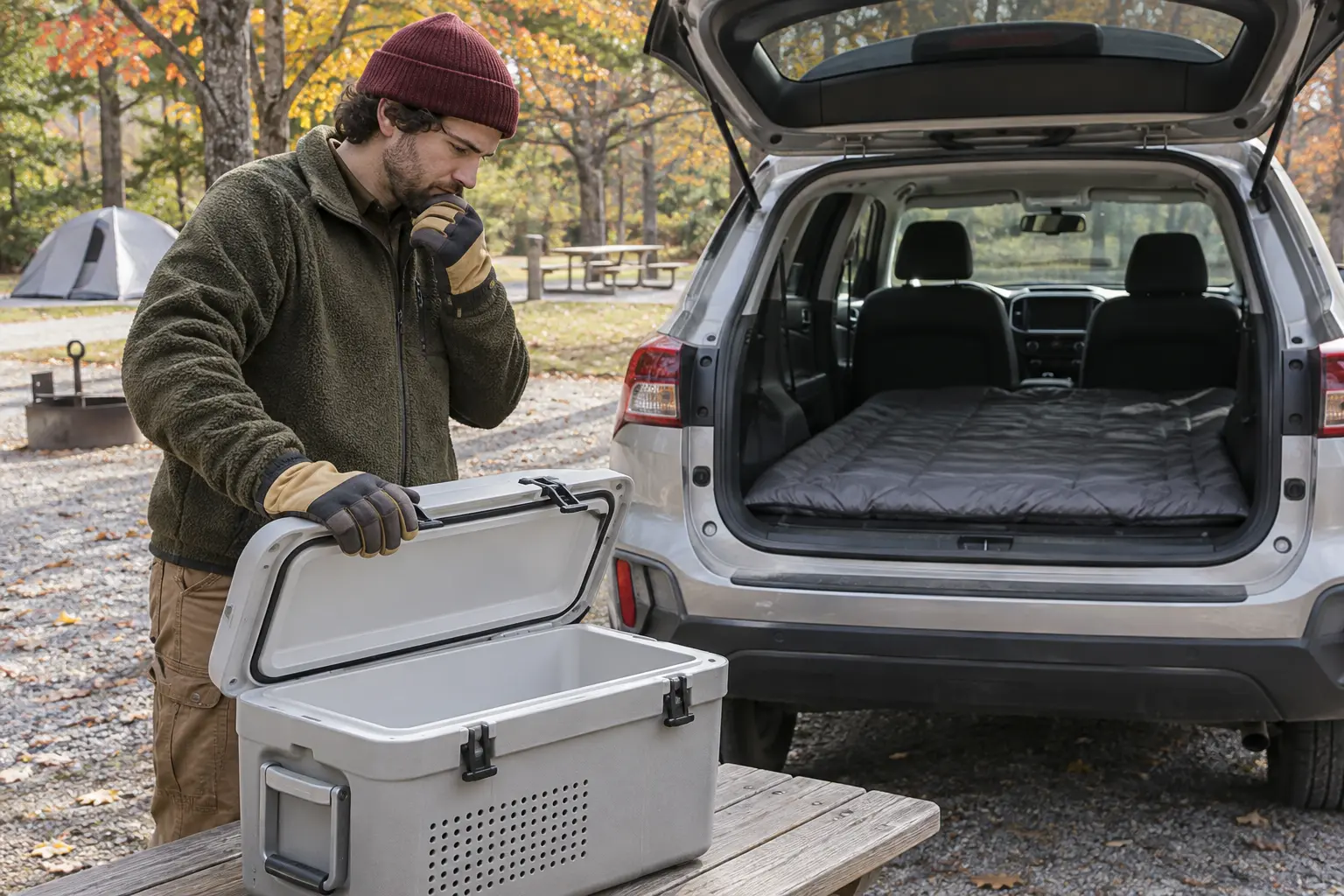
Do not sleep in a car, SUV or minivan while dry ice is inside the enclosed passenger cabin. Dry ice changes directly into carbon dioxide gas. In a small, poorly ventilated space, that gas can build up without a useful smell or color to warn you. The CDC’s dry-ice guidance is unusually direct: never leave dry ice in a parked passenger vehicle.[1]
This is not a reason to panic about every cooler. It is a reason to separate two jobs that are easy to blur together: transporting cold food and creating a safe place to sleep. If dry ice and sleepers would share one enclosed cabin, change the cold source.
The short decision
| Your setup | Decision | Reason |
|---|---|---|
| The cooler must remain in the enclosed passenger cabin while anyone sleeps | Do not use dry ice | CDC guidance says never leave dry ice in a parked passenger vehicle |
| Dry ice can travel in a genuinely separate or open-air cargo location and will be removed before sleep | Follow current supplier, cooler-maker and transport instructions | The gas must still escape, and the container must not be airtight |
| There is no safe separate location, or the instructions are unclear | Use wet ice, frozen packs or bottles, or a suitable powered fridge | This keeps the cold-storage problem separate from cabin carbon-dioxide risk |
Text equivalent: If dry ice and sleepers would share one enclosed cabin, change the cold source.
Why the cooler does not solve the cabin problem
A normal dry-ice container cannot simply trap everything inside. As dry ice warms, it becomes carbon dioxide gas. That gas needs a way out. CDC and FDA guidance warns against airtight or glass containers because pressure can build as the dry ice sublimates.[1][4]
So there are two different hazards to avoid:
- Letting gas collect in the vehicle: a vented cooler can still release carbon dioxide into the surrounding cabin.
- Trying to seal the gas in: an airtight container creates a pressure hazard rather than making the setup safe.
Cracking a window is not a dependable bedtime workaround. Ventilation changes with wind, window position, obstructions and the vehicle’s layout. A sleeping person is also poorly placed to notice early symptoms. The safer decision is structural: do not keep the dry ice in the space where people will sleep.
A CDC investigation documented serious illness, including loss of consciousness, after dry ice was carried in a closed vehicle cab with recirculated air.[2] That report does not tell us what every quantity will do in every vehicle. It does show why a parked sleeping cabin is the wrong place to improvise.
Before driving, check the whole system
Dry ice is not a drop-in replacement for ordinary ice. Read the current instructions from the dry-ice seller and the cooler manufacturer before buying it. Confirm that the container is compatible, can release gas as intended and is not made of glass or designed to be sealed airtight.
Handle dry ice with insulated gloves. CDC and NIOSH guidance notes that direct contact can cause cold injury or frostbite.[1][3] Eye protection may also be appropriate under the supplier’s handling instructions. Keep children and pets away from the material, and do not treat a towel or thin food-prep glove as confirmed protective equipment.
Transport guidance depends on the vehicle and cargo arrangement. CDC guidance discusses a trunk or truck bed with fresh-air circulation, while FDA guidance says not to transport dry ice in a car without adequate ventilation.[1][4] Do not turn those statements into a universal promise that any trunk, hatchback cargo area or partly open window is safe. Many SUVs and minivans have one connected air space from tailgate to dashboard. If you cannot establish a genuinely appropriate transport arrangement from current instructions, choose another cooling method.
At camp, make the bed decision before dark
Do not wait until you are tired to discover that the cooler has nowhere else to go. Decide where every cold-storage item will live while the bed is deployed.
If the only option is beside the mattress, behind a folded seat or under the sleeping platform in the same enclosed cabin, dry ice is out. Use ordinary ice, frozen bottles or gel packs in a suitable cooler. For trips where electrical capacity and food volume justify it, a suitable 12V fridge may be another option. Our cooler-versus-12V-fridge guide explains the space and power trade-offs without assuming one answer fits every weekend.
If dry ice was transported in a separate closed cargo area, follow the official instruction to ventilate that area before entering it. CDC guidance specifies opening the area and allowing fresh air to circulate for five minutes before entry.[1] Do not climb into a suspect space first and then start looking for the cooler.
Food temperature is a separate check
Removing dry ice from the sleeping cabin does not answer whether the food is still safe. USDA guidance says perishable food should remain at 40°F (4.4°C) or colder.[5] Use a food thermometer to verify temperatures rather than guessing from how cold the lid feels.[7]
Keep raw food separated from ready-to-eat food, minimize unnecessary lid opening and keep the cooler shaded. A separate drink cooler can reduce how often the food cooler is opened. USDA also recommends packing refrigerated food with sufficient ordinary ice or ice packs for travel.[6] For a simple two-night plan, see our step-by-step cooler-packing guide.
Dry ice can make part of a cooler extremely cold, but it does not replace temperature monitoring, safe food separation or the maker’s packing instructions.
If someone may have been exposed
Carbon dioxide is colorless and odorless. NIOSH lists possible exposure symptoms including headache, dizziness, breathing difficulty, confusion, coma and asphyxia.[3] Those symptoms are not specific enough to diagnose carbon-dioxide exposure by yourself.
If symptoms develop in or near a vehicle that contains dry ice, move to fresh air and contact local emergency or poison-control services for current instructions. Do not re-enter a suspect enclosed space merely to retrieve gear. Tell responders that dry ice or another carbon-dioxide source may be present.
This follows the same basic principle as moving away from generator exhaust near a car bed: do not ask a sleeping cabin to double as a hazard-control system.
A simpler cold-storage plan
For most short car-camping trips, the least complicated plan is also the easiest to inspect before bed:
- Chill food before packing.
- Use a suitable cooler with wet ice, frozen bottles or gel packs.
- Keep a thermometer where it can be read quickly.
- Separate raw food and drinks to reduce opening and cross-contamination.
- Check that the cooler fits without taking over the sleeping area.
Dry ice can be useful in properly planned settings. A parked passenger cabin where people will sleep is not one of them.
Sources
- CDC: Guidelines for Safe Work Practices in Human and Animal Medical Diagnostic Laboratories — dry-ice handling and transport guidance
- CDC: Acute Illness from Dry Ice Exposure During Hurricane Ivan
- CDC/NIOSH Pocket Guide to Chemical Hazards: Carbon dioxide
- FDA Investigations Operations Manual 2026, Chapter 10 — safety guidance
- USDA FSIS: Keeping food safe during outdoor activities
- USDA FSIS: Keeping meat safe when grilling away from home
- USDA FSIS: The food-safety Danger Zone and temperature verification