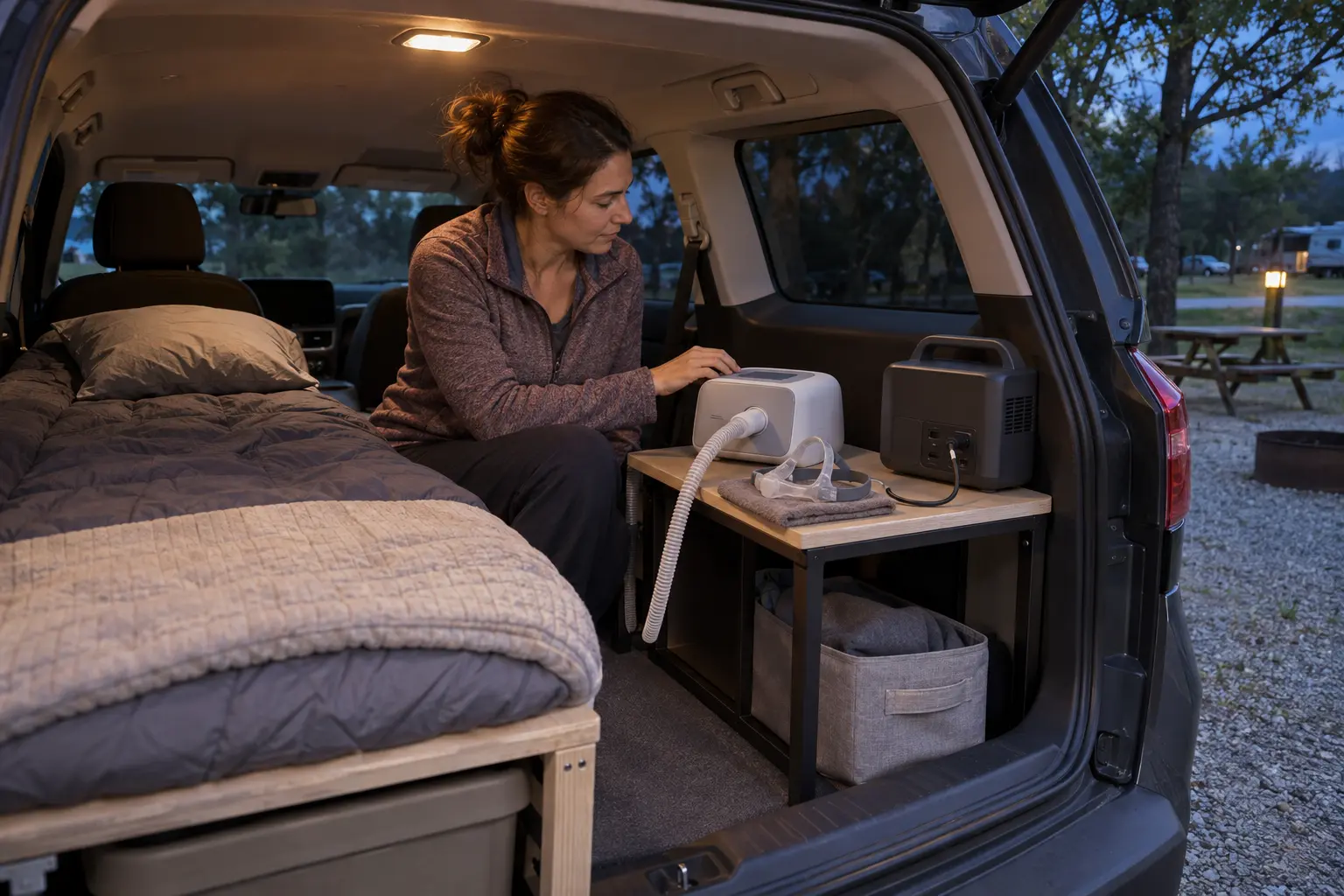
Taking a CPAP on a car-camping trip is not mainly a question of buying the biggest battery you can fit behind the seat. It is a matching job: your exact machine, its approved power path, the setup you normally use, and a separate battery that has already completed a full-night trial at home.
That approach is slower than copying somebody else’s watt-hour number, but much more useful. CPAP power needs vary with the device, settings, humidification, heated tubing, adapter and conditions. A battery that worked for one camper is not a promise for your machine.
Start with the label, not a battery listing
Write down the full model name and the power information from the device and its power supply. Then open the manual for that exact model and market. “CPAP” is a category, not a single electrical specification.
The differences are practical. The ResMed AirSense 11 user guide, for example, documents its own power supply and setup conditions. The Philips DreamStation 2 manual specifies Philips Respironics DC components and tells users to confirm the correct cord with Philips or their home-care provider. Those instructions apply to those products, not every machine with a hose.
Confirm four things before shopping:
- the exact machine model and the prescribed configuration you normally use;
- whether the manufacturer supports AC power, a model-specific DC converter, or another approved battery path;
- the connector and output required by that approved path; and
- the machine’s operating temperature, humidity and placement limits.
A cable that physically fits is not proof of compatibility. A generic USB-C lead, 12-volt cord or inverter may be wrong for the device even if an online comment says it worked for a different model.
Build a four-link power plan
Think of the setup as a chain. Every link has to match before the trip.
| Check | Evidence to copy from your equipment | Pass condition | Stop condition |
|---|---|---|---|
| Machine | Full brand, model and the manual for that exact version | The exact manual and normal prescribed setup are identified | The model or applicable manual is uncertain |
| Power path | The manufacturer-approved AC supply, DC converter or battery accessory | Compatibility with the exact machine is confirmed | The cable, connector or output is generic or unknown |
| Energy source | The battery and output actually used in the home trial | It completes a normal full night with a useful reserve | Runtime exists only as an estimate or someone else’s anecdote |
| Car setup | Manual requirements for level, dry placement, clear inlet, hose and cord routing | The installed setup meets those conditions and keeps an exit clear | Bedding blocks airflow, water can reach the device, or a cord crosses the exit |
Text equivalent: every link must match—exact machine, approved adapter, tested separate battery and manual-compliant placement. If one link is unknown, stop and resolve it before the trip.
1. Exact machine
Use your normal prescribed configuration for the trial. Do not change pressure or other therapy settings to chase a longer runtime. If you are considering a different machine or a treatment-affecting change for travel, involve the prescribing clinician or equipment supplier.
2. Approved power path
Some machines can use their normal AC power supply with a suitable battery outlet. Some have a manufacturer-approved DC converter. The correct choice depends on the exact model. An older ResMed technical battery guide shows how pressure, humidification and heated tubing can change the battery requirements for the specific Air10-era machines it covers. It also says supported ResMed DC converters are more efficient than using an inverter. That is useful model-specific guidance—not permission to transfer its tables to an AirSense 11 or another brand.
3. Separate, tested energy source
Plan for the CPAP to run from a separate battery rather than treating the car’s starter battery as the overnight supply. A starter battery is designed to crank the engine, and an unknown overnight load can leave you unable to start in the morning. Our broader guide explains the distinction between a power bank and a portable power station; the right CPAP source still depends on exact compatibility and a real trial.
Philips adds a model-specific warning for DreamStation 2 users: when DC power comes from a vehicle battery, the device should not be used while the engine is running. Rather than trying to turn individual instructions into a universal rule, follow the manual for your own device and keep the starter-battery plan separate. The site’s starter-battery bedtime check covers the other vehicle loads worth switching off.
4. Manual-compliant placement
A made-up car bed creates hazards that do not exist on a bedside table. ResMed tells AirSense 11 users to place the machine on a stable, level surface and, when using the humidifier, lower than the user’s head. It also says to keep the area dry and clear of clothes or bedding that could block the inlet or cover the power supply. Philips similarly calls for a firm, flat surface below the sleeping position and a clear air inlet.
Set the machine where it cannot slide, collect water or be buried by a sleeping bag. Route the hose without a sharp pinch. Keep the power cable out of the doorway you would use for a quick exit. Do this during your normal first-night setup rehearsal, not after dark at camp.
Run a full-night trial at home
A wattage printed on a power supply is not a measured overnight energy total. Nor is a stranger’s one-night result. The cleanest answer is a dress rehearsal with the actual machine, approved adapter, battery, prescribed settings, humidifier or heated tube as normally used, and expected sleep duration.
- Fully charge the proposed battery and record its starting indicator.
- Connect the same approved power path you will take camping.
- Use the machine for a complete normal night without changing therapy settings for the test.
- Record the ending indicator and whether the system ran continuously.
- Keep a meaningful reserve rather than planning to arrive at zero.
- Repeat the trial after changing the machine, adapter, battery, prescribed configuration or power-hungry accessories.
The reserve is not a universal percentage. Battery displays are imperfect, capacity changes with age and temperature, and a delayed bedtime can extend the run. Your own repeatable result matters more than a tidy internet formula.
Do not quietly redesign therapy to save power
Heated humidification and heated tubing can increase energy use. ResMed’s support guidance says its humidifier draws substantial power and does not recommend humidifier use on battery power. A medically reviewed SleepApnea.org camping guide also notes that heated humidification and tubing affect consumption.
That does not make “turn everything off” a universal instruction. Humidification can affect comfort, machines handle it differently, and treatment decisions belong with the exact manual and care team. If your normal setup will not pass the power trial, ask the equipment supplier or clinician about approved options instead of improvising.
Pack and move it like medical equipment
Water and transport need their own routine. Both the AirSense 11 and DreamStation 2 manuals say to empty the humidifier tank before moving the device. ResMed specifically warns against transporting the AirSense 11 with water in the tub while a vehicle is moving.
Before driving:
- stop therapy and follow the manual’s shutdown sequence;
- let hot components cool if the manual requires it;
- empty the humidifier tank;
- disconnect and pack the machine, approved power hardware, mask and hose so they stay dry; and
- secure the battery and equipment so they cannot become loose cargo.
At camp, check the machine’s listed operating conditions against the actual temperature and humidity. Do not assume a warm sleeping bag also keeps electronics within their permitted range.
Have a backup that matches the medical need
A second tested battery, a powered campsite or a shorter itinerary may be sensible, but no backup is universal. If missing therapy would create a serious medical risk—or if you use a ventilator or another life-supporting device—this general CPAP planning guide is not enough. Make a clinician-approved backup and emergency plan before an off-grid night.
The best car-camping CPAP setup is not the largest battery on the shelf. It is the boring one you can identify, connect correctly, run through a complete home trial, place safely in the car and pack without spilling water. That is a much stronger plan than hoping an online runtime claim survives contact with your exact machine.
Sources
- ResMed, AirSense 11 user guide — exact-model setup, placement, power, operating conditions and transport instructions.
- Philips Respironics, DreamStation 2 user manual — exact-model DC components, placement and travel instructions.
- ResMed, Battery Guide — older model-specific technical guide explaining configuration-dependent battery requirements and starter-versus-deep-cycle use.
- ResMed, Air solutions support FAQ — manufacturer guidance on battery power, humidification and transport.
- SleepApnea.org, How to Camp With a CPAP Machine — updated July 20, 2026; physician-written, medically reviewed planning guidance.