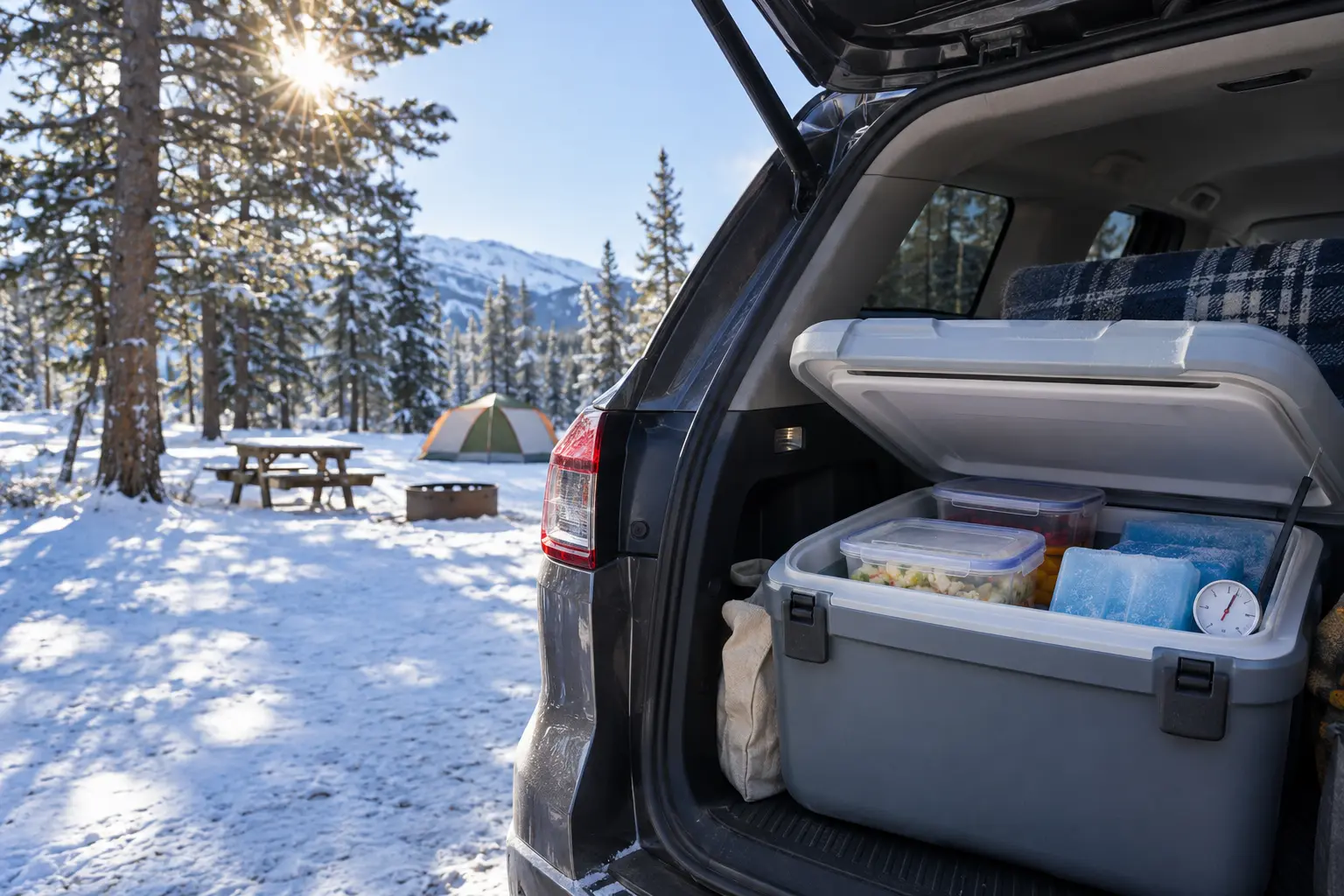
A frosty morning does not turn your parked car into a refrigerator. Outdoor air can warm, direct sun can heat the cabin, and a cooler can lose its cold source long before the trip ends. For winter car camping, the safe rule is simple: keep perishable food in an insulated cooler with ice or frozen gel packs, and use a thermometer to check the temperature inside.
In the United States, official guidance uses 40°F (about 4°C) or colder as the target for refrigerated food. That number—not snow on the ground, the weather forecast or how cold a package feels—should guide your decision. This article uses US food-safety thresholds; follow the food authority and product instructions for the country where you camp.
Why the car is not controlled cold storage
A parked vehicle follows changing conditions rather than holding one set temperature. The US Department of Agriculture warns that refrigerated food can warm in a vehicle trunk and that sunlight can thaw frozen food even when the outdoor air is very cold. A shaded car at midnight and the same car in morning sun are two different storage environments.
Snow is not a substitute for a cooler, either. FoodSafety.gov advises against putting perishable food directly in snow: the outside temperature can vary, and food may be exposed to animals or unsanitary conditions. If the weather is cold enough, you can freeze clean water outside and use that sealed ice as a cold source inside the cooler. The food itself stays protected and contained.
This distinction also prevents an easy mistake: checking only the forecast low. A forecast describes outdoor air over an area. It does not measure the temperature beside your yogurt, cooked meat or opened milk. Put an appliance or cooler thermometer where it monitors the cooler environment, then read it when you need to make a decision.
Read the thermometer, then act
These are US guidance thresholds for perishable food. When the time above 40°F is unknown, choose the safer action.
40°F or colder, cold source present
Keep the cooler closed, shaded and supplied with ice or frozen gel packs.
Action: keep monitoring.
40°F or colder, cold source nearly gone
The food is still cold enough now, but the buffer is disappearing.
Action: replace the cold source promptly.
Above 40°F, with documented time at that temperature under two hours
Restore cooling immediately and follow the food label. Do not reset the clock by chilling it again.
Action: cool now and use promptly.
Above 40°F for two hours or more—or time unknown
Appearance, smell and touch cannot prove that mishandled food is safe.
Action: discard the perishable food.
Build a controlled cold zone
Use an insulated cooler even when the campsite is below freezing. Add enough ice or frozen gel packs to keep the measured interior at or below 40°F. Keep the lid closed as much as possible and place the cooler in shade rather than against a sunlit window. A separate drinks cooler can reduce how often the food cooler is opened, but it is optional; the thermometer and cold source do the essential work.
If you need the loading order, ice strategy and leak-control details, use our two-night cooler-packing guide. This guide answers a different question: whether winter weather lets you skip controlled cooling. It does not.
Some food does not need refrigeration until opened. Shelf-stable meals, unopened shelf-stable milk, whole fruit and other pantry foods can reduce cooler demand, but read the exact label. “Shelf stable” is a product instruction, not a guess based on packaging. After opening, the storage rule may change.
Keep a simple temperature record
You do not need a laboratory log. Check the cooler thermometer when packing, after long drives, after a major weather change and before using vulnerable food. If the reading rises above 40°F, use only a time-above-40°F history you actually documented. A previous spot check cannot show exactly when the cooler crossed the line. If the duration is unknown, discard the food.
Do not use the food’s smell, appearance or surface feel as a substitute. FDA guidance says food can make people sick even when it does not look, smell or taste spoiled. Do not treat cooking as an automatic rescue for food that official guidance says to discard. When the safe-temperature history is missing, throwing away the food is cheaper than gambling on it.
What if the food freezes?
Winter creates the opposite problem too: food and water can freeze. Freezing may damage texture, crack containers or make the next meal unusable, but it does not justify moving perishables into an uncontrolled warm cabin. Adjust the cooler’s position, insulation and cold-source quantity while continuing to measure its interior. Keep liquids in containers with room for expansion, and follow package directions for foods that should not be frozen.
If you use a powered refrigerator instead, the same target still matters: verify its displayed or independent thermometer reading and plan for power loss. Our cooler-versus-12V-fridge comparison explains the space and power trade-offs. Neither system is safe merely because it feels cold.
A quick winter routine
- Pack perishables pre-chilled in an insulated cooler with a cold source and thermometer.
- Store the cooler shaded, stable and easy to check without unloading the sleeping setup.
- Read the thermometer after travel and meaningful weather or sun exposure.
- Replace ice or gel packs before the cooler drifts above 40°F.
- Discard perishable food that has been above 40°F for two hours or more, or when that time is unknown. Use the one-hour limit above 90°F.
Cold outdoor conditions may reduce heat gain, but they cannot promise a food-safe temperature. Treat winter air as a condition around your storage system, not as the storage system itself.
Sources
- USDA Food Safety and Inspection Service: Keeping Food Safe During Outdoor Activities, updated March 6, 2025 — cooler use, cold sources and the 40°F target.
- USDA Food Safety and Inspection Service: Will Meat Remain Safe in My Trunk?, updated December 20, 2024 — vehicle and sunlight limits.
- US Food and Drug Administration: Are You Storing Food Safely? — refrigerator temperature, thermometer use and the two-hour rule.
- US Food and Drug Administration: Handling Food Safely While Eating Outdoors — ice or gel packs, shade, lid opening and temperature limits.
- FoodSafety.gov: Food Safety in a Disaster or Emergency — why snow and outdoor temperatures do not replace protected, controlled cooling.