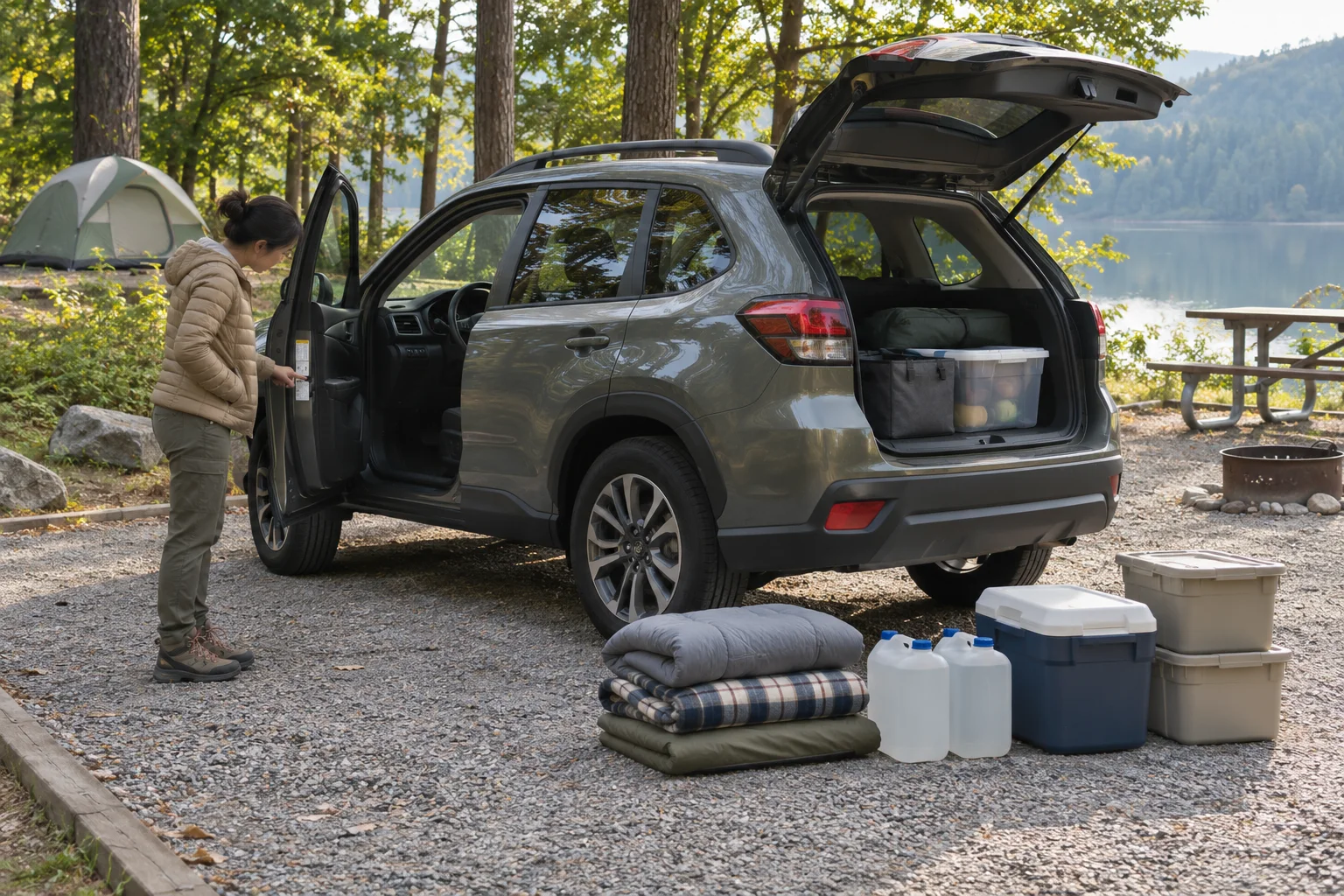
Water, bedding, a cooler and a few tidy bins may fit easily behind the seats. That does not mean the car has enough carrying capacity for them. Payload is a weight budget, and every person gets counted before the camping gear.
The useful number is not a “typical” payload from a generic vehicle listing. Start with the label and owner’s manual for your exact car, model year and market. In the United States and Canada, look around the driver’s door or B-pillar for wording such as “The combined weight of occupants and cargo should never exceed…” Vehicles sold elsewhere may use different labels, terms or locations.
Start with the car, not the gear pile
A 2001 NHTSA proposed rule presents a direct load-limit calculation: find the vehicle’s occupant-and-cargo maximum, total the people who will ride in it, subtract their weight, then compare the remaining capacity with the luggage and cargo you plan to load.
That means the driver, passengers, removable sleeping platform, drawers, mattress, water, food, cooler, battery, bedding and ordinary luggage all belong in the same budget. Added hardware counts too. A manufacturer’s payload guidance notes that extra equipment reduces the payload available after the vehicle leaves the factory.
A roomy cargo bay can still belong to a car with little capacity left once people and accessories are aboard. Space and weight are separate limits.
Build a payload budget before packing
Photograph the relevant labels so you can read them while the car is open and unloaded. Keep the exact owner’s manual beside the list; nearby labels may show several different ratings, and they are not interchangeable.
| Budget line | Reader enters | What it means |
|---|---|---|
| Placard occupant-and-cargo maximum | ___ kg or lb | Your vehicle-specific starting limit |
| Driver and passengers | − ___ | People consume payload before gear |
| Platform, drawers and added accessories | − ___ | Added equipment remains part of the load |
| Water, food, bedding and bins | − ___ | Trip cargo, including what is already in the car |
| Roof or hitch accessories and transferred load | − ___ | Count with guidance from the exact manual |
| Remaining capacity | = ___ | Must not be negative; a close result needs a better check |
Text equivalent: Start with the vehicle label’s occupant-and-cargo maximum. Subtract the driver and every passenger, then subtract every added item and piece of trip cargo. If little capacity remains—or you are unsure how the load sits on the axles—check the fully loaded vehicle against the exact manual’s GVWR and GAWR.
Count the easy-to-forget weight
Make the list from the car outward. Begin with anything that stays installed between trips: a removable platform, storage drawer, hitch accessory or roof hardware. Add every traveler. Then add the trip load, including water containers, cooler contents, food, bedding, battery, chairs, recovery gear and the “small” bags that tend to appear at the last minute.
If you use a roof box, its contents still contribute to the vehicle’s load, while the roof and rack have their own limits. Our roof-box load-limit guide explains those separate checks. Do not use spare room on the roof as proof that the whole vehicle has spare payload.
A trailer does not automatically remove the problem either. Load transferred to the tow vehicle—often discussed as tongue or king-pin weight—can consume payload. Use the towing section for your exact vehicle rather than borrowing a figure from a similar model.
Payload is only the first check
Staying within the occupant-and-cargo number is necessary, but it does not by itself prove that every other rating is satisfied. The vehicle also has a gross vehicle weight rating (GVWR), the maximum allowable loaded-vehicle weight, and gross axle weight ratings (GAWRs), which limit what each axle can carry. Ford’s current loading definitions are a clear example, but the numbers that matter are the ones attached to your own vehicle.
If your arithmetic leaves little room, if many heavy items sit at one end of the car, or if you cannot identify the correct label, stop guessing. Load the car as it will travel—with people and gear represented accurately—and use an appropriate vehicle scale or qualified service to compare the measured weights with the exact GVWR and GAWR in the manual and certification labels.
Do not assume that springs, airbags or other suspension parts rewrite the certified ratings. They may change how a vehicle sits or handles, but this article cannot establish a new payload, GVWR or GAWR.
Check the tires by the vehicle specification
Loading and tire pressure belong in the same pre-trip routine, but the target pressure does not come from the maximum molded into a tire’s sidewall. NHTSA TireWise directs drivers to the vehicle’s Tire and Loading Information label or owner’s manual for the recommended cold pressure. It defines “cold” as the car not having been driven for at least three hours.
Some vehicles specify different front and rear pressures or model-specific instructions for heavy loads. Follow the exact manual. There is no honest universal PSI or kPa figure for every car-camping setup.
A five-minute pack check
- Photograph the vehicle labels and open the exact owner’s manual.
- Copy the occupant-and-cargo maximum, keeping kg and lb consistent.
- Subtract the actual driver and passengers.
- Subtract installed additions, camping gear, food, water and ordinary luggage.
- Review GVWR, both GAWRs, roof or hitch limits, and any towing instructions that apply.
- When the result is close or distribution is uncertain, verify the loaded vehicle rather than inventing a margin.
The goal is not to squeeze one more bin into a mathematical maximum. It is to know what the car is rated to carry, count the whole load, and remove or redistribute gear before the trip when the numbers do not work.
Sources
- National Highway Traffic Safety Administration: 2001 Tire Safety Information proposed rule and example load-limit calculation (U.S.; accessed November 13, 2026)
- Ford: Calculating Payload (manufacturer manual example for U.S./Canada; accessed November 13, 2026)
- Ford: Load Carrying—Load Limit (manufacturer manual example; copyright 2026; accessed November 13, 2026)
- NHTSA TireWise (U.S. tire-pressure guidance; accessed November 13, 2026)