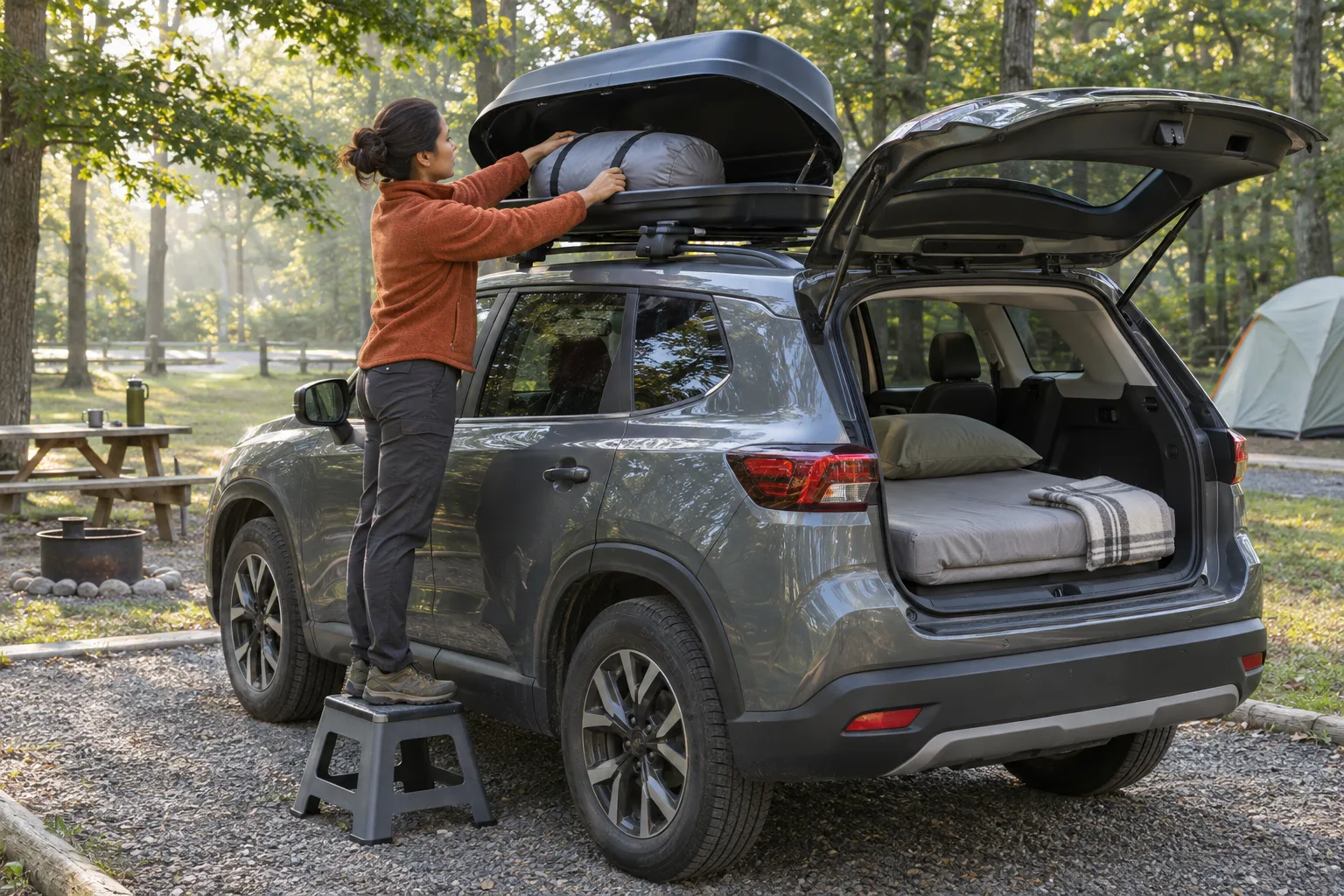
A roof box can be a smart car-camping move when sleeping space is scarce. Bulky, lightweight gear goes upstairs; the mattress and people get more room below. But the number printed on the box is only one part of the answer.
Before loading anything, check four separate limits: the vehicle roof, the complete rack system, the exact cargo box and the vehicle’s remaining allowance for occupants and cargo. All four must pass. The lowest applicable limit controls.
Start with the job, not the box
A roof box is best suited to awkward but relatively light items such as sleeping bags, pillows, blankets and clothing. That can clear the cabin without moving dense gear high above the road. Keep water, tools, batteries and other heavy items low and secured inside the vehicle, subject to its load limits. Our car-camping gear-placement guide explains how to keep the sleeping area usable without leaving loose items around occupants.
Do not buy from volume alone. A large box may still be wrong for the car, crossbar spacing, hatch clearance or local-market rack. Collect the exact manuals and product records first, then work through the four gates below.
The four-limit check
Text equivalent: The setup is acceptable only when the vehicle roof allowance, every rack component rating, the box rating and the whole-vehicle occupant-and-cargo allowance all pass. Subtract the rack and empty box where the vehicle’s roof figure includes them, count every item on the roof, and use the lowest applicable limit.
| Gate | Exact record | What counted | Stop condition |
|---|---|---|---|
| Vehicle roof | Owner’s manual for the exact model, model year, body and drivetrain | Rack, feet, adapters, empty box and cargo when the manual’s limit includes the complete rooftop load | The manual prohibits the setup, a required configuration is missing, or the total exceeds the stated driving limit |
| Rack system | Instructions for the exact rails, feet, bars, adapters and vehicle fit | Every load-bearing component and any on-road or off-road reduction | Any component, fit rule or use condition has a lower limit than the planned load |
| Cargo box | Manual and listing for the exact regional model number | Cargo inside the box, plus required spacing, mounting and clearance rules | Cargo exceeds the box rating or the box cannot meet its mounting and clearance instructions |
| Whole vehicle | Driver-door placard and owner’s-manual load calculation | Occupants, all cabin cargo, rack, box, rooftop cargo and other added equipment | The combined occupant-and-cargo allowance, GVWR or an axle rating would be exceeded |
Gate 1: read the vehicle manual literally
Find the roof-luggage section for the exact vehicle, not a forum answer for a similar trim. Confirm whether the published figure is for driving, which equipment it includes, what crossbars are required and whether the limit changes with drivetrain or other configuration.
One narrow example shows why details matter. The United States and Canada manual page for a 2026 Toyota 4Runner from June 2026 production lists different roof-luggage cargo limits for 2WD and 4WD models: 125 lb (57 kg) and 135 lb (62 kg), respectively. Toyota also calls for at least two suitable cross rails, even distribution between them, secure fastening and periodic checks during certain trips. Those figures illustrate version-specific instructions; they are not targets for another 4Runner, another production period or any other vehicle.
If the manual does not clearly authorize your exact arrangement, pause and ask the vehicle or rack manufacturer. Do not substitute a parked, or static, figure for the limit that applies while driving.
Gate 2: the rack is a system
Roof rails, feet, crossbars and adapters form a chain. The weakest applicable component or vehicle-fit rule sets the rack-side ceiling. Yakima’s European guidance specifically tells users to consider the rating of each component, static versus dynamic forces and on-road versus off-road use. That is a useful checklist even when you own another brand, but the numbers must come from your own components.
Record each part number and its conditions. A bar’s headline rating does not cancel a lower vehicle, foot, adapter or use-specific limit.
Gate 3: check the exact box, not just the family name
Model names cross borders, but model numbers, specifications and instructions can differ by market. As checked on November 11, 2026, Thule’s United States page identifies its Force 3 M as model 645250, with a 37 lb empty weight and a 165 lb box load capacity. The Ireland page identifies a Force 3 M as model 645200, with a 16.5 kg empty weight and a 75 kg load capacity. The values are broadly comparable, but the identifiers, units and supporting fit information are not interchangeable.
The box rating is not permission to put that much cargo on every roof. It is simply another ceiling. If the vehicle or rack allows less after the empty rack and box are counted, the lower figure wins.
Gate 4: keep the whole vehicle within its allowance
Moving a duffel from the cabin to the roof does not make its weight disappear. In the United States, the driver-side placard states the maximum combined weight of occupants and cargo. NHTSA explains that vehicle capacity weight cannot exceed the difference between the manufacturer’s GVWR and unloaded vehicle weight. The roof rack, box and gear therefore remain part of the vehicle-level load picture, along with people and everything else you packed.
Use the procedure in your manual and the placard on your vehicle. Count actual occupants and cargo rather than assuming a brochure payload applies to your equipped car. Also respect axle ratings and any separate limits the manual identifies.
Pack for the drive
- Use the driving, or dynamic, limit when the vehicle will move.
- Favor bulky lightweight items. Keep dense gear low and secured.
- Distribute the load exactly as the vehicle, rack and box instructions require.
- Secure the contents so they cannot shift, and close and mount the box according to its manual.
- Measure the vehicle’s new total height and check clearance before garages, car washes and low branches.
- Before departure and at the intervals specified by the manufacturers, check the mount and cargo again.
Thule’s current packing guide recommends counting the vehicle, rack and box limits, subtracting the rack and empty box from a roof allowance that includes them, and using the dynamic limit for travel. It also suggests placing half the cargo weight between the crossbars and a quarter at each end. Treat that distribution as brand guidance, not a replacement for instructions supplied with your exact equipment.
The practical answer
A roof box can be worthwhile when it solves a real sleeping-space problem with lightweight gear and passes every exact-manual check. Skip it when you cannot establish the vehicle fit, when a required component is undocumented, when the remaining allowance is too small, or when you would need to move heavy cargo onto the roof to justify it.
The safest shopping list is paperwork first: vehicle manual, door placard, rack component records and the exact regional box instructions. Once those four records agree, you know how much room you truly have.