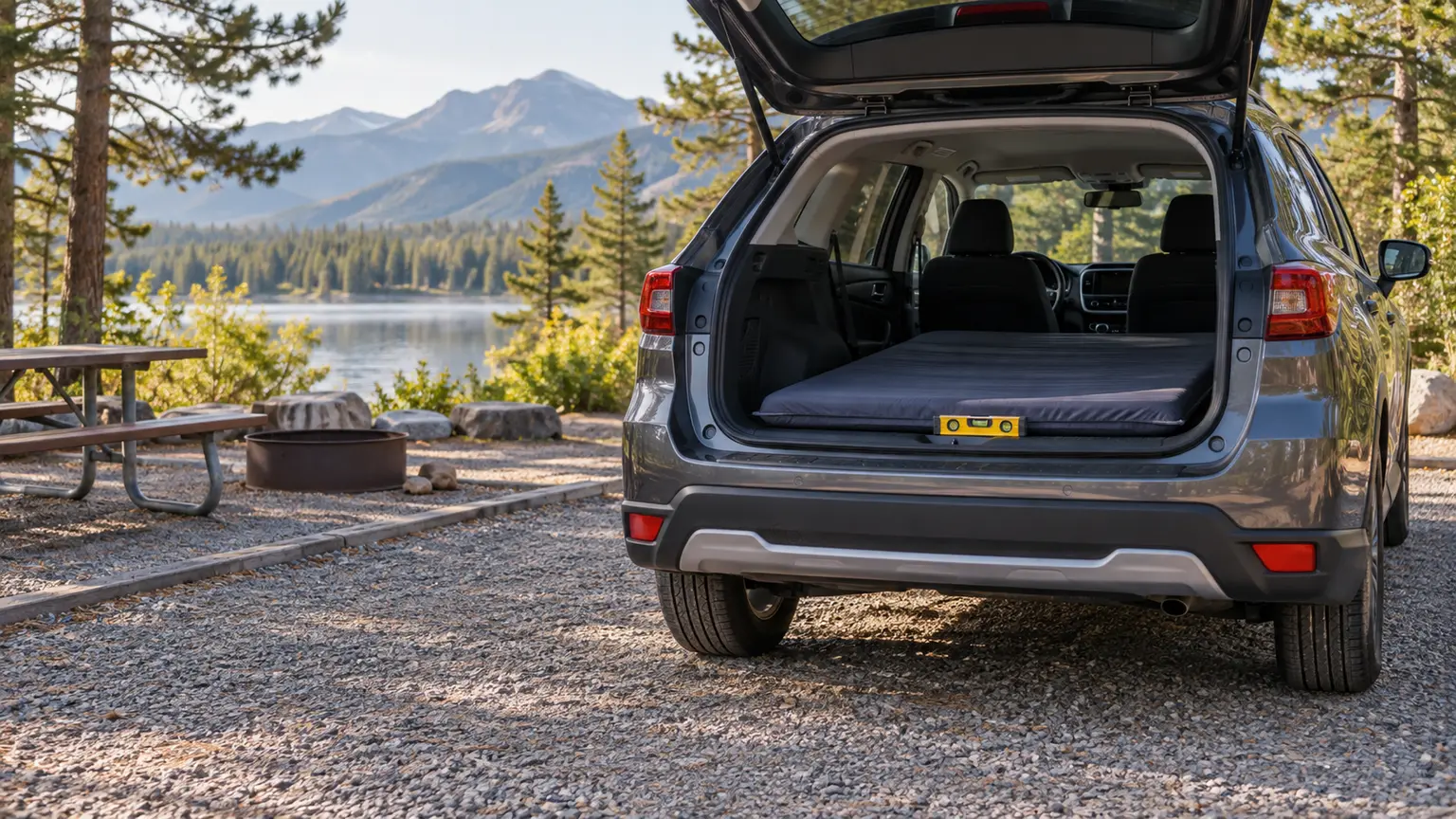
The short answer: solve a sloped sleeping spot by choosing or reorienting the parking position—not by lifting an occupied car. Stay fully inside a permitted, firm parking area, keep every tire on the ground, use Park or the correct gear plus the parking brake, and lie down for a brief comfort check. If you still slide, twist or need an improvised stack to make the bed usable, move.
A perfectly flat mattress can still feel miserable when the whole vehicle leans. A small front-to-back slope may be comfortable for some sleepers; a side-to-side lean often makes bodies, bedding and loose gear migrate. There is no universal angle that turns every car, surface and sleeper into a safe setup, so this routine uses observable stop conditions instead of invented degree limits.
Start with permission and the surface
A flatter patch is not automatically an acceptable parking place. First confirm that overnight vehicle use is allowed in the exact space. Then stay within the designated pad or parking boundary. The National Park Service Leave No Trace principles say to know local regulations, concentrate use on existing campsites in popular areas and avoid altering a site. A park-specific example at Glen Canyon directs visitors to designated roads and parking areas rather than expanding them.
Look for firm, durable ground with the whole vehicle supported and no obvious edge, erosion, soft shoulder or vegetation under the intended tire path. Do not dig, move natural features or drive beyond the allowed surface to improve the sleeping angle. For the broader location hazards that angle alone cannot reveal, use the separate flash-flood sleeping-spot guide.
Turn a sideways lean into a simpler slope
If rules, traffic flow and the boundaries of the space allow it, try a different orientation within the same pad. Reversing or turning the car can sometimes change a side-to-side lean into a gentler head-to-foot slope. Everyone must return to a belted travel seat before the vehicle moves, and the sleeping setup must be stowed as needed for safe driving.
Many car sleepers say they prefer their head at the higher end. Treat that as a comfort preference, not medical advice or a safety guarantee. Reflux, vertigo, respiratory concerns, pregnancy, mobility limits and other health conditions call for relevant clinical advice—not a camping rule copied from a forum.
A no-lift decision table
| What you find | First action | Sleep decision | Do not do |
|---|---|---|---|
| Firm, permitted surface; bed feels level enough | Park fully in the space, secure the vehicle and do a short lie-down. | Proceed if bodies, bedding and gear stay put. | Do not skip the parked-state check because the dashboard looks level. |
| Mild front-to-back slope | Reorient within the rules if useful; otherwise try the head at the higher end as a comfort preference. | Proceed only if the position is comfortable and nothing migrates. | Do not present “head uphill” as medical advice. |
| Sideways lean, body sliding or shifting bed | Reposition or choose another allowed space. | Reject the spot if legal repositioning does not fix it. | Do not reach for loose rocks, scrap lumber or an emergency jack. |
| Soft ground, edge, vegetation or area beyond the pad | Choose another permitted, durable spot. | Reject. | Do not alter or expand the site. |
| Any plan that leaves the occupied vehicle lifted | Stop and choose another spot; consult the exact owner’s manual. | Reject. | Never use the emergency jack as an overnight support. |
Text version: use the spot only when it is permitted, firm, fully inside the designated area and comfortable with every tire on the ground. Reorienting within the rules may turn a sideways lean into a tolerable front-to-back slope. If bodies, bedding or gear still slide—or leveling would require terrain alteration, unstable objects or an occupied vehicle on a jack—move.
Secure the parked vehicle before making the bed
Come to a complete stop, select Park in an automatic or the gear specified by the manual in a manual-transmission vehicle, and set the parking brake. The California Driver’s Handbook uses both Park or gear and the parking brake because a vehicle on a hill can roll after an equipment failure. Its wheel-direction instructions apply to California public roads and curb conditions; they are not a universal campground rule. Follow local law and your vehicle’s manual.
Turn the engine off before converting the cabin. A phone level or a small bubble level can help compare two orientations when it is placed consistently, but it cannot certify the ground, parking legality or mechanical safety. No single degree reading is a universal approval threshold.
Do a two-minute bed check
- Load the sleeping setup as it will actually be used. Occupants and gear change how the bed feels.
- Lie down without lifting the vehicle. Notice side pressure, sliding and whether the mattress or removable platform creeps.
- Check loose gear. A bottle, cooler or storage box that moves during the test may move again overnight.
- Open the doors or hatch you may need. Confirm they operate normally and are not obstructed by the bed.
- Finish the separate lock-and-exit routine. The key-fob, alarm and exit guide covers that check without turning this article into a security guide.
This is a comfort and movement check, not a structural test. If the setup twists, a door behaves oddly, the surface settles or the car no longer feels stable, pack up and choose another allowed spot.
Why the emergency jack is the wrong tool
Emergency tire jacks are designed for a bounded maintenance task, not for holding an occupied sleeping vehicle. A Honda owner’s guide instructs users to place the jack on a firm, level surface, not to put anything above or below it, and not to have people or luggage in the vehicle or enter it while it is raised. A current 2026 Honda CR-V manual again requires firm, level ground. Hyundai’s 2026 guidance similarly tells drivers to move to level, firm ground before changing a tire.
Those manufacturer examples do not replace the manual for your own car. They do show why “just lift one corner for the night” conflicts with the intended use of an emergency jack. Loose rocks, random wood scraps and stacked household objects are not a documented substitute.
The one-rule summary
Choose and orient the parking spot until the bed works with all four tires on the ground—or move. A permitted durable surface, Park or the correct gear, the parking brake and a brief lie-down are a repeatable routine. A jack, terrain alteration or a universal angle number is not.
Sources
- National Park Service: Leave No Trace Seven Principles
- National Park Service: Glen Canyon Leave No Trace
- California DMV: California Driver’s Handbook, hill parking
- Honda Owner’s Guide: jack safety
- 2026 Honda CR-V Owner’s Manual: jack on firm, level ground
- 2026 Hyundai owner’s manual: tire-changing precautions