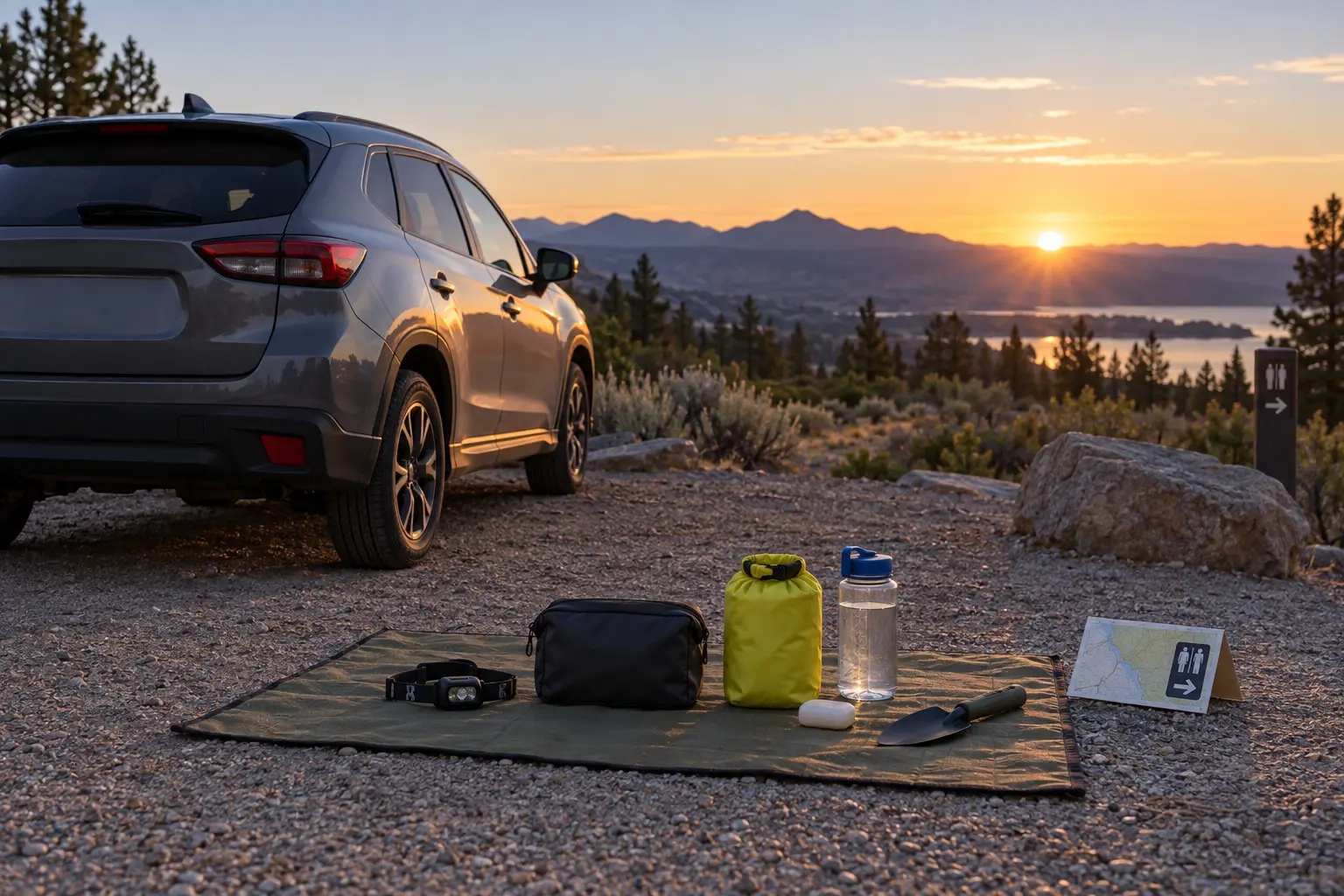
If your campsite has no toilet, the correct backup is not whatever seems convenient at 3 a.m. Check the site’s current rules before the trip, use a provided toilet whenever one is available, and carry the waste out when the land manager requires it. A cathole is an option only where the specific location allows one.
That may sound less spontaneous than tossing a roll of toilet paper into the car. Good. Human-waste rules change between parks, forests, river corridors and even neighboring districts. A five-minute plan before dark is easier than discovering, headlamp in hand, that the ground is frozen, burial is prohibited or the seasonal restroom is locked.
Start with the site, not a generic camping rule
Open the official campground, permit or land-manager page before leaving home. Confirm whether a toilet is provided, whether it is operating in the current season, and what the site requires when it is not available. The Bureau of Land Management notes that developed campgrounds range from serviced to primitive and recommends checking the campground page or local field office. Its dispersed-camping guidance also makes clear that burial is appropriate only in some places.
Local instructions can be stricter than the familiar Leave No Trace summary. For example, Joshua Tree National Park’s current backcountry guidance requires visitors in the covered backcountry context to pack out human waste and toilet paper with an approved system. That is a Joshua Tree rule, not proof that every park has the same rule. It is proof that guessing is a poor sanitation strategy.
If the official page is unclear, call or ask the land manager. If you cannot verify a lawful method, bring a compliant carry-out backup or choose a site with a working toilet. Our guide to checking whether a campsite allows sleeping in your car covers the separate booking question; permission to sleep there does not answer the bathroom question for you.
Choose the bathroom route the site allows
-
Is a working toilet provided?
Yes: use it and follow every posted restriction, including what may go inside.
No: continue to the next check.
-
Is carry-out required or burial prohibited?
Yes: use an approved engineered pack-out system and the authorized disposal route.
No: continue to the final check.
-
Is a cathole expressly allowed here?
Yes: follow that location’s depth, setback, soil and toilet-paper rules.
No or unclear: carry a compliant backup, ask the land manager or use another site.
Build a small removable bathroom kit
This is not a vehicle conversion. Keep the kit in one opaque, washable pouch or box that can move between cars and stay separate from food and cooking gear. A practical kit can include:
- Toilet paper in a dry bag or sealed pouch.
- An opaque, sealable bag for used paper and hygiene waste.
- An approved engineered human-waste bag system for destinations that require or favor carry-out.
- A compact trowel only for trips where the official rules permit catholes.
- Soap and clean handwashing water, plus sanitizer as a backup rather than a full substitute.
- A headlamp and stable shoes that can be reached without unpacking the car.
- An offline copy of the site map and rules in case mobile service disappears before the restroom does.
The National Park Service’s Leave No Trace waste guidance similarly recommends researching the destination and matching the kit to the permitted method. A trowel and a carry-out bag are not interchangeable symbols of preparedness: one is useful only where digging is allowed, while the other must be an actual containment system used and disposed of according to its instructions.
Set up the nighttime route in daylight
Find the toilet while you can still see the signs. Walk the route once if it is unfamiliar, notice steps or loose ground, and check whether the facility needs a key, code or flashlight. Before bed, place footwear, light, keys and the approved kit where you can reach them without climbing over another sleeper.
Do not quietly turn the space beside the vehicle, the edge of the parking pad or the back of the nearest shrub into an informal bathroom. Those spots are still part of a campsite, trail corridor or drainage area. They also concentrate impacts exactly where the next camper will park, cook or pitch a tent.
Treat urine as part of the site-specific plan too. Follow posted restrictions and keep it away from water, vegetation, camp pads and other high-use spaces. If mobility, privacy or urgency makes an outdoor route impractical, a purpose-made, securely closable portable urinal may be a better overnight bridge; empty and clean it only at an authorized sanitary facility, never beside the vehicle or into a storm drain.
If mobility, urgency or privacy makes the legal toilet route impractical, solve that before nightfall. A compliant pack-out setup may be the right answer where it is permitted; a closer toilet-equipped site may be the better answer elsewhere. The goal is not to shame anyone into a long walk. It is to match a real human need with a lawful, containable method.
When pack-out is required
Use an engineered human-waste containment system designed for that purpose, not a loose household bag presented as equivalent. Follow the manufacturer’s use directions and the land manager’s disposal directions. Keep the sealed system upright, isolated from food, and secured inside a secondary container for transport.
BLM Utah’s human-waste guidance explains why carry-out is preferred or required in deserts, alpine areas, frozen or rocky ground, narrow canyons and heavily used places. It also warns visitors not to dump carried waste into BLM vault toilets. Do not assume a filled bag belongs in every public bin, and never leave it beside a bin for someone else to solve.
Wipes, menstrual products, diapers, bags and other hygiene items are pack-out items. “Biodegradable” is not permission to bury a wipe. Do not burn toilet paper or sanitation waste; fire does not turn an unapproved disposal method into a good one.
When a cathole is expressly allowed
Follow the exact local instruction. General Leave No Trace guidance commonly describes catholes about 6–8 inches deep and at least 200 feet from water, trails and camp, followed by covering and disguising the site. Those numbers are a general starting point, not a permit and not a replacement for posted rules.
Soil, season and terrain matter. A cathole is not appropriate merely because you packed a trowel. Hard desert crust, thin alpine soil, frozen ground, river corridors and busy camping zones can call for pack-out instead. Use a durable surface to approach the permitted area, choose an inconspicuous site with suitable organic soil where the rules direct, and disperse separate catholes rather than creating a shared toilet area.
Pack out any item the local rules do not allow you to bury. That normally includes wipes and hygiene products, even when their packaging uses outdoorsy language. If the park specifies that toilet paper must also be packed out, its instruction controls.
Wash hands before touching food or the sleeping area
After toilet use, wash with soap and clean water. CDC outdoor norovirus guidance recommends washing for at least 20 seconds and notes that hand sanitizer alone does not work well against norovirus. Keep the wash setup away from natural water sources and capture or dispose of the wash water according to the same site-specific rules.
Sanitizer is still a useful backup when reaching the full wash kit takes a moment, but it is not magic soap without water. Store the bathroom kit away from the camp kitchen, then clean hands before handling bottles, snacks, cookware or bedding. For the rest of a simple no-sink routine, see our two-night car-camping hygiene guide.
Five-minute departure check
- Count every used containment bag and place it in the authorized transport container.
- Check the ground for toilet paper, wipes, packaging and improvised privacy material.
- Inspect beneath the vehicle and around the parking pad rather than assuming “out of sight” means gone.
- Take carried waste to the disposal point approved for that system and destination.
- Restock the clean kit before the next trip so the backup is still a backup.
The short answer
Before dark, verify the site’s working facilities and human-waste rule. Use the provided toilet first. Where carry-out is required, use an approved engineered system and the authorized disposal route. Where a cathole is expressly allowed, follow the location’s own depth, setback, soil and paper instructions. When the rule is unclear, ask, carry a compliant backup or choose another site—never improvise beside the car.
Sources
- Bureau of Land Management: Camping on Public Lands — facility variation, destination checks and conditional dispersed-camping guidance.
- National Park Service: Leave No Trace Principle 3 — destination research, compact sanitation kit and conditional methods.
- Leave No Trace: Dispose of Waste Properly — general cathole, setback, toilet-paper and wipe guidance.
- BLM Utah: When Nature Calls — pack-out environments, containment and vault-toilet restriction.
- Joshua Tree National Park: Backpacking — current backpacking/backcountry pack-out requirement.
- CDC: Preventing Norovirus When Camping, Hiking, or Outdoors — soap-and-water handwashing guidance.