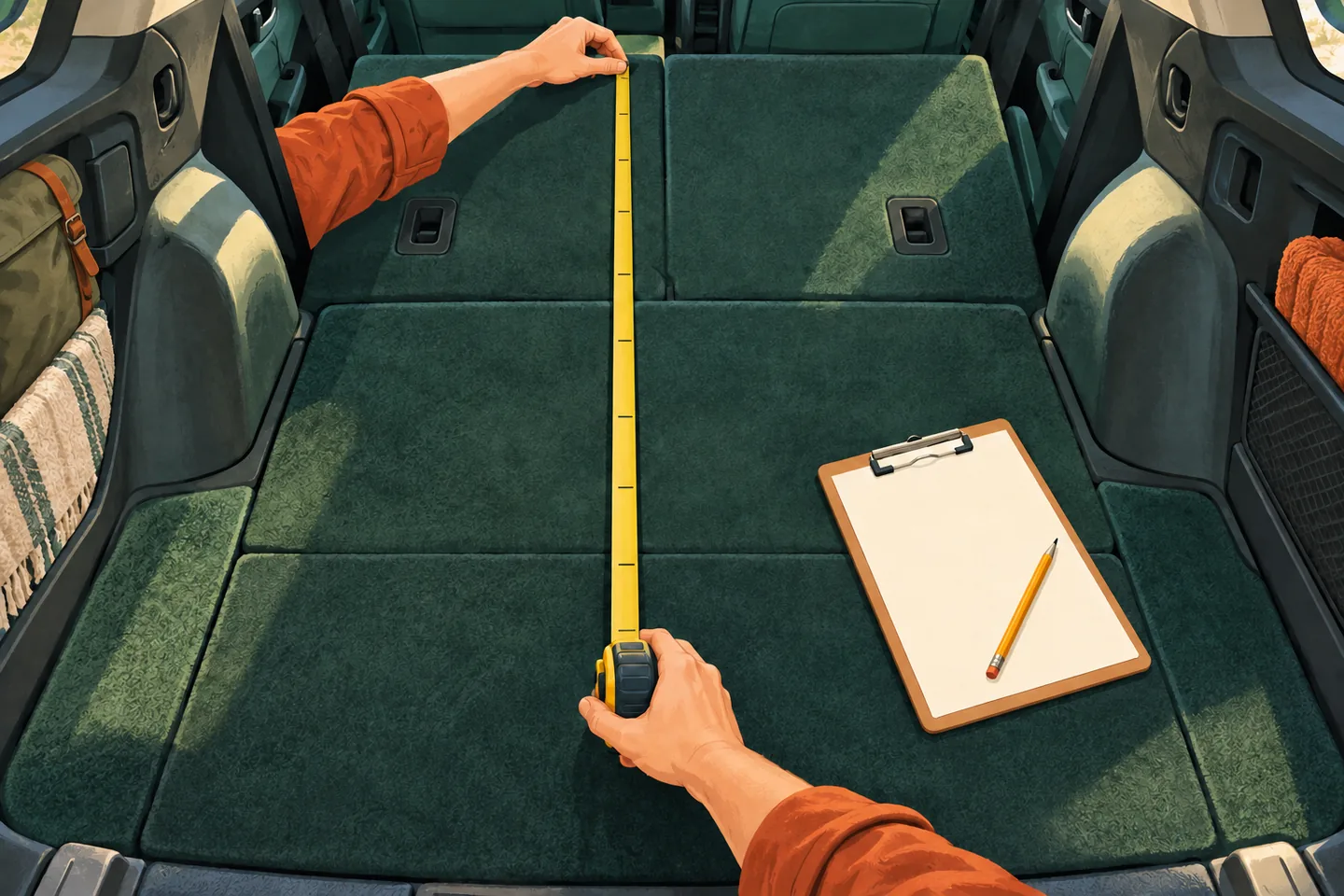
Measure your car in the arrangement you will actually sleep in, with the hatch closed. Record the supported length on each side, widths along the bed, and room above the proposed mattress. Then check slopes, gaps and where your luggage will go.
Those measurements give you a useful mattress shortlist. A cargo-volume figure or a make-and-model match cannot describe the whole sleeping arrangement.
This is our practical measuring checklist, informed by manufacturer guidance and REI’s sleeping-pad advice. We have not physically tested these setups. It is a measuring aid, not a fit certificate. Sources checked October 10, 2026.
1. Set up the car for the night you have in mind
Start with a tape measure, notebook and a straightedge. Use either inches or centimetres consistently.
Park the car and arrange the seats according to your vehicle manual. Fold, slide or retain the seats you expect to use overnight, and position the front seats and headrests accordingly. Record the cargo-floor setting and anything you remove.
The configuration matters. HEST’s sizing guide notes that dimensions can vary with trim and seat arrangement, and recommends measuring before purchase. HEST sizing guide
Keep the rehearsal realistic. If a bag will remain inside overnight, give it a place. If the front seats must move forward for sleeping, record those positions rather than measuring with them set for driving.
Choose your sleeping direction and mark where your head and feet will go. For two sleepers, draw both paths; they may encounter different boundaries.
2. Map the surface beneath the mattress
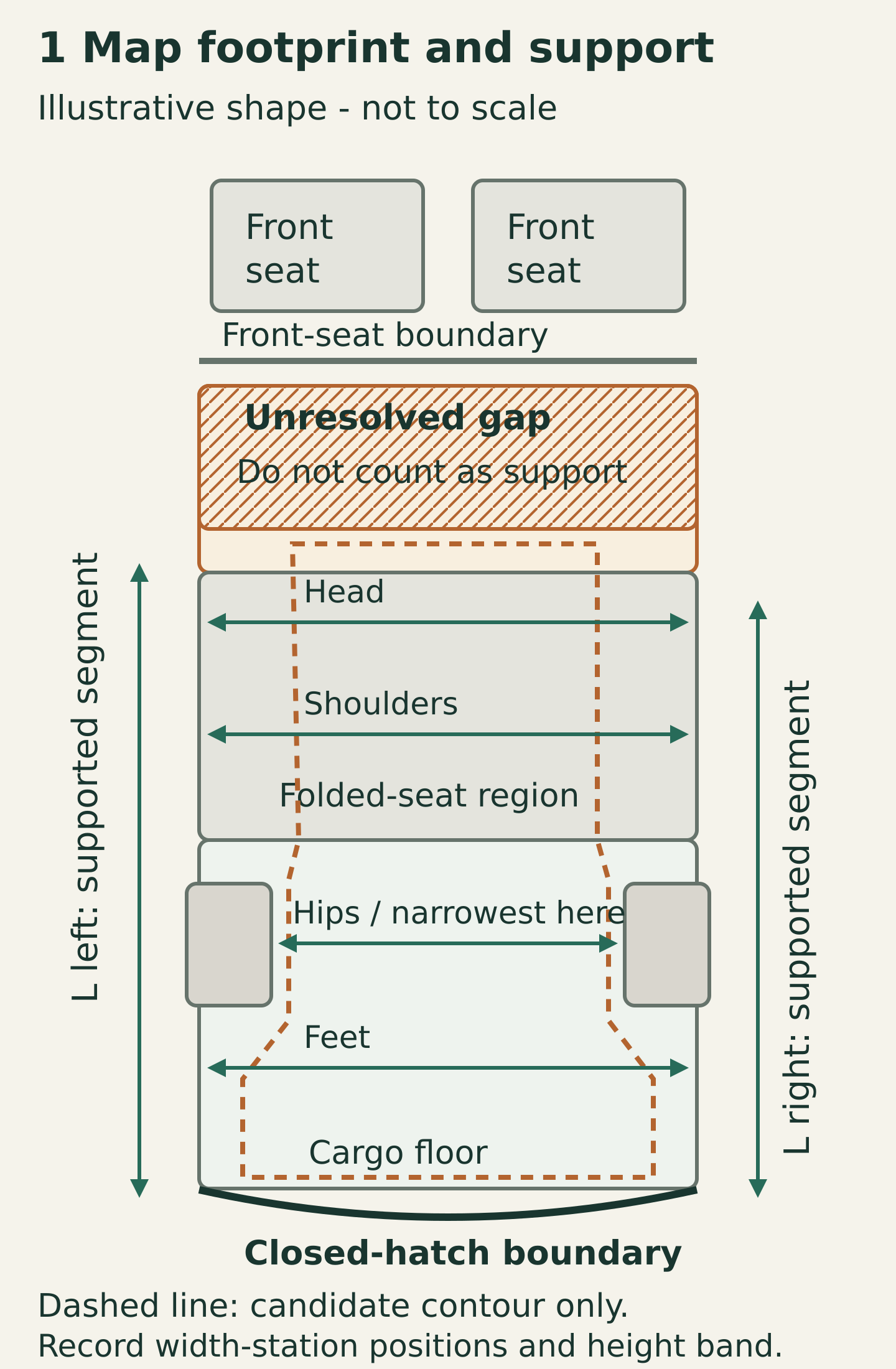
Before measuring the bed’s outline, identify what will support it.
Look for continuous floor or folded-seat surfaces, raised hinges, steps, consoles and open spaces. Luno’s fit guidance flags captain’s-chair gaps, consoles and uneven support. These are useful things to inspect even when considering another brand. Luno vehicle fit guidance
Lay a straightedge across changes in the surface to help reveal steps or slopes. Sketch each gap and record its span and depth. Mark where the surface rises toward either end.
A uniform-thickness mattress does not necessarily make an inclined floor level; deepsleep Overland explains that its mat follows the underlying incline. deepsleep Overland FAQ
Keep contour space and supported length separate. Space beyond a folded seat may accommodate a mattress outline while leaving part of it unsupported. Record each continuous supported segment with its own start and end points; do not add separated segments and a gap into one usable supported length.
If a candidate needs a bridge or platform, check that system’s instructions. A sketch or dimension match cannot establish its gap-spanning capacity.
3. Measure length with the hatch closed
Measure along the intended left and right sleeping paths, adding a centre measurement if its boundaries differ. Name the limiting surfaces: for example, the back of a front seat at one end and the inside of the closed hatch at the other.
Record the overall contour space separately from the supported segments and gaps within it. Avoid measuring diagonally unless that is the sleeping orientation you intend to use.
Check the boundary throughout the proposed mattress’s height band. A sloping hatch can leave more length near the floor than higher up. The hatch opening also has a different shape from the closed interior.
A paper footprint or lightweight height mockup can help reveal an obstruction. Close the hatch normally and do not force it against a mockup or mattress. Leave any boundary you cannot measure confidently unresolved.
4. Measure several widths, not just the widest one
Record width at your planned head, shoulder, hip and foot positions. Note each position’s distance from the same rear boundary so you can compare it with a mattress outline. Add a measurement wherever wheel wells, trim or a console create another restriction.
EXPED recommends measuring the specific vehicle even for its wheel-well-shaped DeepSleep Mat Auto. Cutouts do not remove the need to compare shapes. EXPED DeepSleep Mat Auto
Measure across the height band the mattress will occupy, rather than only on the bare floor. If you propose a raised platform, check the footprint at that raised position too.
For a tapered mattress, maximum width alone is not enough. Find out where it narrows and whether that taper lines up with your car’s restrictions. Ask for a dimensioned outline if the published specifications omit the detail that determines fit.
| Measurement | What to record |
|---|---|
| Left and right length | Overall closed-hatch contour space; each supported segment separately |
| Width at head, shoulders, hips and feet | Width and distance from the recorded rear boundary |
| Additional narrow point | Width, location and restricting feature |
| Measurement height | Height band above the recorded base |
| Gaps, steps and slopes | Location, span, depth or height, and slope direction |
5. Calculate the room above the mattress
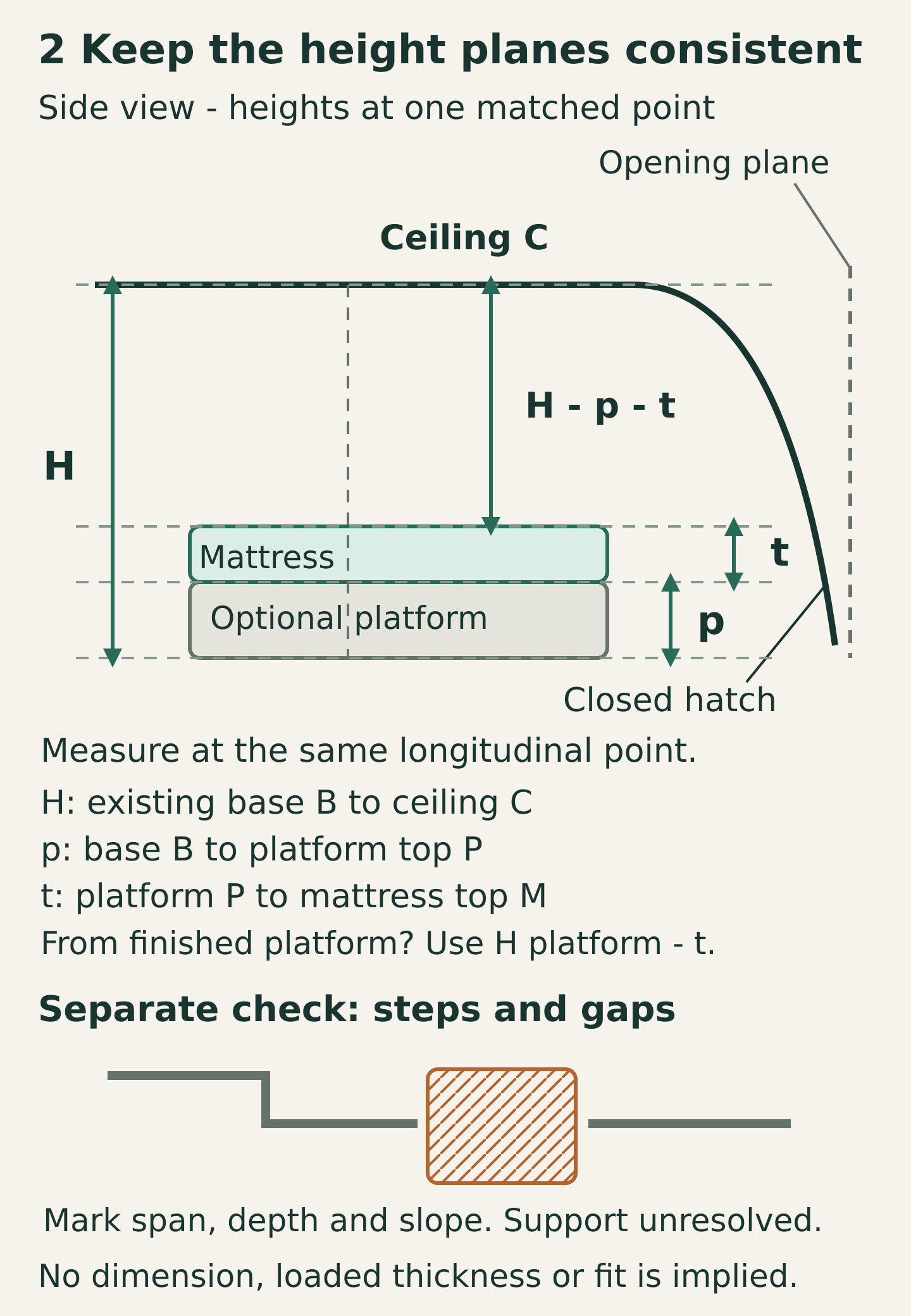
Measure vertically from a clearly identified existing base to the ceiling at the head, torso and foot positions. Keep each calculation tied to the same point along and across the bed.
For a platform added above that base:
Remaining overhead height = H − p − t
Here, H is the vertical base-to-ceiling height, p is the added vertical rise to the platform’s top, and t is the mattress’s vertical height above that supporting surface at the same point. With no platform, p = 0.
If you measure from a finished platform top, use platform-to-ceiling height − t. Its rise is already accounted for, so do not subtract p again.
Published thickness is a starting estimate for t on a level surface, not a measurement of loaded compression. On a slope, check the local vertical height rather than mixing it with a thickness measured perpendicular to the surface. Repeat the calculation wherever the ceiling or base changes height.
The result estimates space; it does not tell you whether sitting will feel comfortable. Consider lying down, turning and sitting to read, then check your intended postures where practical on an established supporting surface. There is no single headroom allowance for every person and car.
6. Allocate space for people and overnight gear
A mattress fitting inside the vehicle is one question. Having enough room to use it is another.
Outline each sleeper’s space, including pillows and bedding. Consider how you turn and where your knees or elbows move. REI’s pad-selection advice treats width and room to move as meaningful choices. REI sleeping-pad selection[1]
Check solo and shared layouts separately. Product configurations can differ: Luno’s AIR Pro manual describes a detached single half and a double setup. This flexibility is specific to that product. Luno AIR Pro manual
Give shoes, bags and frequently used items an overnight location. Mark what you can reach without dismantling the bed. A “two-person” label does not answer those questions for two particular sleepers.
7. Check the packed setup as well
Record the mattress’s packed dimensions, plus its pump, bedding and accessories. For a cylindrical bag, note length and diameter; for a box-shaped package, note all three dimensions.
REI’s camping-pad advice distinguishes sleeping space from packed fit in the vehicle and storage between trips. Apply that same distinction to your in-car setup. REI camping sleeping pads[2]
Plan separately for daytime transport and nighttime storage. Check the loading opening, not just the space beyond it, and consult the maker’s home-storage instructions.
Your mattress-fit checklist
- Record vehicle year, trim, market and exact seat arrangement.
- Mark the existing base and proposed mattress support surface.
- Measure closed-hatch contour length and each supported segment separately.
- Record widths at body positions and additional restrictions.
- Check boundaries through the proposed mattress-height band.
- Map slopes, steps and unsupported gaps.
- Calculate overhead room without subtracting platform rise twice.
- Allocate space for each sleeper, bedding and overnight gear.
- Check packed size, loading access and storage instructions.
- Compare the exact mattress version, size, contour and thickness.
Download the two-page measurement worksheet (A4 PDF). An HTML worksheet and plain-text version are also available.
Finish with one of three results: dimensionally plausible, unresolved, or does not meet your requirements. For an unresolved result, name the missing information: contour, support, headroom or another recorded need.
“Plausible” means worth investigating further. Send unresolved measurements and a sketch of your configuration to the manufacturer before buying. You will have a concrete question to ask—and a clearer reason to accept or reject the answer.
Next, compare Luno AIR Pro vs EXPED MegaMat Auto using your recorded measurements.
Once you have recorded the sleeping space, use the first-night car-sleeping checklist to plan where your bags go, what stays within reach and what to check before settling in.